Visual answer
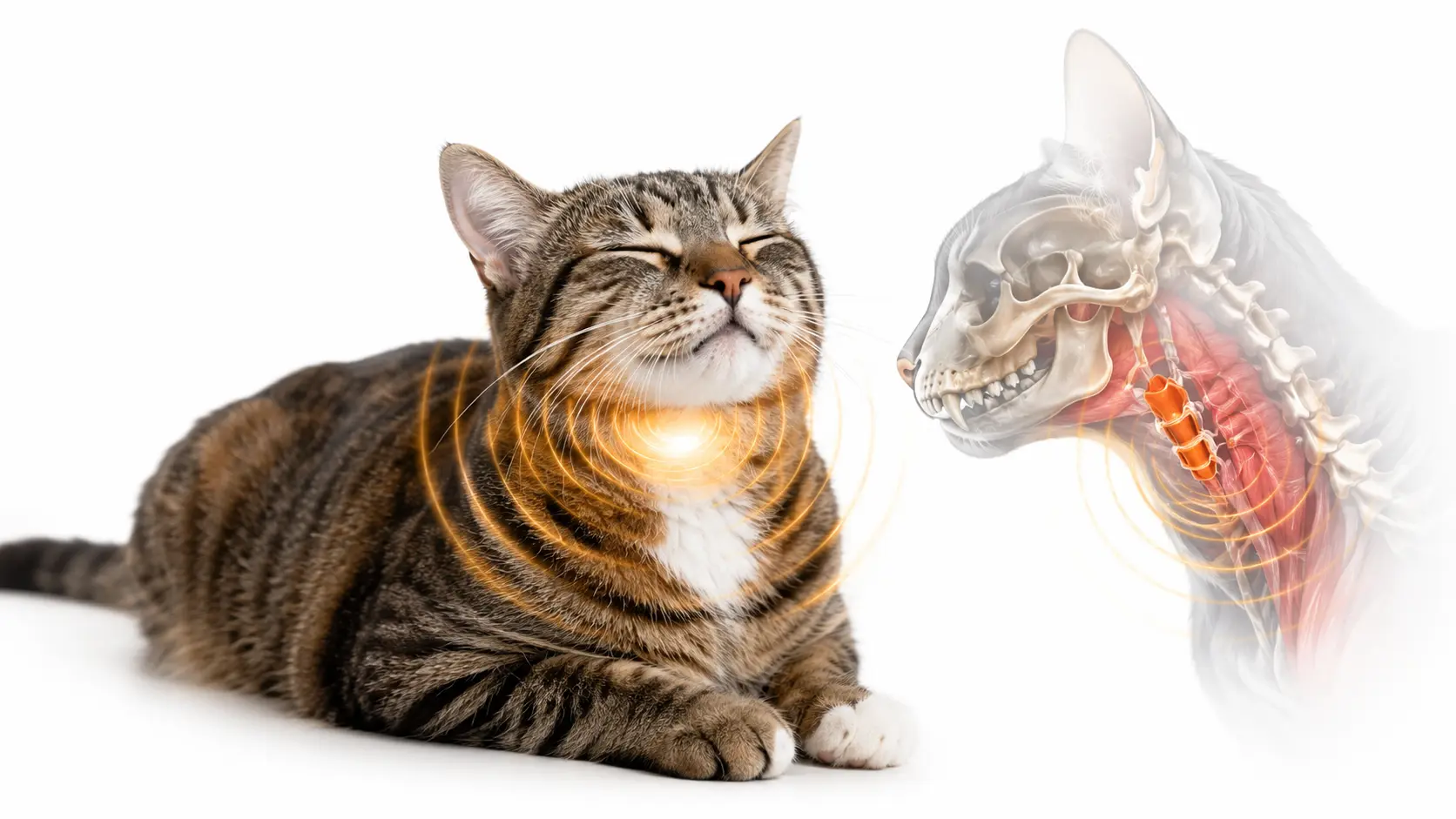
How a Cat Produces a Purr
A purr is created by rapid movement in the voice box during both breathing in and breathing out.
Brain signal
A rhythmic signal from the nervous system activates muscles around the cat's voice box.
Voice box movement
The laryngeal muscles rapidly tighten and relax, changing the opening between the vocal cords.
Airflow vibration
Air passing through the moving opening creates the familiar low vibration.
Continuous sound
Because it happens while breathing in and out, the purr can continue almost unbroken.
How it works
How a Cat Creates That Unbroken Sound
A purr feels effortless, as if the cat simply switches on a tiny motor somewhere behind the ribs.
The real mechanism is stranger.
Inside the cat's throat, muscles around the voice box contract and relax in a rapid rhythm. As air moves through the shifting opening, it creates the vibration we hear and feel as a purr.
What makes the sound unusual is that it continues while the cat breathes in and while the cat breathes out.
Most vocal sounds happen mainly on the exhale. A purr runs in both directions, which gives it that smooth, continuous quality.
It is less like a meow and more like a biological engine idling quietly in the background.
Happy purring
The Purr Everyone Recognizes
The most familiar purr is the peaceful one.
A cat curls into your lap, softens its eyes, tucks its paws, and begins to vibrate. This kind of purring usually means the cat feels safe.
It often appears alongside other comfort signals: slow blinking, relaxed whiskers, loose posture, and kneading.
In this setting, the purr works like a small social bridge. It tells the nearby human or animal that the cat is calm and settled.
It may calm the cat too. The rhythm, vibration, and familiar body state all reinforce one another.
That is why a purring cat can make a room feel quieter even when nothing else has changed.
Stress purring
Why Cats Purr When They Are Not Happy
The mystery begins when cats purr in situations that are clearly not pleasant.
Cats may purr at the vet, while giving birth, after injury, during illness, or when frightened.
This does not mean they are secretly enjoying the experience.
It suggests that purring is not tied to one emotion. Instead, it may be part of a regulation system. The cat may be trying to calm itself, ask for care, or manage discomfort.
Humans do something faintly similar when they hum, rock, pray, breathe rhythmically, or speak softly during stress.
The purr may be the cat's built-in way of keeping the body steady when the world feels unsafe.
Healing idea
Could Cats Be Healing Themselves?
One of the most intriguing ideas in feline biology begins with the frequency of the purr.
A cat's purr often falls within a low-frequency range that overlaps with vibration frequencies studied for bone growth, tissue repair, and pain reduction.
That does not prove that purring heals cats. Biology is rarely that tidy.
But it raises a fascinating possibility. A cat recovering from injury, resting for long hours, and vibrating at these frequencies may be doing more than making a sound.
The purr could help maintain the body during rest. It may support comfort, reduce stress, and perhaps play some role in repair.
The evidence is suggestive rather than final, but the idea is hard to forget once you hear it.
Food purr
The Purr That Gets Humans Moving
Some cats have another trick: the urgent purr.
Owners often recognize it immediately. It sounds like a normal purr with something sharper hidden inside it, especially when breakfast is late.
Researchers have found that cats can add a higher-pitched cry into their purr when they want something, particularly food.
Humans tend to find this version harder to ignore.
That makes sense. The sound sits uncomfortably close to the kind of frequency that grabs human attention.
A cat may not understand acoustics, but it has learned the practical lesson perfectly. Certain purrs make humans stand up.
Big cats
Why Some Cats Purr and Others Roar
Not every cat can purr the way a house cat does.
Smaller cats, including domestic cats, bobcats, lynx, cougars, and cheetahs, can produce a true continuous purr.
Lions and tigers went down a different evolutionary road. Their throat anatomy allows them to roar with tremendous power, but it does not allow the same smooth, continuous purring mechanism.
In a rough sense, cats had to specialize. Some became great roarers. Others became great purrers.
This is why a cheetah can sound oddly domestic when it purrs, while a lion can shake the air but cannot curl up and rumble like a house cat.
Always happy?
Myth vs Reality
What people think
A purring cat is always happy
Most people learn to treat purring as a simple sign of contentment.
What actually happens
Purring can appear in both comfort and distress
Cats often purr when relaxed and happy, but they may also purr during fear, pain, labor, illness, or recovery. The sound alone is not enough. Body language and context tell the real story.
Quick answers
Common questions
Does purring always mean a cat is happy? +
No. Cats often purr when happy, but they can also purr when stressed, sick, injured, frightened, or recovering. The cat's posture, eyes, environment, and behavior matter.
Why does my cat purr when I pet it? +
Your cat may feel safe, comfortable, and socially connected. Petting can trigger a relaxed state that makes purring more likely.
Why does my cat purr at the vet? +
A cat purring at the vet may be self-soothing rather than happy. Stress purring is common in unfamiliar or uncomfortable situations.
Can cats purr while breathing in and out? +
Yes. That is one reason the purr sounds continuous. The mechanism works during both inhalation and exhalation.
Do cats purr when they are alone? +
Yes. Cats can purr when alone, especially while resting or self-soothing. This supports the idea that purring is not only social communication.