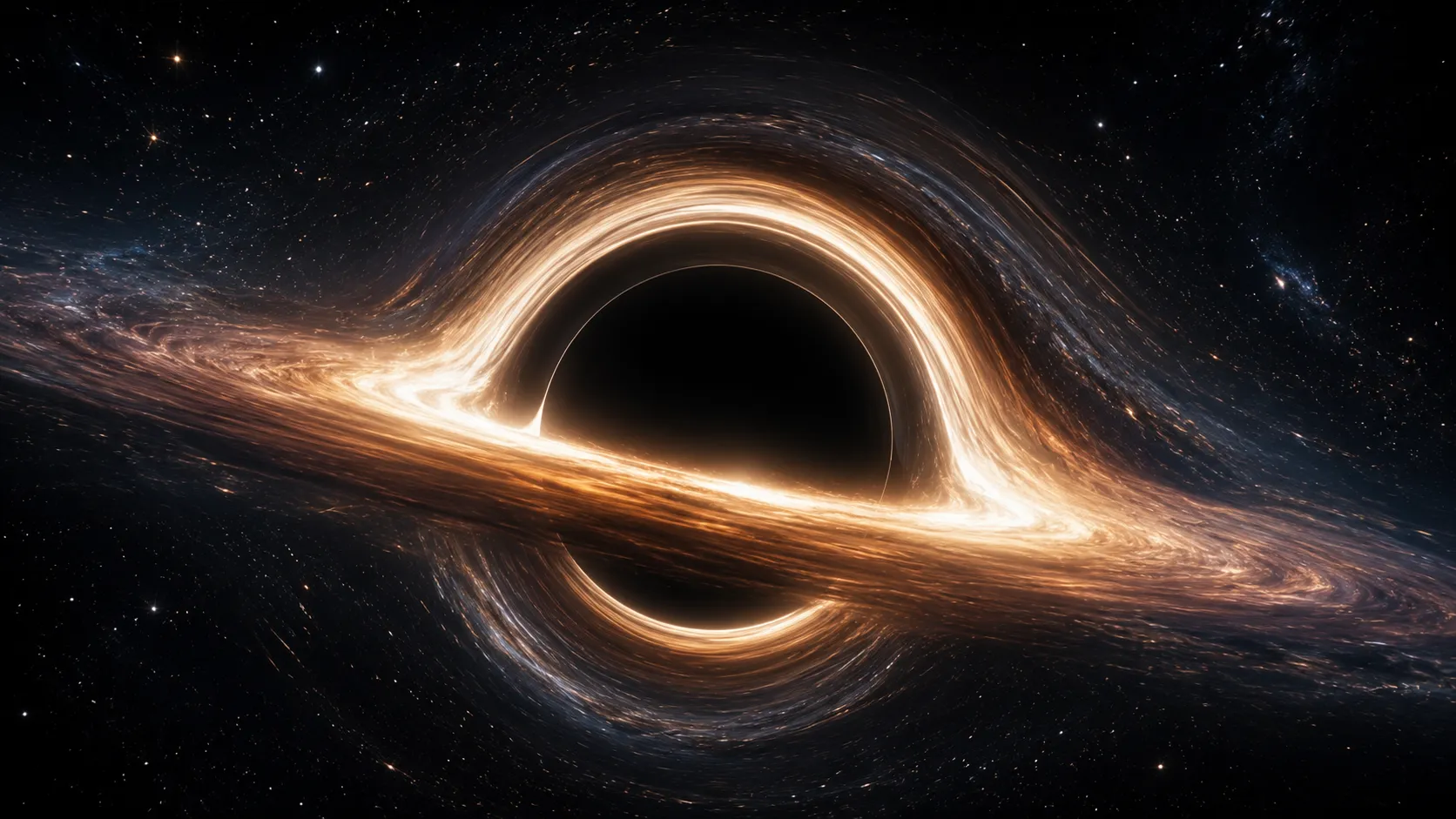
Visual answer
Parts of a black hole
A black hole has distinct structural features even though we cannot see inside one.
Singularity
The theoretical center where mass is compressed to infinite density. Current physics breaks down here.
Event horizon
The point of no return. Cross this and escape is impossible. Not a physical surface.
Photon sphere
A region where gravity is strong enough to make light orbit the black hole.
Accretion disk
A disk of superheated gas and dust spiraling in. This is what makes black holes visible.
How they form
How black holes form
Most known black holes form when a massive star runs out of fuel and collapses under its own gravity.
During the collapse, the core is compressed so violently that protons and electrons merge into neutrons. If enough mass is present, not even that can stop the collapse and a black hole forms.
Supermassive black holes, millions or billions of times the mass of the sun, sit at the centers of most galaxies including our own. How they formed is still an active research question.
Vacuum myth
Are black holes giant vacuum cleaners in space?
What people think
Black holes suck in everything nearby.
They are often depicted as pulling in ships, planets, and light from across the galaxy.
What actually happens
They only pull things in that pass too close.
If the sun were replaced by a black hole of equal mass, Earth would continue orbiting normally. The danger zone is relatively local. Distant objects are not affected.
Types of black holes
Types of black holes
Stellar black holes
Formed from collapsing stars. Typically 5 to 100 times the mass of the sun.
Intermediate black holes
Hundreds to thousands of solar masses. Rarer and less well understood.
Supermassive black holes
Millions to billions of solar masses. Found at the center of most large galaxies.
Primordial black holes (theoretical)
Possibly formed in the early universe from density fluctuations. Not yet confirmed.
How we detect them
How we know black holes exist
You cannot see a black hole directly because no light escapes it. But you can observe its effects on nearby matter and light.
Gas falling into a black hole heats up to millions of degrees and glows brilliantly, forming an accretion disk visible across the universe.
In 2019, the Event Horizon Telescope produced the first image of a black hole's shadow, the dark region surrounded by glowing gas, in the galaxy M87.
Quick answers
Common questions
What is a black hole? +
A region of space where gravity is so strong that nothing, including light, can escape. It forms when mass is compressed into a small enough volume to curve spacetime completely closed.
What happens if you fall into a black hole? +
For a large black hole, you would cross the event horizon without noticing. After that, tidal forces would stretch and compress you in a process called spaghettification, and you would not be able to signal the outside world.
Can a black hole destroy Earth? +
Only if Earth passed extremely close to one. There are no black holes close enough to threaten Earth, and they do not actively pull in distant objects.
Do black holes last forever? +
No. Stephen Hawking predicted that black holes slowly emit radiation and lose mass over an astronomically long timeframe, eventually evaporating completely.
Have we ever photographed a black hole? +
In 2019, scientists photographed the shadow of the black hole at the center of galaxy M87. In 2022, the same team imaged Sagittarius A*, the black hole at the center of our own Milky Way.