Quick Facts
Quick Facts
Wi-Fi signals are electromagnetic radiation, part of the same family as visible light and radio broadcasts.
Human eyes can only detect a tiny sliver of the full electromagnetic spectrum—Wi-Fi sits well outside that range.
Metal objects, like refrigerators and metal studs in walls, are particularly effective at blocking or reflecting Wi-Fi.
Multiple devices in a home create dense, overlapping fields of signal, all passing through each other constantly without interfering visibly.
Visual answer
How Wi-Fi actually travels
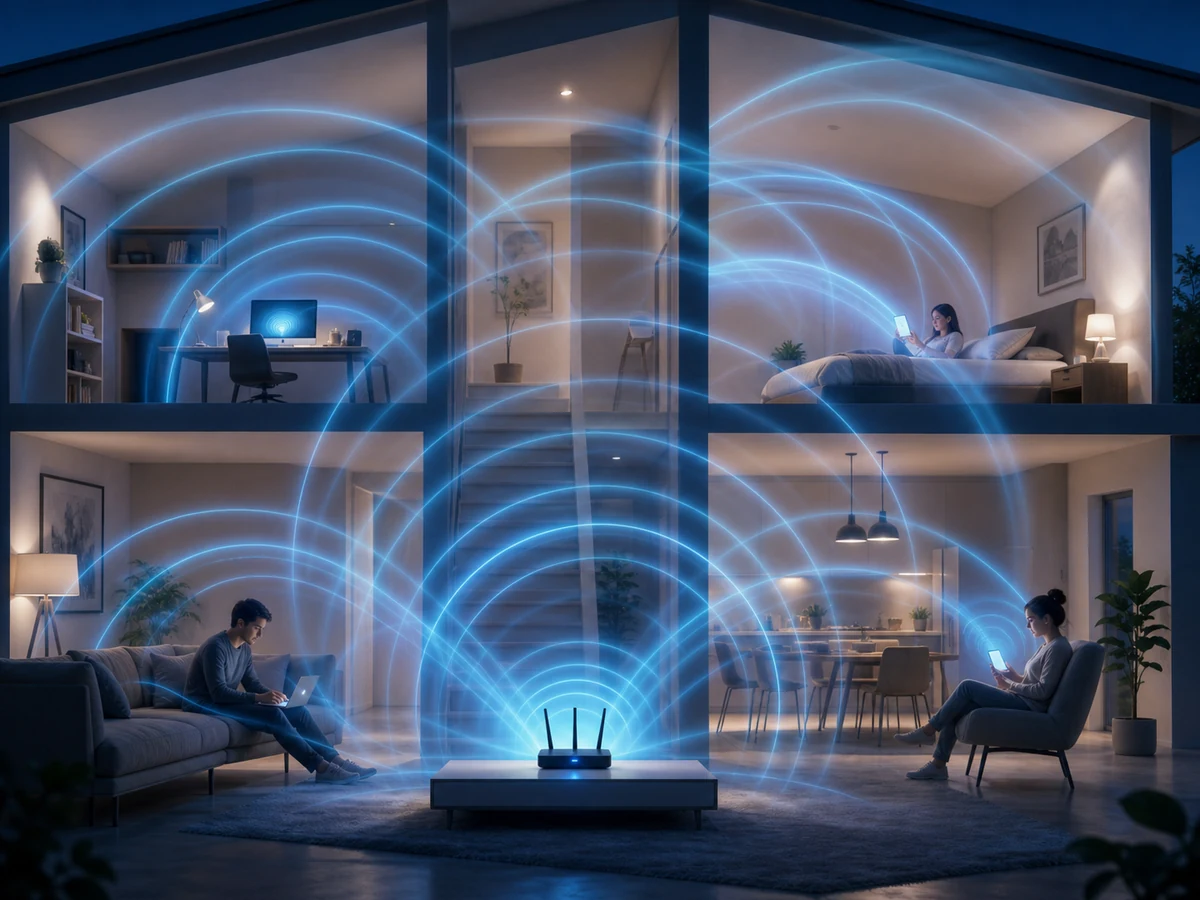
Wi-Fi radiates outward from its source in overlapping waves, weakening with distance and losing strength as it passes through solid materials.
The router emits
The router radiates radio waves outward in all directions, roughly like a dim light bulb.
Waves pass through walls
Signals penetrate most walls but lose strength each time they do.
Devices receive
Phones and laptops pick up the weakened waves and translate them back into data.
The Scene
Your Living Room Would Look Like a Light Show
If Wi-Fi suddenly became visible, your router would appear to glow, pulsing gentle waves outward in every direction, like ripples spreading from a stone dropped in still water—except the water is your living room, and the ripples never fully stop.
Your phone, held close to your body, would show its own faint returning glow as it talks back to the router, and every laptop, smart speaker, and doorbell camera in the house would join in with its own small, steady shimmer.
Walk from room to room, and you'd notice the light dimming as it passed through walls, and practically vanishing near your refrigerator or any large metal appliance—both notorious in the real, invisible world for disrupting Wi-Fi signals.
Same Family
It's Really Just Light in Disguise
Visible light, radio waves, microwaves, and Wi-Fi signals are all fundamentally the same thing: electromagnetic radiation, differing only in wavelength.
Human eyes evolved to detect a narrow band of that spectrum—the part useful for spotting predators and ripe fruit—leaving Wi-Fi's much longer wavelength completely outside our natural view, despite it behaving in many of the same basic ways light does.
Analogy
A Radio Station You Can't Tune Your Eyes To
The familiar part
A radio station broadcasts constantly whether or not anyone's listening—the music is there in the air the whole time, waiting for a receiver tuned to the right frequency.
How it applies
Wi-Fi works exactly the same way, just with data instead of music, and our eyes simply aren't built with the right receiver to tune in.
Where the analogy breaks
Unlike a radio signal, Wi-Fi doesn't broadcast for miles—it's a much shorter-range, more local kind of invisible chatter.
Curiosity Notes
Details Most People Miss
Why this still matters
Why This Still Matters
Picturing visible Wi-Fi is a handy way to intuitively understand why signal strength drops in certain rooms, why metal appliances cause dead zones, and why moving a router to a more central spot can make such a noticeable difference.
Key Findings
- ✓Core findingWi-Fi is electromagnetic radiation, part of the same family as visible light.
- ✓Strong evidenceIt radiates outward from routers and devices, weakening with distance and through walls.
- ⚠Main consequenceMetal objects are particularly effective at blocking or reflecting Wi-Fi signals.
- ✓Wider legacyHuman eyes simply aren't built to detect this particular wavelength range.
Final insight
A Last Thought
Wi-Fi has been quietly lighting up your home this entire time, in a color your eyes were never given the chance to see—proof that invisibility, more often than not, just means 'outside our particular slice of the spectrum.'
Quick answers
Common questions
Is Wi-Fi the same thing as visible light? +
They're part of the same electromagnetic spectrum family, but Wi-Fi has a much longer wavelength than visible light, which is why our eyes can't detect it.
Why does Wi-Fi get weaker in certain rooms? +
Walls, floors, and especially metal objects absorb or reflect radio waves, weakening the signal the further it has to travel through solid material.