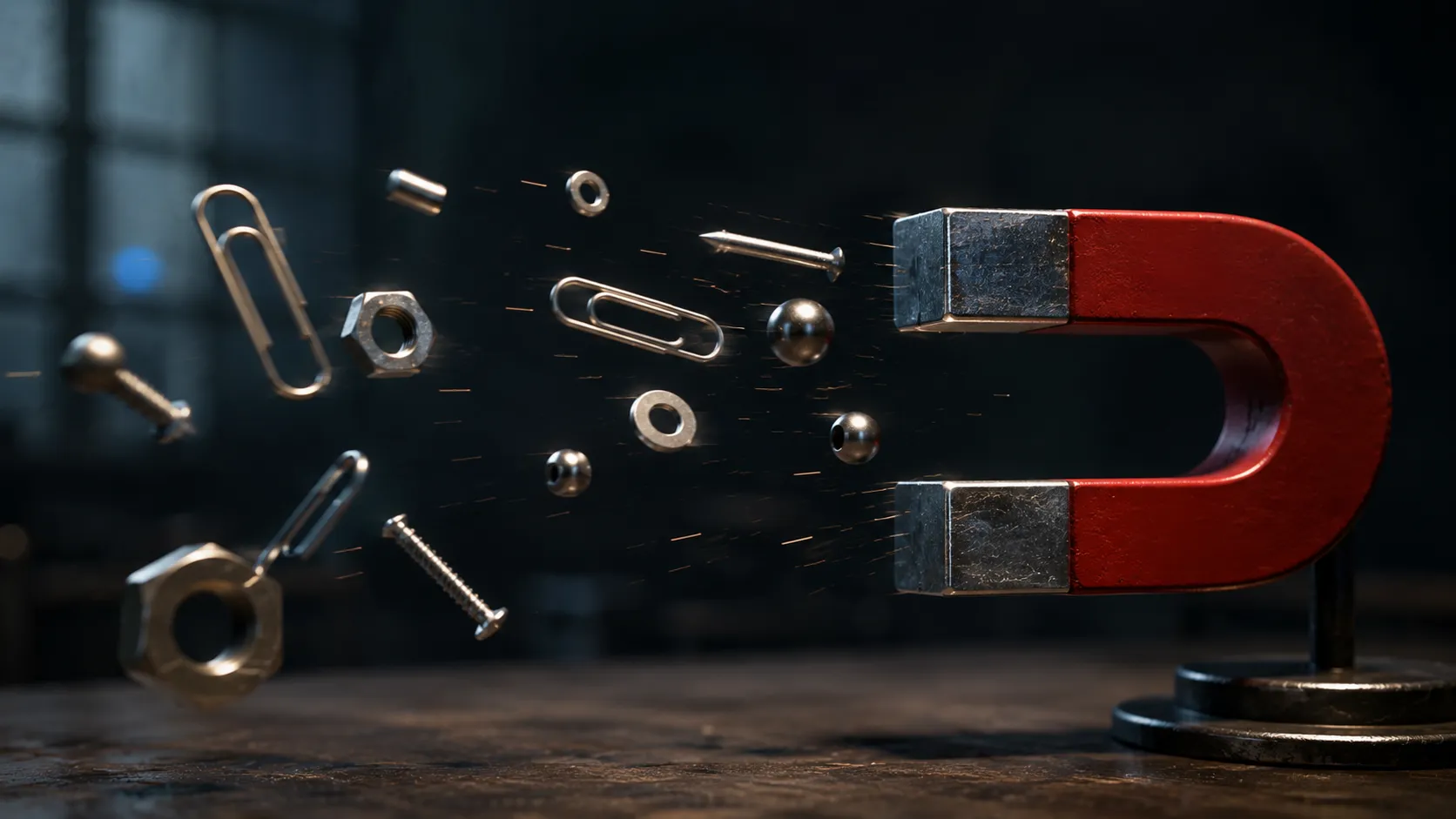
Visual answer
Magnetic domains: aligned vs scrambled
The difference between a magnet and a non-magnetic piece of metal comes down to how electron groups are arranged.
Unmagnetized iron
Electrons form small regions called domains. The domains point in random directions and cancel each other out.
Magnetized iron
The domains have been aligned in the same direction, so their fields add up instead of canceling.
North pole
The end where field lines emerge from the magnet.
South pole
The end where field lines re-enter the magnet.
Electrons as tiny magnets
Every electron is a tiny magnet
Electrons have a property called spin. You can think of it loosely like a ball spinning in place, though it is really a quantum mechanical property with no perfect everyday analogy.
Because of this spin, each electron generates its own small magnetic field.
In most materials, electrons pair up with opposite spins and their fields cancel. In iron, cobalt, and nickel, the atomic structure leaves some electrons unpaired, and their fields point the same way.
Poles myth
Can you isolate a north pole on its own?
What people think
If you cut a magnet in half, you get a north pole and a south pole separately.
It seems logical that cutting through the middle would separate the two poles.
What actually happens
Each half becomes a complete magnet with its own north and south pole.
No matter how many times you cut a magnet, each piece develops both poles. A single isolated magnetic pole (a magnetic monopole) has never been observed.
Types of magnets
Different kinds of magnets
Permanent magnet
Stays magnetized on its own. Made from aligned domains that do not easily scramble. Examples: fridge magnets, neodymium magnets.
Temporary magnet
Only magnetic while in a strong field. Paperclips and some iron objects behave this way.
Electromagnet
Created by running electrical current through a coil of wire. Can be switched on and off.
Superconducting magnet
Extremely powerful electromagnets used in MRI machines and particle accelerators.
Magnetism and electricity
Magnetism and electricity are the same fundamental force
Electric currents create magnetic fields. Moving magnets create electric currents. This is the basis of every generator and electric motor in the world.
James Clerk Maxwell unified electricity and magnetism into electromagnetism in the 1860s, showing they are two sides of the same phenomenon.
When you plug something in, you are benefiting directly from this relationship.
Quick answers
Common questions
How do magnets work? +
Electrons behave like tiny magnets. In magnetic materials, many electrons align their spins in the same direction, and their combined fields create a magnetic force you can feel.
Why do opposite poles attract? +
Magnetic field lines want to complete a loop from north to south. When two opposite poles face each other, the field lines connect and pull the magnets together.
Why do same poles repel? +
When two north poles or two south poles face each other, their field lines push against each other rather than connecting. This creates a repulsive force.
Can you make a magnet with only one pole? +
No. Every magnet always has both a north and a south pole. A single isolated pole, called a magnetic monopole, has never been found.
Why do some metals stick to magnets but others do not? +
Iron, nickel, and cobalt have atomic structures that allow electron spins to align. Aluminum, copper, and most other metals have electron arrangements that prevent this.