Visual answer
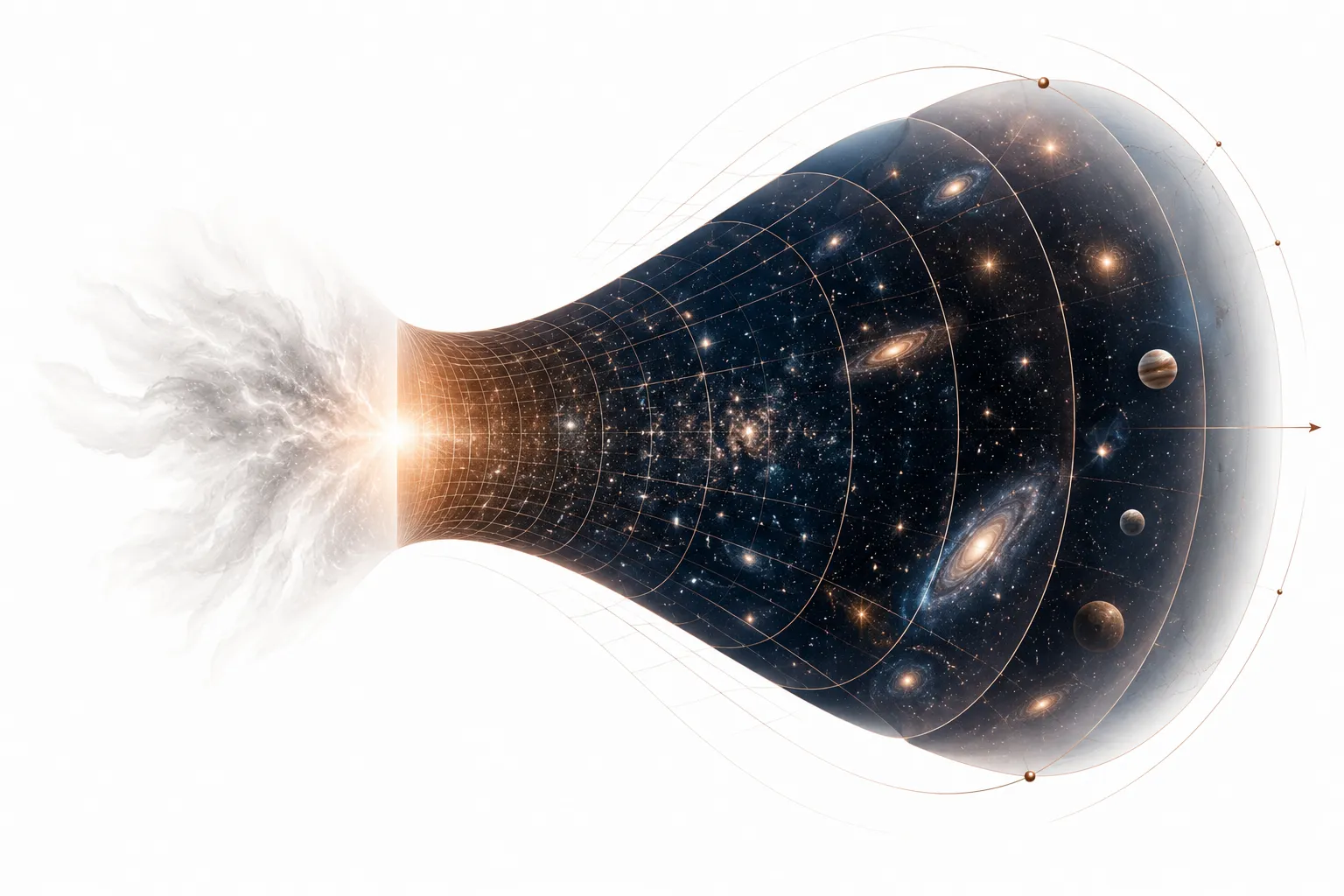
Timeline of the Universe and Its Theoretical Predecessors
From the Planck epoch to the present and the speculative region 'before' the Big Bang.
The 'Before' zone
Speculative region quantum vacuum, prior contracting universe, or simply no temporal coordinate.
Planck epoch (0–10⁻⁴³ s)
Physics breaks down here no valid theory describes this era.
Inflation (10⁻³⁶ s)
Exponential expansion of space explains the universe's large-scale uniformity.
Present (13.8 billion years)
Observable universe everything causally accessible to us.
The Problem With 'Before'
Why the Question Might Be Meaningless And Why That's Not a Cop-Out
When Stephen Hawking was asked what existed before the Big Bang, he said asking the question was like asking what lies south of the South Pole. There's no point on Earth more southerly than the South Pole not because something blocks you, but because the coordinate system runs out. South is defined relative to a geometry that simply doesn't extend beyond that point.
Time, according to general relativity, is not a static backdrop against which events occur. It's a dimension woven into the fabric of spacetime and spacetime itself began at the Big Bang. If time had no existence before the Big Bang, then 'before' is a word pointing at nothing. There is no temporal location called 'before the Big Bang' in which things could exist.
This isn't a physicist's way of dodging the question. It's a genuine consequence of our best theory of gravity and cosmology. The question 'what came before?' assumes time is infinite in both directions an assumption the Big Bang model explicitly rejects. Reframing the question as 'what is the boundary condition of the universe?' opens more productive territory.
What Physicists Propose
The Leading Theories for What Came 'Before'
The Hartle-Hawking 'no boundary' proposal
PossibleStephen Hawking and James Hartle proposed that the universe has no boundary in imaginary time that time near the Big Bang becomes space-like, meaning there is no first moment, just as there is no southernmost point south of the South Pole. The universe is self-contained with no 'before.'
Eternal inflation and the multiverse
PossibleIn eternal inflation models, the quantum field driving inflation never stops everywhere it's constantly generating new 'bubble universes' including ours. Our Big Bang was a local event in an eternally inflating background that has no beginning or end. There was always something.
The Big Bounce (Loop Quantum Cosmology)
PossibleLoop quantum cosmology replaces the Big Bang singularity with a 'Big Bounce' a prior universe contracted to an extreme density (but not infinite quantum effects prevent the singularity) and then rebounded into expansion. Our universe had a predecessor.
An eternal quantum vacuum
PossibleQuantum field theory shows that a 'vacuum' is not nothing it seethes with virtual particles and energy fluctuations. Some cosmologists propose the universe spontaneously arose from a quantum vacuum fluctuation, a timeless state that is 'something' without being a universe.
The Analogy
The South Pole Problem
The familiar part
Stand at the South Pole and ask: 'What's further south?' Every direction from the South Pole is north. 'South' simply ceases to be a meaningful direction at that point not because of a wall, but because the coordinate breaks down.
How it applies
Time at the Big Bang may be exactly like this. 'Before' is a temporal direction. If time began at the Big Bang, then 'before' ceases to be a meaningful direction at that boundary not because something blocks access, but because the coordinate runs out.
Where the analogy breaks
The analogy assumes the Hawking-Hartle picture is correct. If loop quantum cosmology or eternal inflation is right, time did exist before our Big Bang it just belonged to a different cosmic epoch or a background inflating medium. The question may have a real answer we haven't found yet.
The Myth
The Explosion Myth
What people think
"The Big Bang was an explosion in empty space"
The common picture: an infinitely dense point explodes outward into pre-existing empty space, like a bomb going off. Before the explosion, there was empty space waiting.
What actually happens
Space itself began at the Big Bang there was no 'outside' waiting
The Big Bang was the beginning of space, not an event in space. Matter didn't fly outward into a pre-existing void space itself expanded and carried matter with it. There was no surrounding empty space before the Big Bang because there was no 'before' in which space could exist. This is why the question of what came before is so structurally different from ordinary 'what happened before?' questions.
Final insight
The Most Honest Answer Is Also the Most Interesting One
Physics has reached a genuine boundary. The question of what preceded the Big Bang either has no answer (because 'before' is meaningless), a quantum mechanical answer (a seething vacuum), or points to a larger cosmic structure (eternal inflation, the Big Bounce) we can barely see the edges of. This is not failure it's the frontier. The universe is under no obligation to have a backstory we can comprehend.
Quick answers
Common questions
If the Big Bang is the beginning of time, does that mean time had a cause? +
This is where physics and philosophy intertwine. Causation as we understand it requires time causes precede effects. If time began at the Big Bang, the question 'what caused it?' may be applying a temporal concept (cause) to a situation where time doesn't yet exist. Some philosophers argue this makes the Big Bang necessarily uncaused; others argue for a timeless cause.
Will we ever be able to observe what came before the Big Bang? +
Almost certainly not directly the Big Bang itself represents a horizon beyond which electromagnetic radiation cannot carry information to us. However, gravitational waves may propagate through a bounce, and certain patterns in the cosmic microwave background might carry signatures of pre-Bang physics. This is an active area of observational cosmology.
Does the Big Bang mean the universe had a creator? +
The Big Bang is a physical model describing the early evolution of the universe from an extremely hot, dense state. It doesn't address the question of a creator, which is a theological and philosophical question outside the scope of physics. Both theistic and atheistic cosmologists accept the Big Bang model.
What is the singularity at the start of the Big Bang? +
The singularity is a mathematical breakdown a point where the equations of general relativity produce infinite values, signaling that the theory is being applied outside its range of validity. Most physicists believe a quantum theory of gravity (which we don't yet have) would replace the singularity with a finite, extreme but physically meaningful state.