Quick Facts
Quick Facts
Einstein's general theory of relativity replaced the idea of gravity as a force with gravity as curved spacetime.
The bending of starlight around the sun, observed during a 1919 solar eclipse, provided the first strong evidence for this idea.
Black holes represent the most extreme dents in spacetime known, deep enough that not even light can climb back out.
Even ordinary objects, including you, create a barely-detectable dent in the space around them.
Visual answer
How mass bends space
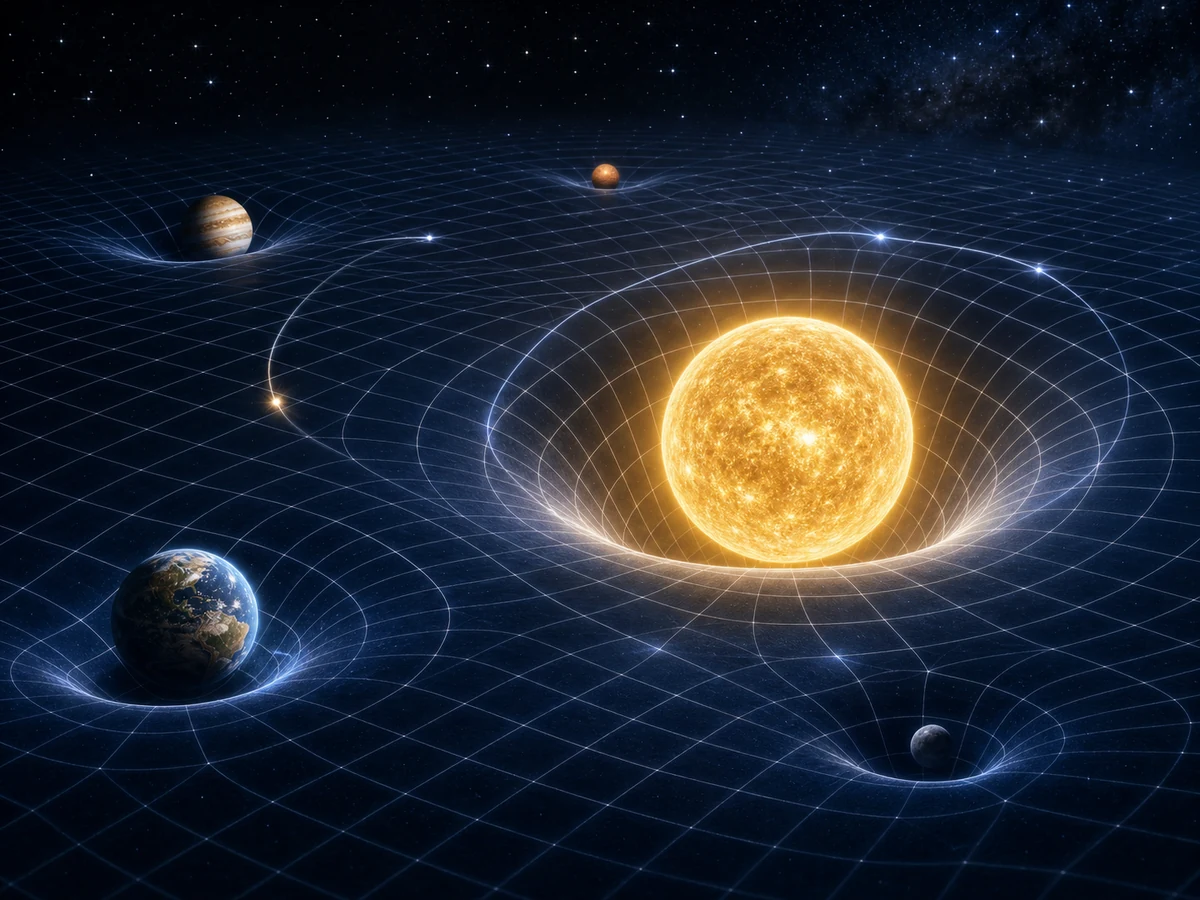
Every object with mass creates a dent in spacetime, and nearby objects simply follow the curve of that dent.
A massive object sits in space
A star or planet occupies a region of the universe's underlying fabric.
Space curves around it
The fabric of space itself dips downward near the object, more steeply the more massive it is.
Nearby objects follow the curve
Smaller objects moving nearby simply travel along that curved shape, which we experience as being pulled inward.
The Scene
The Universe Would Look Like a Stretched Sheet, Sagging Everywhere
Picture the universe as an enormous, taut sheet stretched out in every direction. Now imagine every star, planet, and moon resting on that sheet, each one pressing down and creating its own dent, deeper for the heavier objects and shallower for the lighter ones.
The sun would sit in a vast, sweeping crater, deep enough that the Earth, orbiting nearby, is really just rolling endlessly along the inner slope of that crater rather than being tugged by any invisible thread.
A black hole, in this picture, wouldn't be a dent at all—it would be a hole so deep and so steep-sided that the sheet effectively tears, with nothing, not even light, able to climb back out once it slides too far in.
Even You
You're Bending Space Too, Just Barely
It isn't only planets and stars that create these dents. Every object with mass does, including you, right now, sitting wherever you happen to be reading this.
Your personal dent in spacetime is unimaginably shallow compared to a planet's—far too subtle for any instrument humanity has yet built to measure directly—but according to the physics, it's there all the same.
Analogy
The Trampoline That Never Stops Sagging
The familiar part
Drop a bowling ball onto a trampoline, and a smaller marble nearby will roll toward it, not because the ball reached out and grabbed it, but simply because the marble is following the curve the ball created.
How it applies
That's the whole idea behind gravity as curved spacetime—objects aren't being pulled by an invisible force so much as sliding along a shape that's already there.
Where the analogy breaks
The real universe, unlike a trampoline, curves in three dimensions at once, which is part of why it's so notoriously hard to actually picture.
Curiosity Notes
Details Most People Miss
Why this still matters
Why This Still Matters
Rethinking gravity as a shape rather than a force isn't just a physicist's technicality—it's the foundation behind GPS satellites, black hole imaging, and our entire modern understanding of how the universe behaves on the largest scales.
Key Findings
- ✓Core findingGravity isn't a pulling force—it's the curvature of space itself caused by mass.
- ✓Strong evidenceHeavier objects create deeper dents in spacetime, and nearby objects follow those curves.
- ⚠Main consequenceBlack holes represent the most extreme possible dent, steep enough to trap even light.
- ✓Wider legacyThis idea was confirmed by observing starlight bending around the sun in 1919.
Final insight
A Last Thought
If gravity were visible, the universe wouldn't look like a battlefield of invisible pulls and tugs—it would look like a vast, sagging landscape, dented everywhere something with mass happened to be resting, with everything else simply rolling along the curves.
Quick answers
Common questions
Is gravity really not a force at all? +
In Einstein's general relativity, gravity is described as the curvature of spacetime rather than a traditional force—though it still behaves like a force for most everyday purposes.
Can we actually detect spacetime curvature directly? +
Yes—effects like the bending of starlight, GPS satellite timing adjustments, and gravitational wave detectors all rely on and confirm the curvature of spacetime.