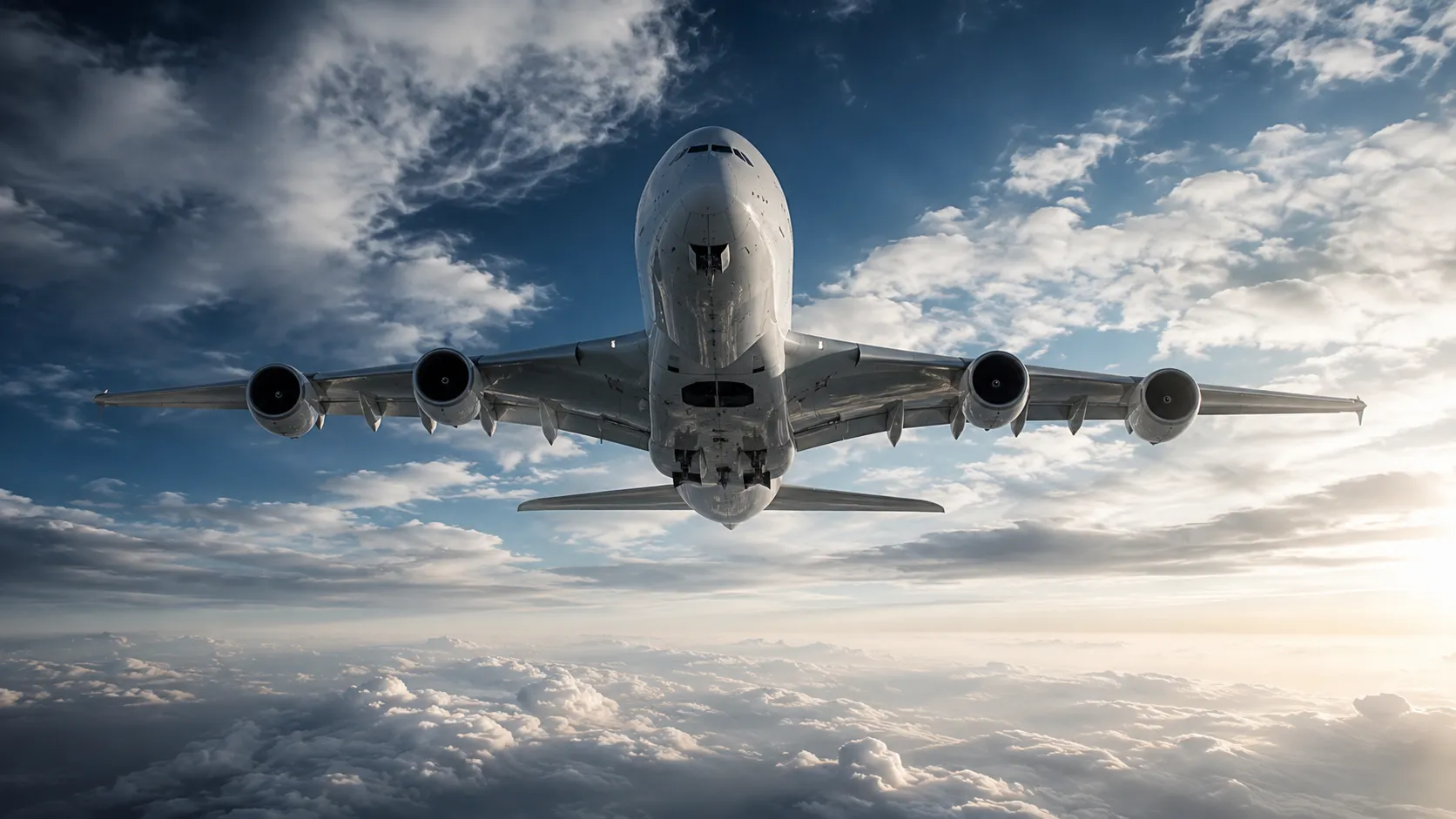
Visual answer
The four forces of flight
A plane flying straight and level has four forces perfectly balanced.
Lift
Generated by the wings. Acts upward and counteracts the weight of the plane.
Weight
Gravity pulling the plane downward. Lift must exceed weight to climb.
Thrust
Produced by engines. Pushes the plane forward through the air.
Drag
Air resistance pushing back against the plane. Thrust must exceed drag to accelerate.
How lift works
The wing is the key
A wing's cross-section is called an airfoil. It is curved on top and flatter on the bottom.
When the plane moves forward, air splits at the leading edge of the wing. The air over the curved top has to cover more distance in the same time, so it moves faster.
Faster air has lower pressure, as described by Bernoulli's principle. The slower, higher-pressure air underneath pushes the wing upward. That push is lift.
Bernoulli myth
Is lift purely because of wing shape?
What people think
Lift is entirely explained by the curved wing shape and Bernoulli's principle.
The standard textbook explanation stops at the curved top surface creating faster airflow.
What actually happens
Wing angle and Newtonian reaction forces also play a major role.
Modern aeronautical science considers both Bernoulli effects and the deflection of airflow downward by the angled wing. Both matter, especially at different speeds and aircraft types.
Phases of flight
What each phase of a flight involves
Takeoff
Thrust exceeds drag. Lift is built up as speed increases until it exceeds weight.
Climb
Lift exceeds weight. Thrust still exceeds drag.
Cruise
All four forces are balanced. The plane holds altitude and speed.
Landing
Thrust is reduced. Flaps increase drag and lift for a controlled slow descent.
What engines do
Engines create thrust, not lift
A common misconception is that engines hold the plane up. They do not. The wings hold the plane up.
Engines create thrust: forward force that moves the plane fast enough for the wings to generate lift.
Gliders have no engines at all. They fly entirely on lift generated by their wings, trading altitude for forward speed.
Quick answers
Common questions
How do airplanes stay up in the air? +
Wings generate lift by creating a pressure difference between the top and bottom surfaces. Higher pressure below pushes the wing upward, keeping the plane aloft.
What keeps a heavy airplane from falling? +
Lift. As long as the plane moves fast enough through the air, its wings generate enough upward force to counteract gravity.
Do engines lift the airplane or just push it forward? +
Just push it forward. Engines create thrust. Wings create lift. Without forward speed, no lift is generated.
What happens if an airplane loses an engine? +
Modern airliners are designed to fly safely on one engine. The remaining engine maintains enough speed for the wings to generate lift. The plane descends gradually but can still fly and land.
How do planes fly upside down? +
Stunt planes use a high angle of attack to generate lift even when the wing is inverted. The wing shape matters less than how air is being deflected when flying upside down.