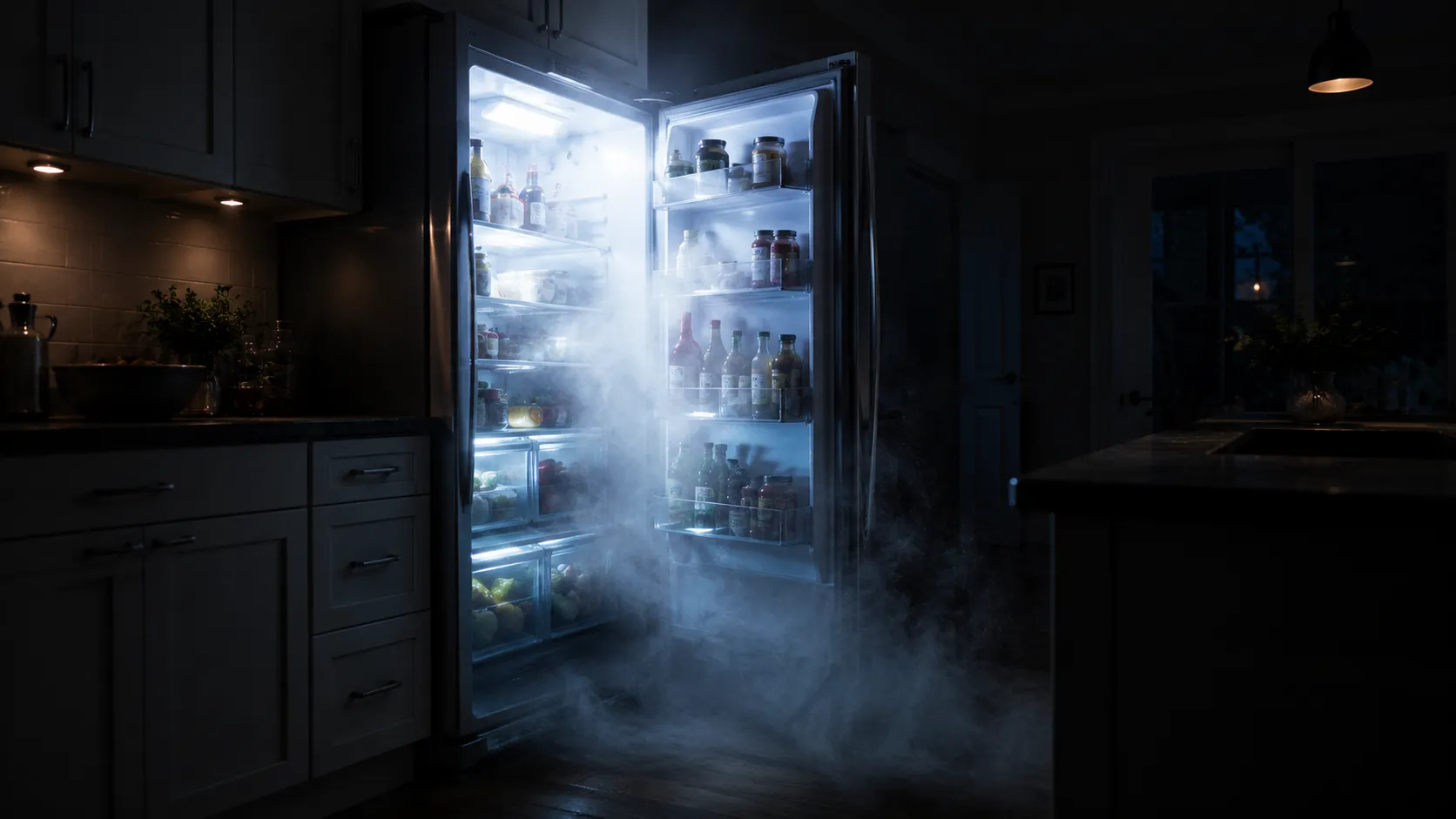
Visual answer
The refrigeration cycle
Refrigerant moves through four stages in a continuous loop.
Evaporator (inside the fridge)
Liquid refrigerant evaporates here, absorbing heat from the food and air inside.
Compressor
Compresses the refrigerant vapor, raising its pressure and temperature.
Condenser (coils on the back)
Hot refrigerant releases its heat into the room air and condenses back into a liquid.
Expansion valve
Pressure drops rapidly, cooling the refrigerant before it enters the evaporator again.
Evaporation cools
Evaporation absorbs heat
When a liquid evaporates, it absorbs energy from its surroundings. This is why you feel cold when you step out of a swimming pool. Evaporating water pulls heat from your skin.
Refrigerators use this principle with a refrigerant fluid that is engineered to evaporate at very low temperatures.
Inside the fridge, the refrigerant evaporates and absorbs heat. That heat is no longer in the fridge. It has been carried away.
Cold myth
Does your fridge make cold air?
What people think
The fridge generates cold and pumps it inside.
Most people picture a machine that produces cold the way a heater produces warmth.
What actually happens
It removes heat. Cold is just what is left.
There is no such thing as a cold particle or cold energy your fridge injects. Cold is simply a low level of heat energy. The fridge continuously removes heat from the interior.
Fridge vs air conditioning
Refrigerators and air conditioners work the same way
Refrigerator
Moves heat from inside the cabinet to the kitchen.
Air conditioner
Moves heat from inside the building to outside.
Heat pump (heating mode)
Moves heat from outside to inside to warm a building.
Freezer
Same as a refrigerator but the evaporator runs cold enough to freeze water.
Why the back is warm
Why the back of your fridge is warm
The coils on the back of a refrigerator are the condenser. This is where the refrigerant dumps the heat it collected from inside.
All the heat that was removed from your food and the interior air gets released here.
This is also why putting a fridge in a very warm room or in a tight space with no ventilation reduces efficiency. It becomes harder for the condenser to dump heat.
Quick answers
Common questions
How does a refrigerator make things cold? +
It removes heat from inside the cabinet using an evaporating refrigerant that absorbs heat and carries it to the coils on the back where it is released into the room.
Why is the back of my refrigerator warm? +
The condenser coils on the back release the heat that was collected from inside the fridge. That warmth is the heat that was removed from your food.
What is refrigerant? +
A fluid engineered to evaporate at low temperatures, allowing it to absorb heat at cold temperatures. Modern fridges typically use hydrofluorocarbon refrigerants.
Why does an old fridge use more electricity? +
Older compressors are less efficient, insulation degrades over time, and door seals wear out letting warm air in. All of these make the compressor work harder and longer.
Is an air conditioner the same as a fridge? +
Essentially yes. Both use the same refrigeration cycle to move heat from one place to another. An air conditioner moves heat from inside a building to outside.