Quick Facts
Quick Facts
Galileo did not invent the telescope, he improved it. The Dutch had the basic design; he made it dramatically more powerful.
He discovered Jupiter's four largest moons in January 1610. Initially he tried to name them after his patrons, the Medici family.
He eventually went blind, possibly from years of looking at the Sun through his telescope.
He published his discoveries in a short book called Sidereus Nuncius (The Starry Messenger) in March 1610. It sold out almost immediately.
Saturn's rings puzzled him, he could see something odd but his telescope was not good enough to resolve what it was. He described Saturn as a planet with ears.
His discovery of sunspots was independently made around the same time by at least two other astronomers. Priority disputes followed. They were unpleasant.
Visual answer
Five Discoveries That Rewrote the Sky
What Galileo found, and why each discovery mattered far beyond astronomy.
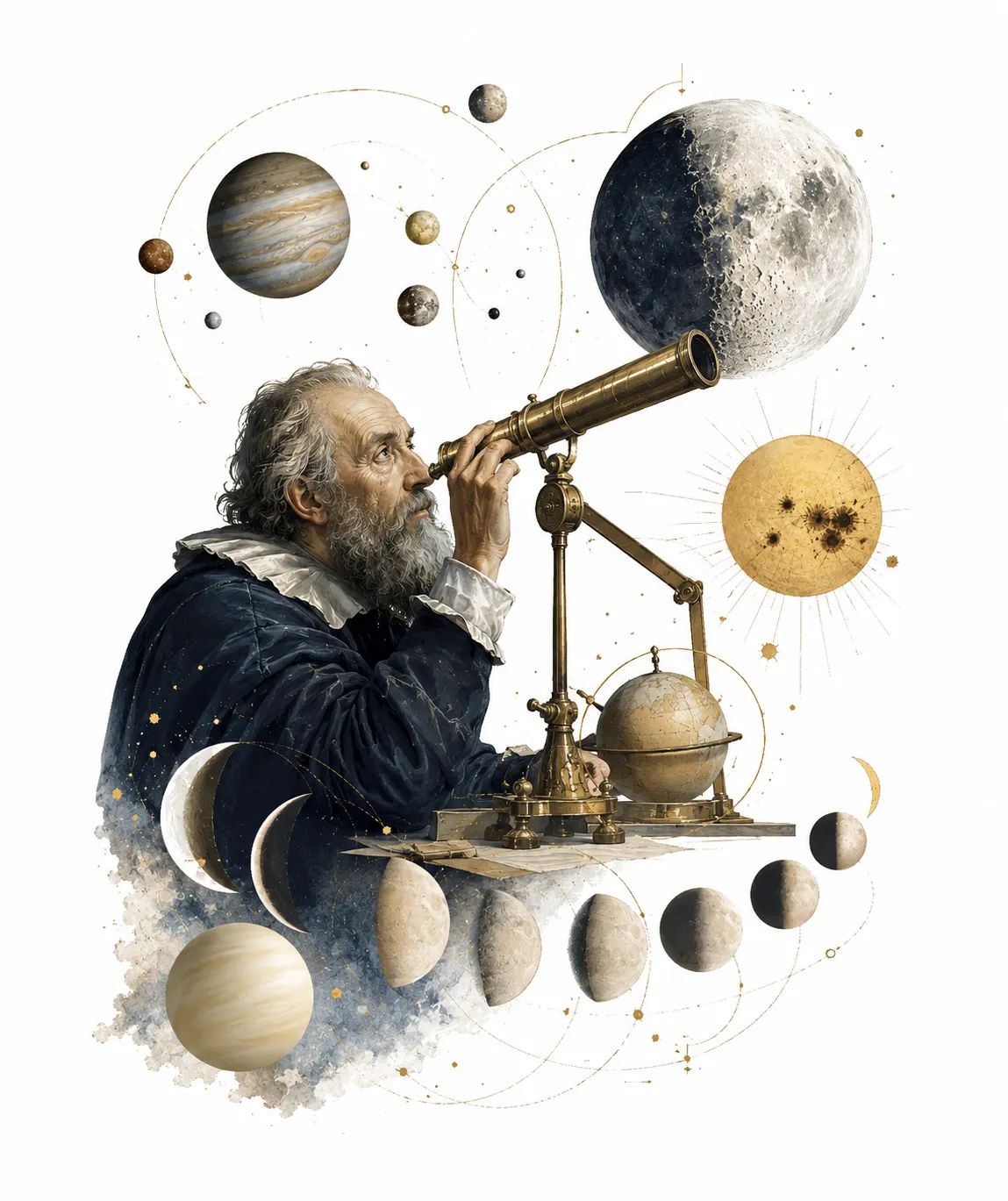
Mountains on the Moon
The Moon was supposed to be a perfect heavenly sphere. Galileo found it was cratered and mountainous, essentially, another world like ours.
Jupiter's Four Moons
Four objects orbiting Jupiter proved that not everything in the cosmos circled the Earth. The universe's rotation had another centre.
Phases of Venus
Venus showing a full cycle of phases, like the Moon, was only possible if it orbited the Sun. This was decisive evidence against the Earth-centred model.
Sunspots
The Sun had dark, moving blemishes. The heavens were not perfect and unchanging. They were physical, dynamic, and impermanent.
The Milky Way
What appeared to the naked eye as a luminous cloud resolved through the telescope into millions of individual stars. The universe was enormously, bewilderingly larger than anyone had imagined.
Story in brief
Story in Brief
1609
Galileo hears about a Dutch spyglass and builds his own, rapidly improving it to twenty times magnification.
The improvement made astronomical observation possible for the first time.
November–December 1609
He turns the telescope on the Moon and finds a cratered, mountainous surface.
The first blow against the doctrine of heavenly perfection.
January 7, 1610
He notices three small lights near Jupiter. Within days he finds a fourth. He realises they are moons in orbit.
Proof that not everything orbited Earth. The old model had a crack in it.
March 1610
He publishes Sidereus Nuncius, describing all his discoveries to date.
Within weeks, Galileo was famous across Europe.
1610–1611
He observes the phases of Venus and sunspots.
The phases of Venus were the most powerful direct evidence against the Earth-centred model.
c. 1638
He goes completely blind.
Probably the cost of years of solar observation. His greatest telescope work was done by this point, but the irony was noted by everyone.
The Discoveries
What Made the Telescope So Dangerous
The telescope itself was not the problem. Plenty of people had looked through spyglasses before Galileo. What made his observations so inflammatory was not the instrument but the framework they were aimed at dismantling.
For two thousand years, Western science had operated on a model inherited from Aristotle and refined by Ptolemy: the Earth sat at the centre of the universe, surrounded by concentric spheres of perfectly circular motion, upon which the planets and stars were fixed. The heavens were made of a fundamentally different substance to the Earth, perfect, eternal, unchanging. This was not just astronomy. It was theology, philosophy and physics all wrapped together.
Galileo's telescope, in less than two years, found something wrong with almost every part of this picture. The Moon had mountains. Jupiter had satellites. The Sun had spots. Venus went through phases that could only happen if it orbited the Sun rather than the Earth. The Milky Way was not a divine smear but an incomprehensibly large collection of individual stars. Each discovery was, on its own, extraordinary. Together, they were a demolition.
Galileo's Own Words
"I have observed that the planet Saturn is not a single star but is a composite of three, which almost touch each other."
, Galileo Galilei, letter to Cosimo II de' Medici, 1610
This was Galileo's baffled description of Saturn's rings. His telescope was not powerful enough to resolve what he was seeing, so he concluded Saturn must have two companion bodies, one on each side. He described them as 'ears.' The actual rings would not be correctly identified until Christiaan Huygens observed them in 1655. Galileo had stumbled on something real that he simply could not yet explain.
Evidence Against Earth-Centrism
Which Discoveries Mattered Most, and Why
Jupiter's moons proved that not every celestial body orbited Earth.
StrongVenus's full cycle of phases was only possible if it orbited the Sun.
StrongSunspots moving across the Sun's surface showed the heavens were not perfect or unchanging.
ModerateMountains on the Moon showed celestial bodies were physical, earthlike, not made of a different substance.
ModerateKey Points
What He Actually Showed
Each discovery targeted a specific claim of the old Aristotelian-Ptolemaic model.
The phases of Venus were the most scientifically decisive: they were flatly incompatible with an Earth-centred universe.
Jupiter's moons were the most famous: they were the discovery that made him a celebrity almost overnight.
He published his early findings in a short book in March 1610 that sold out across Europe.
He did not prove heliocentrism beyond doubt, that would require Newton's physics decades later. What he did was destroy the confidence that the old model was obviously correct.
Analogy
Not One Discovery, A Systematic Demolition
The familiar part
Imagine a building that has been standing for two thousand years. One crack in the foundation might be explained away. Two cracks might be coincidence. But if you find cracks in the foundation, the walls, the roof and the load-bearing columns simultaneously, it is time to consider that the building was not as solid as everyone assumed.
How it applies
Galileo's discoveries in 1609 and 1610 did not disprove the old model on any single point. They found fault with it everywhere at once.
Where the analogy breaks
Unlike a building, a scientific model can survive quite a lot of damage before people agree it needs replacing. The Earth-centred cosmos had defenders who were creative, intelligent and extremely motivated. It would take decades, and a new theory of gravity, to fully close the argument.
Curiosity Notes
Details Most People Miss
Why this still matters
Why This Still Matters
Galileo's discoveries matter not just as historical milestones but as a demonstration of what systematic observation can do. He did not have a better theory than his contemporaries. He had a better instrument and the willingness to look at what it showed him, even when, especially when, what it showed him was inconvenient.
Key Findings
- ✓Core findingGalileo improved, but did not invent, the telescope.
- ✓Strong evidenceHis major discoveries were the Moon's mountains, Jupiter's four moons, the phases of Venus, sunspots, and the stars of the Milky Way.
- ⚠Main consequenceThe phases of Venus were scientifically the most decisive: they could only occur if Venus orbited the Sun.
- ✓Wider legacyJupiter's moons were the most famous: they proved not everything orbited the Earth.
- ★Bottom lineHe published his findings in The Starry Messenger in March 1610, which became an immediate sensation.
- ✓Wider legacyHe went progressively blind from around 1638, most likely from solar observation.
- ★Bottom lineHe never fully proved heliocentrism, but he made the old Earth-centred model impossible to defend with a straight face.
Final insight
A Last Thought
In less than two years, with a homemade telescope and an almost alarming willingness to follow the evidence wherever it pointed, Galileo overturned a cosmological system that had held for two thousand years. He did not do it by being smarter than everyone before him. He did it by looking.
Quick answers
Common questions
Did Galileo discover that the Earth orbits the Sun? +
He gathered strong evidence for it, particularly through the phases of Venus, but he did not prove it in the mathematical sense. That required Newton's theory of gravity, published in 1687, forty-five years after Galileo's death. What Galileo did was make the evidence against an Earth-centred universe overwhelming.
What were the names of the four moons Galileo discovered? +
The four moons he discovered are now called Io, Europa, Ganymede and Callisto. Galileo himself called them the 'Medicean Stars' to flatter his patrons. The mythological names, suggested by Johannes Kepler, did not catch on for about two hundred years. Galileo, in his own notes, simply called them I, II, III and IV.
Why did Galileo go blind? +
The most likely cause was cumulative damage from observing the Sun through his telescope over many years. He himself acknowledged this as a risk. By 1638 he had lost his sight entirely. He spent his final four years blind, under house arrest, continuing to work by dictating to assistants.
What was Galileo's most important discovery? +
Most historians point to the phases of Venus as his most scientifically decisive discovery, since they flatly contradicted the Ptolemaic model and could not be explained away. But Jupiter's four moons were his most culturally explosive discovery, they were what made him famous almost overnight and spread his name across Europe.
Did Galileo discover gravity? +
Not in the sense we usually mean. He made important early observations about how objects fall, specifically, that heavier objects do not fall faster than lighter ones, contradicting Aristotle. He also recognised that projectiles travel in parabolic arcs. But the full theory of gravity as a force was Isaac Newton's achievement, published in 1687.
