Earth & Space

What Happens If You Dig a Hole Through the Earth?

The exit point is not where you think. And getting there would be impossible, but the physics of falling through is beautiful. The old idea of digging a hole to China is geographically wrong for most of the United States and physically impossible. But if you imagine an ideal frictionless tunnel through Earth, the physics gives one of classical mechanics' most elegant answers. In the ideal model, every straight tunnel through Earth takes about 42 minutes one way, whether it passes through the center or along a shorter chord.

Quick answer

You cannot dig through Earth because heat, pressure, liquid iron, and material limits make such a tunnel impossible. In an ideal hollow, frictionless Earth model, a fall through the planet would take about 42 minutes to the other side. The 42-minute time applies to any straight tunnel through Earth, not just one through the center.
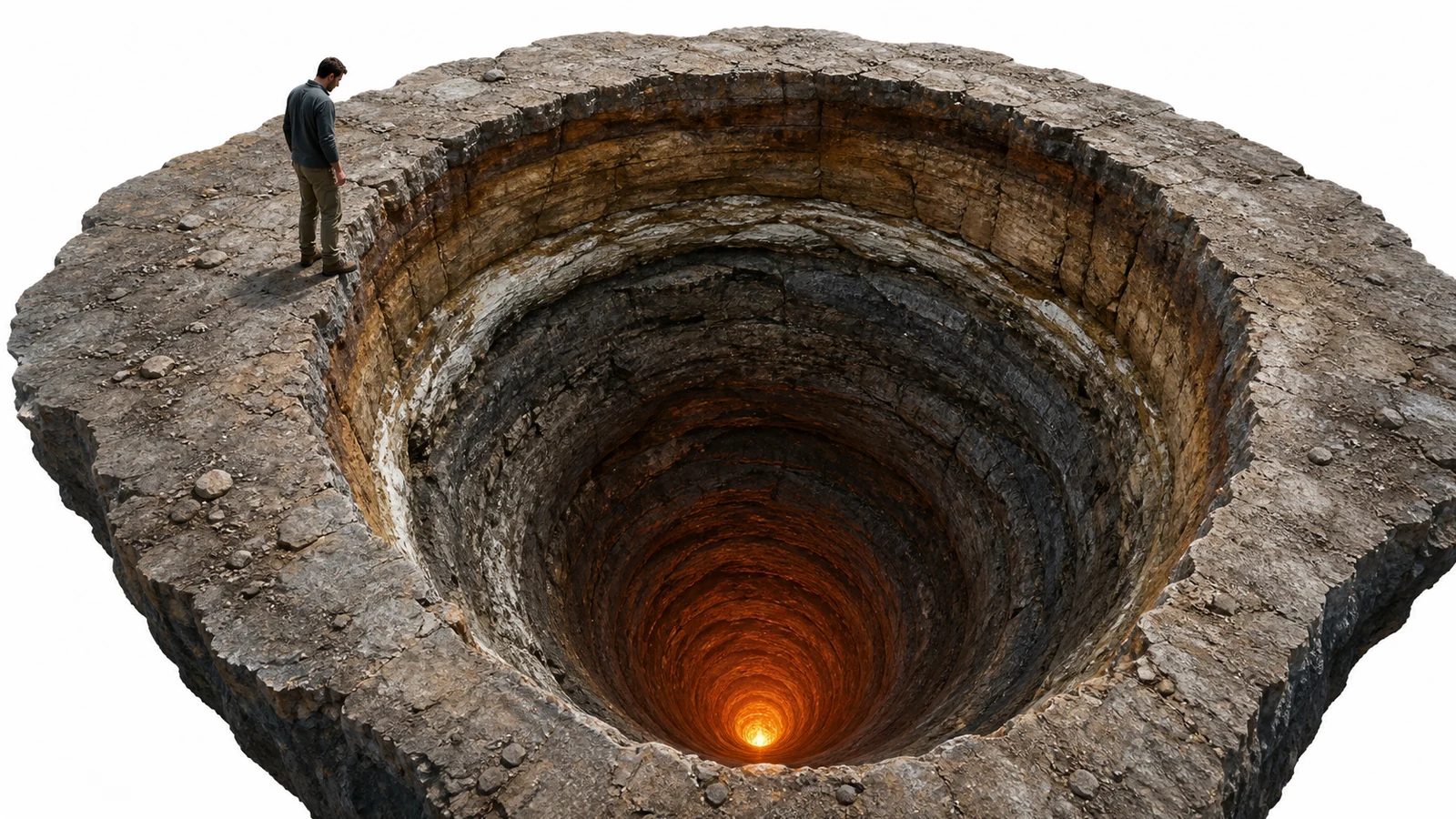
What Happens If You Dig a Hole Through the Earth? hero image

The short answer

You cannot dig through Earth because heat, pressure, liquid iron, and material limits make such a tunnel impossible.

Crust

Solid silicate rock, only a thin skin compared with Earth's radius.

Curiosity twist

The 42-minute time applies to any straight tunnel through Earth, not just one through the center.

Common mistake

If you dug straight down from the United States, you would come out in China.

The physics of falling through a planet

The gravity tunnel thought experiment sets aside engineering impossibility to reveal the connection between falling, oscillation, and orbiting.

The 42-minute fall

As you fall inward, less mass remains below you pulling you toward the center, and gravity approaches zero at the center. Past the center, gravity pulls you back. The motion is like a mass on a spring, with an 84-minute round trip.

Memorable line: Falling through Earth and orbiting Earth are the same mathematics.

The isochronous tunnel

A shorter chord tunnel also takes 42 minutes because it has less distance but also less gravitational acceleration along its length. The effects cancel in the ideal model.

Memorable line: New York to London by gravity tunnel: 42 minutes. New York to Tokyo: also 42 minutes.

What you would actually encounter

The real Earth defeats the idea immediately. Temperatures rise with depth, the mantle flows plastically, the outer core is liquid iron, and the inner core is solid iron under crushing pressure. The Kola Superdeep Borehole reached only 12.26 km into a planet 12,742 km across.

Memorable line: The deepest hole ever drilled barely scratches the surface of Earth.

Earth's interior layers

A descent through Earth crosses four major zones.

1

Crust

Solid silicate rock, only a thin skin compared with Earth's radius. Humans have drilled only a tiny fraction through it.

2

Mantle

Solid but slowly flowing rock, hot enough to convect over geological time and drive plate tectonics. It behaves like very slow fluid.

3

Outer core

Liquid iron and nickel, generating Earth's magnetic field through convection. No tunnel material could survive here.

4

Inner core

Solid iron and nickel despite enormous heat because pressure raises the melting point. It is hotter than you expect and solid for a counterintuitive reason.

Why the 42-minute answer is the same as the orbital period

A falling person in a gravity tunnel and a satellite in low orbit are both in free fall. One falls through Earth; the other falls around it while moving sideways fast enough to miss. The similar period comes from the same gravitational mathematics.

Surprising facts about Earth's interior

The inner core rotates differently
Seismology suggests the inner core can rotate at a slightly different rate than the mantle and crust.
The Kola borehole found deep water
Deep rocks were more fractured and water-bearing than expected, with water produced by mineral reactions.

Would you emerge in China?

Myth

The myth

If you dug straight down from the United States, you would come out in China.

Reality

The reality

Most of the continental United States has antipodes in the Indian Ocean. China's antipode is mostly in South America or nearby ocean regions. Why people think this: China is culturally imagined as the far side of the world from North America, but the actual globe geometry is different.

The gravity train concept

Hyperloop and the gravity train
Vacuum-tube transit ideas sometimes borrow from gravity-train thinking, though the true through-Earth version remains impossible.

What the thought experiment reveals

The question is useful because it connects childhood intuition to serious physics: simple harmonic motion, gravitational field structure, and orbital mechanics.

Surprising consequence: An ideal gravity tunnel would offer equal travel time between any two surface points, a transportation property no real system has.

Worth noting

The beautiful answer to a childish question

The hole through Earth is impossible, but the imagined fall gives a beautiful 42-minute answer tied to the mathematics of orbits. Every hole, every angle, always 42 minutes. This is one of the most beautiful numbers in classical physics.

Quick answers

Common questions

How does Earth's interior affect life on the surface?

Mantle convection drives plate tectonics, while the liquid outer core generates the magnetic field that helps protect the atmosphere.