Earth & Space

What Happens If Earth Stopped Rotating?

A thought experiment that reveals how deeply the spin of the planet is built into everything. Earth rotates at about 1,670 km/h at the equator. You do not feel it because you, the air, the oceans, and the ground are moving together. If the ground stopped instantly, everything not fixed to bedrock would keep moving eastward. The instant-stop version is apocalyptic. The slow-stop version is stranger, because it reveals how much day, weather, magnetism, and life depend on spin.

Quick answer

If Earth stopped instantly, surface material would be flung eastward, the atmosphere would keep moving as catastrophic winds, oceans would redistribute, and there would be no survivors. If it slowed gradually, days could become months long, climate would become extreme, and the magnetic field could weaken. Earth's rotation is already slowing by about 1.4 milliseconds per century, mainly because of tidal interaction with the Moon.
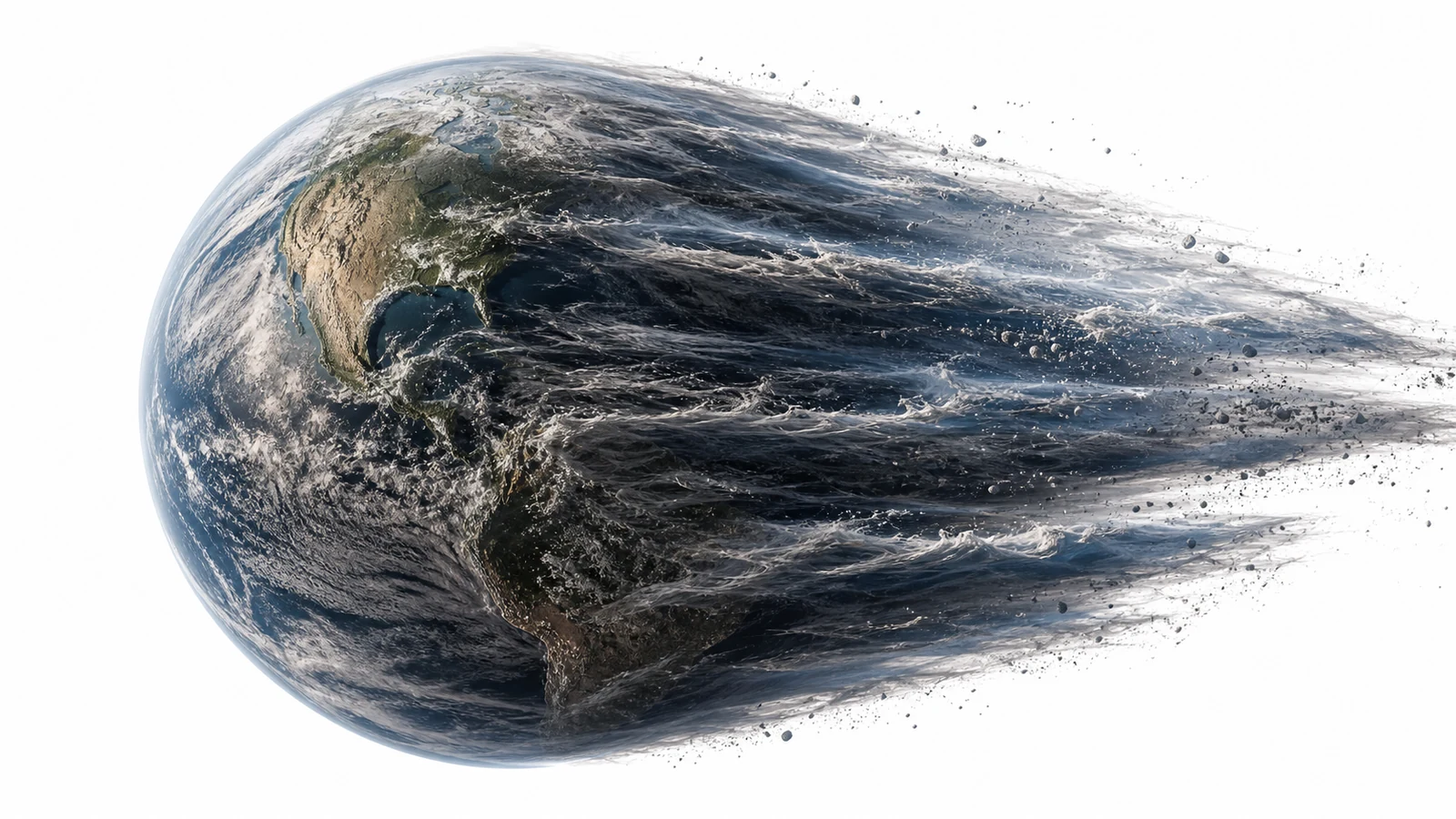
What Happens If Earth Stopped Rotating? hero image

The short answer

If Earth stopped instantly, surface material would be flung eastward, the atmosphere would keep moving as catastrophic winds, oceans would redistribute, and there would be no survivors.

Creates days and nights

Rotation creates the 24-hour light-dark cycle that circadian biology, plant cycles, migration, and predator-prey rhythms evolved around.

Curiosity twist

Earth's rotation is already slowing by about 1.4 milliseconds per century, mainly because of tidal interaction with the Moon.

Common mistake

A tidally locked Earth would have one burning side, one frozen side, and nothing habitable.

The physics of a stopped world

There are two versions of the scenario: impossible instant stoppage and physically plausible gradual tidal slowing. Both show how much kinetic and climatic structure rotation supplies.

The instant stop: everything becomes a projectile

At the equator, ground speed is about 1,670 km/h. If the ground stopped while air and water kept moving, the resulting winds and ocean movement would destroy surface structures, strip soil, and rearrange coastlines.

Memorable line: If Earth stopped rotating instantly, the atmosphere would keep spinning while the ground stopped beneath it.

The slow stop: half a year of night

If rotation slowed over geological time, the world would drift toward extreme long days and nights. A tidally locked or near-locked Earth would have severe day-side heating, night-side cooling, and a habitable zone, if any, near the terminator.

Memorable line: One half would become a broiling desert, and the other a frozen wasteland.

What rotation actually does

Earth's rotation is more than day and night.

1

Creates days and nights

Rotation creates the 24-hour light-dark cycle that circadian biology, plant cycles, migration, and predator-prey rhythms evolved around. The planet's spin is written into biology.

2

Drives atmospheric circulation

The Coriolis effect shapes trade winds, jet streams, ocean circulation, and storm rotation. Weather is partly geometry plus spin.

3

Generates the magnetic field

Rotation helps organize convection in the liquid outer core, supporting the dynamo that creates Earth's magnetic shield. The magnetic field protects atmosphere and surface from solar wind.

4

Bulges the equator

Centrifugal effects make Earth wider at the equator than at the poles and slightly reduce effective weight there. You weigh a little less at the equator.

Why Earth is spinning at all

Earth's rotation is inherited from the angular momentum of the solar system's formation. The spinning protoplanetary disk produced rotating planets, and tidal interaction with the Moon has been slowing Earth ever since.

Rotation's stranger facts

The Moon is slowing Earth down
Tidal friction has lengthened the day from much shorter early-Earth days to the current 24-hour cycle.
Earthquakes change Earth's rotation
Large earthquakes redistribute mass and can shorten the day by microseconds.

Would one side be always hot and uninhabitable?

Myth

The myth

A tidally locked Earth would have one burning side, one frozen side, and nothing habitable.

Reality

The reality

Atmosphere and oceans would move heat between sides, so the terminator region might remain marginally habitable. That is still very different from supporting civilization as we know it. Why people think this: The simple hot/cold image ignores heat transport by fluids.

Rotation effects we feel

The Coriolis effect and daily weather
Hurricanes spin in opposite directions by hemisphere because rotating Earth deflects moving air and water.

The spin that makes Earth habitable

The 24-hour day, magnetic field, global winds, and ocean circulation all depend partly on Earth's rotation rate being in a life-compatible range.

Surprising consequence: Human circadian rhythms still run close to 24 hours even without light cues, because life has adapted to Earth's spin.

Worth noting

The spin in everything

Weather, magnetism, night, day, and moderate temperature patterns all trace back to planetary rotation. You cannot feel the spin. But take it away, and you would have nothing left to feel anything with.

Quick answers

Common questions

How fast would you be moving if you stood at the equator?

About 1,670 km/h relative to Earth's axis, plus about 107,000 km/h around the Sun. You do not feel it because everything nearby shares the motion.