Earth & Space

What Happens If Everyone on Earth Jumped at the Same Time?

This question has a precise, calculated answer. It is very, very anticlimactic. All eight billion humans jumping together sounds planetary. Conservation of momentum gives the deflating answer: humanity's combined mass is tiny compared with Earth's. The jump does almost nothing to Earth. Getting everyone home afterward is the actual disaster.

Quick answer

Earth would recoil by far less than a hydrogen atom's width, with a tiny local seismic signal and no meaningful change to orbit or rotation. The mass ratio makes direct human physical force irrelevant at planetary scale. Humans do measurably affect Earth's rotation through climate-driven ice redistribution, groundwater extraction, and reservoirs, just not by jumping.

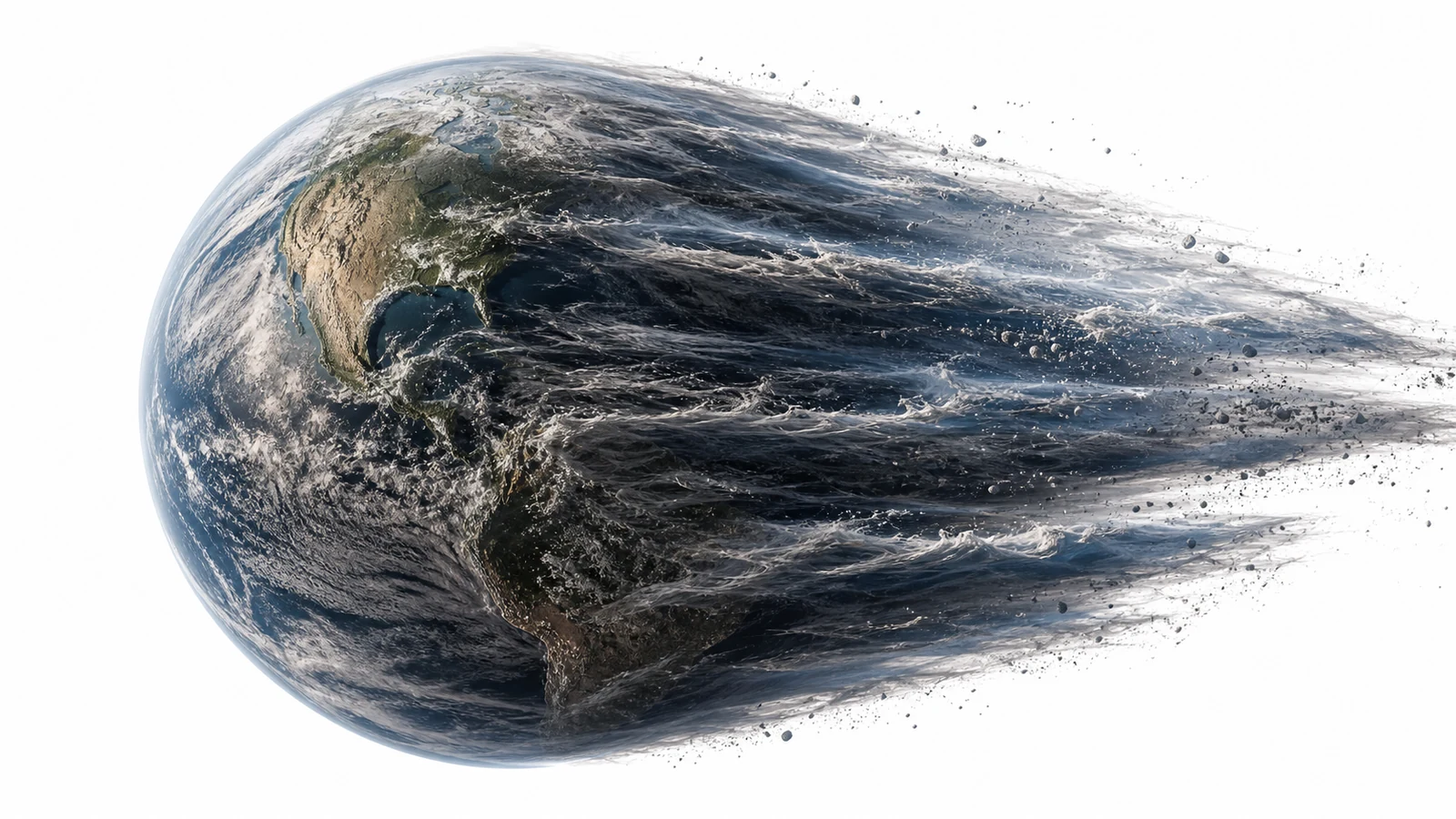
What Happens If Everyone on Earth Jumped at the Same Time? hero image

The short answer

Earth would recoil by far less than a hydrogen atom's width, with a tiny local seismic signal and no meaningful change to orbit or rotation.

Conservation of momentum

When people jump, Earth recoils with equal and opposite momentum, but its mass makes the motion vanishingly small.

Curiosity twist

Humans do measurably affect Earth's rotation through climate-driven ice redistribution, groundwater extraction, and reservoirs, just not by jumping.

Common mistake

If enough people coordinate, humanity can physically shift Earth by force.

The physics, worked out

The thought experiment is a conservation-of-momentum lesson and a scale lesson.

The calculation

Eight billion people at 70 kg jumping upward around 3 m/s gives momentum around 1.68 x 10^12 kg m/s. Earth's mass is about 6 x 10^24 kg, so the recoil velocity and displacement are effectively zero on human scales.

Memorable line: If all humans jumped at once, Earth would move by less than the diameter of a hydrogen atom.

The logistics catastrophe

Putting eight billion people in one place would require impossible-scale food, water, sanitation, transport, and coordination. The physics would be boring; the human logistics would be catastrophic.

Memorable line: The jump would barely move Earth. Getting eight billion people home would be the actual catastrophe.

The physics principles at work

The Earth-jump scenario illustrates basic but humbling physics.

1

Conservation of momentum

When people jump, Earth recoils with equal and opposite momentum, but its mass makes the motion vanishingly small. The equation is simple; the scale is the surprise.

2

The mass ratio problem

Earth's mass is so much larger than humanity's combined mass that human physical force barely registers. More people does not solve a 10^13-scale mismatch.

3

Seismic waves

The landing would create a small local seismic signal, likely below what people would meaningfully feel at distance. The sound would be more dramatic than the geology.

Why humans can't move planets

Human-scale force is tiny compared with geological, atmospheric, and orbital energy. A hurricane or earthquake releases energy at scales coordinated bodies cannot approach.

Surprisingly, humans do affect Earth's rotation

Climate change is slowing Earth's rotation
Melting polar ice redistributes mass toward the oceans and slightly changes Earth's moment of inertia.
Reservoirs change Earth's shape
Large dams redistribute water mass enough to produce tiny measurable changes in rotation and pole position.

Can't mass human action change the planet?

Myth

The myth

If enough people coordinate, humanity can physically shift Earth by force.

Reality

The reality

Direct physical action cannot. Chemical and mass-redistribution effects can accumulate to planetary significance over time. Why people think this: It is intuitive that more people means more force, but planetary mass makes the direct-force route negligible.

Human-scale actions with planetary effects

How humans actually move the planet
Groundwater extraction, reservoirs, ice melt, emissions, and land-use change affect Earth's systems far more than any coordinated jump could.

The lesson in the calculation

The thought experiment shows that human impact is not about direct mechanical force. It is about chemistry, energy balance, ecology, and accumulated infrastructure.

Surprising consequence: The least dramatic actions can have the most serious planetary consequences when repeated billions of times.

Worth noting

The humbling calculation

Humanity is too small to move Earth by jumping, but large enough to change its climate, water distribution, atmosphere, and biosphere by living as we do. We're too small to move the Earth. We're not too small to break it.

Quick answers

Common questions

What would the landing feel like?

Near the landing site it might be a mild vibration and enormous noise, but it would not create a significant earthquake globally.