Visual answer
Why old windows are thicker at the bottom
The real reason has nothing to do with glass flowing over time.
Crown glass making
Glassblowers spun molten glass into flat discs. The spinning created natural variation in thickness.
Uneven result
The outer edges of each disc were thicker than the center.
Installation practice
Glaziers installed panes with the thicker edge at the bottom for stability.
Result
Old windows look like the glass flowed down over centuries. It did not. It started that way.
What glass is
Glass is a solid with a disordered structure
Most solids are crystalline, meaning their atoms are arranged in a regular repeating pattern. Ice, salt, and metal are like this.
Glass is amorphous. Its atoms are arranged randomly, the way a liquid is, but they are locked in place and cannot flow.
Technically, glass formed by cooling molten silica is sometimes called a supercooled liquid or amorphous solid. But at room temperature, it is completely rigid. It does not flow.
Window myth
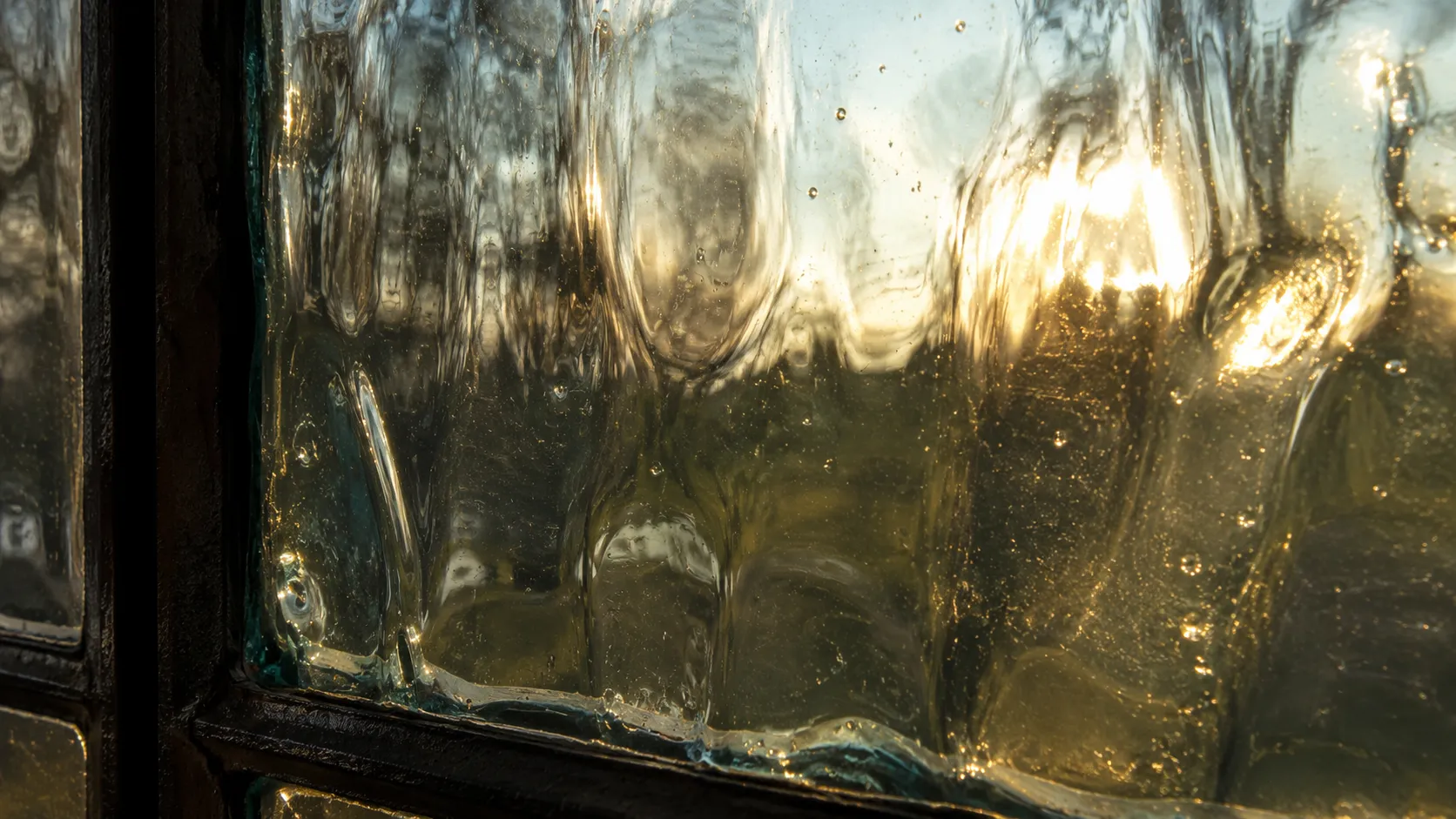
Why are old windows thicker at the bottom then?
What people think
Old glass slowly flows downward over centuries.
The bottom-heaviness of old cathedral windows is offered as evidence that glass is a very slow liquid.
What actually happens
Old windows were made uneven and installed that way on purpose.
Before flat glass manufacturing, glass was made by blowing and spinning. The resulting panes were thicker at one edge. Glaziers placed the thicker edge at the bottom for stability. The variation was there from the start.
Solid types
Crystalline vs amorphous solids
Crystalline solid
Atoms in an ordered repeating lattice. Examples: ice, salt, diamond, metals.
Amorphous solid
Atoms locked in place but in a disordered arrangement. Examples: glass, obsidian, some plastics.
True liquid
Atoms free to move past each other. Takes the shape of its container.
Glass at room temperature
Rigid, brittle, and solid. The disordered structure does not change its physical behavior as a solid.
When glass is liquid
Glass is a liquid when it is hot
Glass does become a liquid at high temperatures. Molten glass at around 1400 to 1600 degrees Celsius flows freely.
As it cools, it becomes increasingly viscous and eventually rigid, without ever going through a distinct crystallization event the way water freezes into ice.
This gradual transition is what gives it its amorphous structure. But once it has cooled to room temperature, it is solidly a solid.
Quick answers
Common questions
Is glass a liquid? +
No. Glass is a solid. It has an amorphous atomic structure but is completely rigid at room temperature and does not flow.
Why are old church windows thicker at the bottom? +
Because of how they were made. Old crown glass was produced by blowing and spinning, which created naturally uneven panes. Glaziers installed them with the thicker end down. The glass did not move.
What does supercooled liquid mean? +
It is a technical term for a substance that was cooled from a liquid without crystallizing, leaving the atoms in a disordered arrangement. At room temperature, glass is still rigid and behaves as a solid.
Can glass flow at all? +
Extremely slowly, over timescales longer than the age of the universe, at room temperature. In any practical sense, no.
At what temperature does glass become liquid? +
Glass begins to soften around 700 to 800 degrees Celsius and becomes fully fluid around 1400 to 1600 degrees Celsius, depending on the composition.