Visual answer
How the Asteroid Killed the Dinosaurs
The chain of events from impact to extinction, spanning hours to hundreds of thousands of years.
The Impact
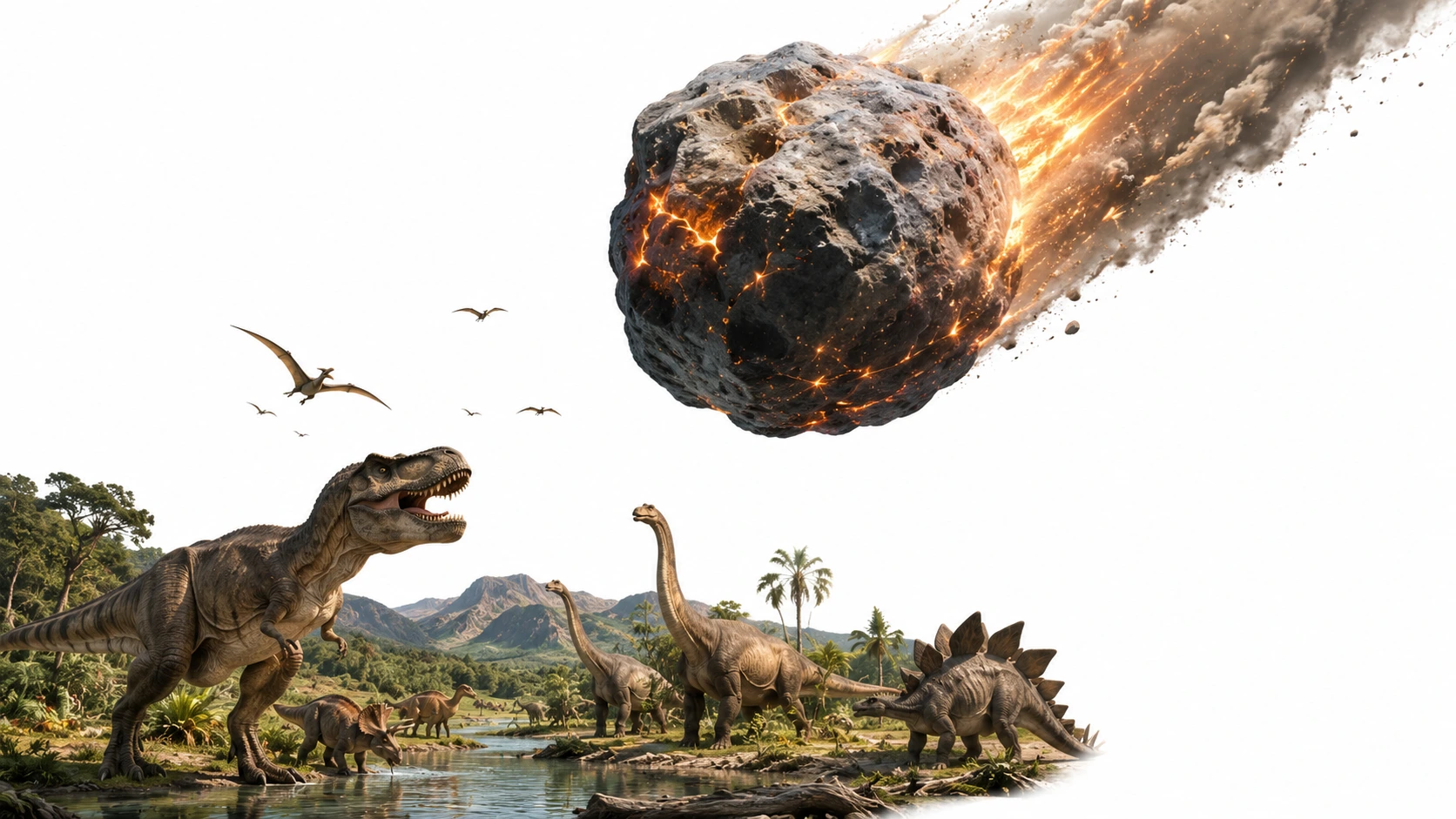
An asteroid approximately 9 to 12 kilometres wide struck the Yucatan Peninsula at around 20 kilometres per second. The energy released was estimated at 100 trillion tonnes of TNT, more than a billion times the Hiroshima bomb.
Immediate Destruction
Within minutes, the impact generated mega-earthquakes, enormous tsunamis, and shockwaves that circled the globe. Material was ejected into the upper atmosphere. Re-entering debris caused widespread wildfires across much of North America within hours.
The Debris Cloud
Soot from global wildfires, along with pulverised rock and sulfur from the impact site, was thrown into the stratosphere. This layer reflected and absorbed sunlight, dramatically reducing the amount reaching the Earth's surface.
Impact Winter
Global temperatures dropped dramatically as sunlight was blocked. Estimates suggest surface temperatures fell by up to 15 degrees Celsius in some regions. This cold and dark lasted potentially years to decades.
Food Chain Collapse
Without sunlight, photosynthesis stopped. Plants died. Herbivores starved. Carnivores that depended on herbivores followed. The collapse cascaded through ecosystems globally, affecting land, freshwater, and ocean food chains simultaneously.
Survivors
Small mammals, birds, crocodilians, turtles, and certain insects survived. The key advantages were small body size, ability to eat seeds and carrion that persisted, and in some cases the ability to go dormant. Birds, which are avian dinosaurs, survived because of exactly these traits.
More than just the asteroid
The Asteroid Was Not the Whole Story
The asteroid gets all the attention, and rightly so. But by 66 million years ago, non-avian dinosaurs were already under pressure. The Deccan Traps in what is now India had been erupting for hundreds of thousands of years before the impact, releasing enormous quantities of volcanic gases that were already altering the climate and making ecosystems less stable.
Some palaeontologists argue that dinosaur diversity had been declining for millions of years before the impact. Others argue the fossil record is too incomplete to be sure. The current consensus is that the asteroid was the killing blow to a world that may already have been struggling.
What is certain is that the impact itself, the Chicxulub event, was the decisive catastrophe. The geological boundary between the Cretaceous and Paleogene periods, found in rock strata worldwide, contains a thin layer of iridium, an element rare on Earth but common in asteroids. That layer is the fingerprint of the impact, visible around the entire planet.
Why birds survived
Why Did Birds Survive When Other Dinosaurs Did Not?
Birds are dinosaurs. Not descended from dinosaurs. They are, technically, avian dinosaurs, a lineage of feathered theropods that survived the extinction. Recognising this means the question is not why did all dinosaurs die, but why did this particular branch survive when 99% of non-avian dinosaurs did not.
The leading explanation involves several advantages birds had in a post-impact world. They were small, meaning they needed far less food. Many could eat seeds, which can persist in soil for years after plants die. Some species may have been able to migrate long distances to find viable food sources. Burrowing or water-based lifestyles also helped many species weather the impact winter.
Toothless beaks were also likely an advantage. Most toothed bird species, which required fresh meat or soft plant matter, went extinct. The toothless species that survived were better at cracking seeds and nuts, foods that remained available when almost nothing else did.
What survived
What Animals Actually Survived the Extinction?
The survivors tend to share a set of characteristics. Small body size, which reduces caloric needs. Dietary flexibility, the ability to eat whatever happened to be available after the impact winter. Some form of shelter, whether underground, underwater, or in dense vegetation.
Mammals were ideally positioned. Most Cretaceous mammals were small, nocturnal, and omnivorous. They could eat insects, seeds, and carrion. Some could hibernate. In the immediate aftermath of the extinction, mammals began filling the ecological niches vacated by dinosaurs, and within 10 million years had diversified into horses, whales, bats, and primates.
Crocodilians, turtles, and certain fish also made it through, primarily by living in or near water, where temperature fluctuations were buffered and food chains took longer to collapse. Some crocodilians can go months without food, a significant advantage when prey was scarce.
Were they declining?
Were Dinosaurs Already Going Extinct Before the Asteroid?
This question divides palaeontologists. Some analysis of the fossil record suggests non-avian dinosaur diversity was declining in the final millions of years of the Cretaceous, as climate change driven by Deccan Traps volcanism destabilised ecosystems.
Other researchers argue the fossil record is too sparse and geographically uneven to draw firm conclusions. The absence of dinosaur fossils close to the boundary in some regions may reflect poor preservation conditions rather than actual decline.
The debate does not change the core conclusion. Whether dinosaurs were thriving or struggling, the asteroid impact created conditions that no large terrestrial animal could survive. The impact winter, not the initial blast, was the mechanism of extinction, and it was indiscriminate.
Discovery
The Father and Son Who Proved What Killed the Dinosaurs
In 1980, physicist Luis Alvarez and his geologist son Walter Alvarez published a paper that changed palaeontology forever. Studying a thin clay layer at the Cretaceous-Paleogene boundary in Italy, they found concentrations of iridium 30 times higher than normal. Iridium is rare in Earth's crust but common in asteroids.
Their hypothesis was radical at the time: a massive asteroid had struck Earth and caused the mass extinction. Many palaeontologists rejected it, preferring gradual volcanic or climate explanations. The controversy was fierce.
The discovery of the Chicxulub crater in the 1990s settled the debate. The crater matched the timing and scale predicted by the Alvarez hypothesis precisely. Luis Alvarez died in 1988 before the crater was confirmed, but Walter lived to see his father's hypothesis become scientific consensus.
Misconception
Common Misconception
What people think
The asteroid directly killed the dinosaurs
Most people imagine the asteroid striking and dinosaurs dying instantly or shortly after from the blast. This is a natural and dramatic image, and films have reinforced it for decades. The impact itself was catastrophic, but most dinosaurs nowhere near the Yucatan would have survived the immediate event.
What actually happens
Reality
The real killer was what happened to the atmosphere. Soot from global wildfires, sulfur aerosols from the impact site, and pulverised rock were thrown into the stratosphere and blocked sunlight for potentially years. This impact winter halted photosynthesis, collapsed food chains globally, and caused the cascading extinctions that followed. The asteroid did not kill dinosaurs directly. It turned off the sun.
Quick answers
Common questions
What actually killed the dinosaurs? +
An asteroid impact triggered wildfires, a debris cloud, and a prolonged impact winter that blocked sunlight. Without sunlight, plants died. Without plants, food chains collapsed globally. The extinction was caused by the chain reaction, not the impact blast itself.
Did an asteroid really kill the dinosaurs? +
Yes. The evidence is overwhelming. A thin iridium-rich layer found in rock strata worldwide marks the exact moment of the extinction. The Chicxulub crater under the Gulf of Mexico matches the predicted size and age precisely. The asteroid hypothesis, once controversial, is now scientific consensus.
Why did birds survive when other dinosaurs did not? +
Birds are avian dinosaurs and survived because they were small, could eat seeds, and in many cases could fly to find food. Toothless beaks allowed seed-eating, providing a food source that persisted through the impact winter. Size was the critical factor, as large animals required more food than post-impact ecosystems could provide.
What is the Cretaceous-Paleogene extinction event? +
It is the mass extinction event 66 million years ago that wiped out approximately 75% of all species on Earth, including all non-avian dinosaurs. It marks the boundary between the Cretaceous period and the Paleogene period in Earth's geological timescale. It is also called the K-Pg extinction or K-T extinction.
Were dinosaurs already declining before the asteroid? +
Some evidence suggests diversity was declining due to Deccan Traps volcanism in the final millions of years of the Cretaceous. The debate continues. However, the asteroid impact created conditions no large terrestrial animal could survive regardless of prior trajectory.
What animals survived the extinction? +
Small mammals, birds, crocodilians, turtles, certain fish, frogs, snakes, and many insects survived. Key advantages were small body size, dietary flexibility, ability to eat seeds or carrion, and in some cases a burrowing or aquatic lifestyle that buffered against the extreme conditions.