Visual answer
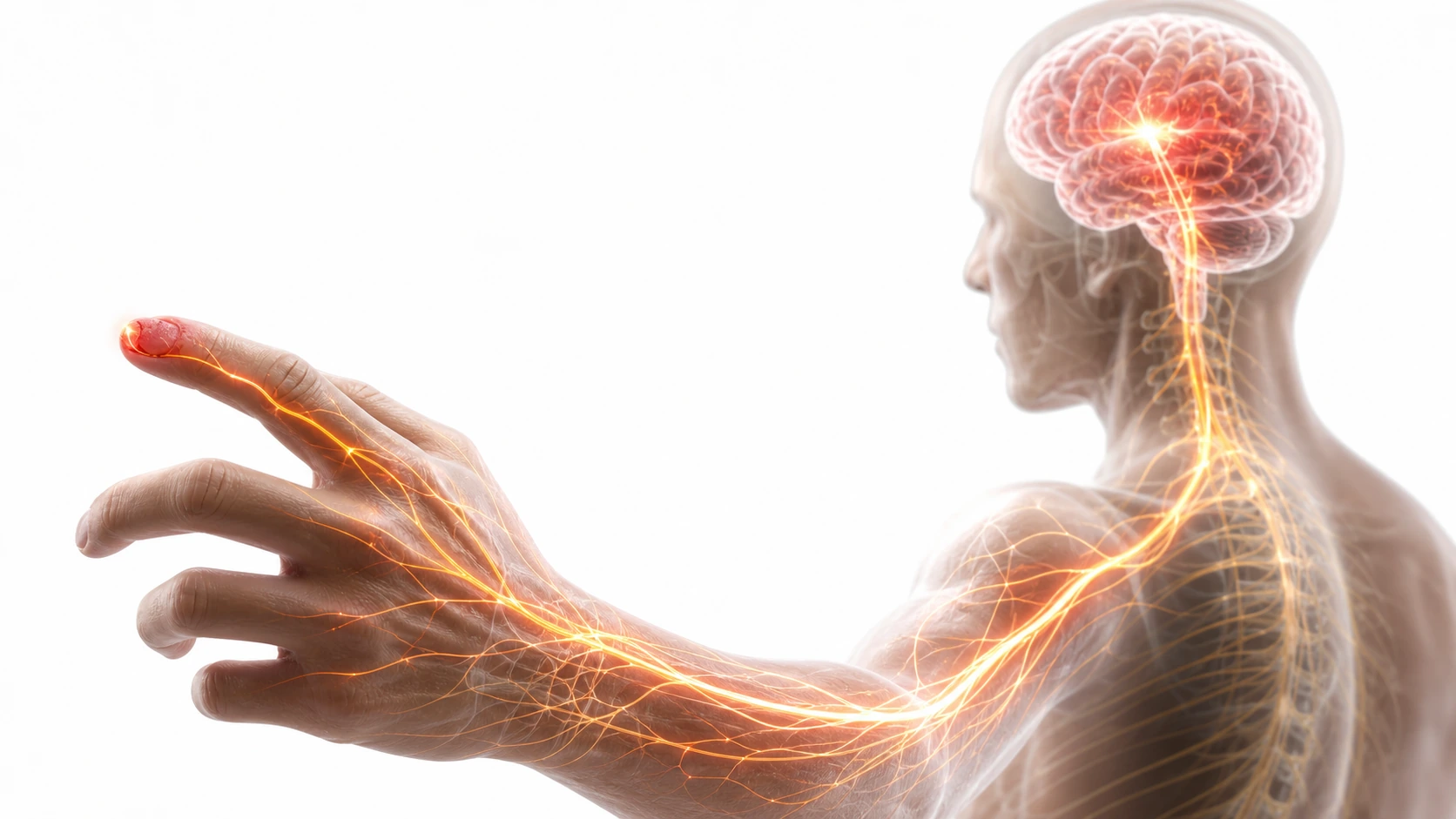
The Pain Pathway
Nociceptors send danger signals to the spinal cord and brain, where multiple regions construct the location, intensity, unpleasantness, and meaning of pain.
Nociceptors detect danger
Special nerve endings detect damage, heat, pressure, and inflammatory chemicals.
Signals reach the spinal cord
Fast and slow fibers carry different kinds of danger signals.
The spinal gate filters
Touch and descending signals can suppress or amplify pain transmission.
The brain constructs pain
Cortex, insula, cingulate, thalamus, and prefrontal regions build the experience.
Context changes intensity
Meaning, fear, attention, and safety cues alter how much it hurts.
Feedback tunes sensitivity
The brain sends signals back down that can dampen or amplify pain.
Answer
The Quick Answer
Pain begins with danger signals from tissue, but pain itself is constructed by the brain after weighing injury signals against context, memory, emotion, attention, and expectation.
Pain is not just a signal from your body. It is a story your brain is telling you. And like all stories, it can be wrong.
Mechanism
From Tissue To Experience
Pain is built, filtered, and modulated by the nervous system.
- 1
Nociceptors detect danger
Special nerve endings detect damage, heat, pressure, and inflammatory chemicals. Analogy: Smoke detectors, not fire itself.
- 2
Signals reach the spinal cord
Fast and slow fibers carry different kinds of danger signals. Analogy: Express train and local train.
- 3
The spinal gate filters
Touch and descending signals can suppress or amplify pain transmission. Analogy: A bouncer at the entrance.
- 4
The brain constructs pain
Cortex, insula, cingulate, thalamus, and prefrontal regions build the experience. Analogy: A committee vote on danger.
- 5
Context changes intensity
Meaning, fear, attention, and safety cues alter how much it hurts. Analogy: A volume knob in the brain.
- 6
Feedback tunes sensitivity
The brain sends signals back down that can dampen or amplify pain. Analogy: A microphone feeding a speaker.
Curiosities
Details That Make It Stranger
These are the facts that turn the simple explanation into a better story.
Chili activates heat pain
Capsaicin triggers TRPV1 receptors, which also respond to damaging heat.
Music can reduce pain
Patient-chosen music can reduce post-surgical pain and opioid need.
Mirror therapy helps some phantom pain
Visual feedback can update the brain's body model.
Rubbing helps
Touch signals can reduce pain transmission in the spinal cord.
Story
The Mystery Of Wind-Up
Clifford Woolf's work on central sensitization showed that repeated pain input can change spinal neurons, making the nervous system itself more sensitive.
This shifted chronic pain science from only looking at tissues to studying plasticity in the nervous system.
Hidden mechanism
The Brain's Best Guess
Pain may be the brain's protective prediction: does this body part need defending right now?
The deeper insight
If pain is a brain output, changing the brain's threat assessment can change pain itself.
Myths
Common Myths
What people think
Pain equals injury severity
Pain equals injury severity
What actually happens
Reality
Pain reflects perceived threat, not simply tissue damage.
Another Misconception
What people think
Chronic pain always means ongoing damage
Chronic pain always means ongoing damage
What actually happens
Reality
The nervous system can become sensitized and keep producing pain after tissues heal.
Quick answers
Common questions
Why does rubbing a stubbed toe help? +
Touch fibers can close spinal gates that transmit pain signals.
Can emotions cause physical pain? +
Yes. Emotional and physical pain share brain networks involved in suffering.
Is pain subjective? +
Pain is subjective by definition, but its neural correlates can be measured.
Can pain exist without damage? +
Yes, especially in sensitized or altered nervous systems.