Visual answer
Electromagnetic Induction In Practice
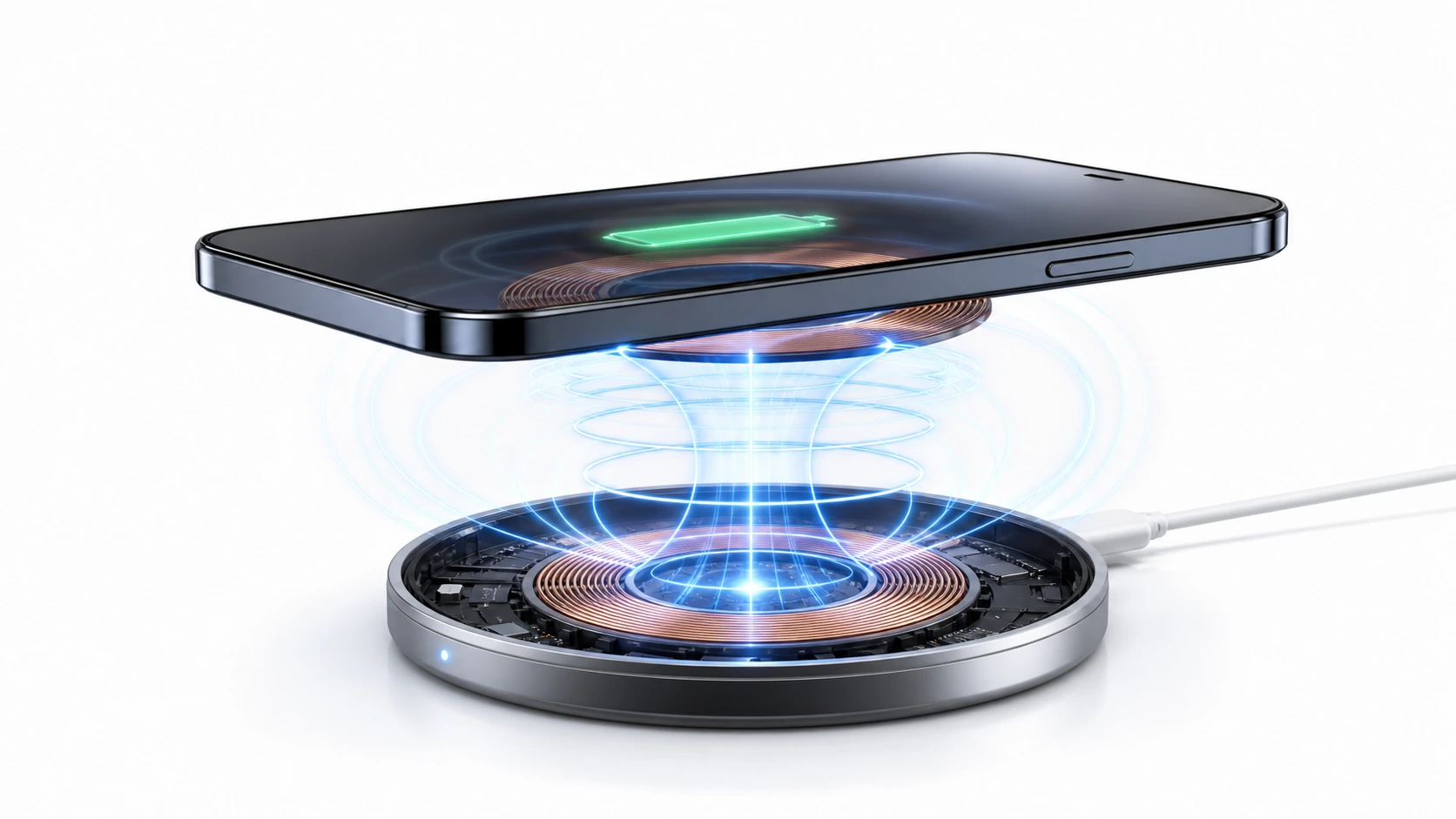
The transmitter and receiver coils must be close and aligned so the changing magnetic field couples efficiently into the device.
AC enters the pad
The charger creates high-frequency alternating current.
The primary coil creates a field
Current through the pad coil creates a changing magnetic field.
The phone coil receives it
The changing field induces voltage in the phone's coil.
AC becomes DC
A rectifier converts induced AC into battery-safe DC.
A controller manages charging
Electronics regulate power, voltage, and temperature.
Answer
The Quick Answer
Wireless charging uses electromagnetic induction: a coil in the charger creates a changing magnetic field, which induces current in a matching coil inside the device.
Your phone charges without touching anything. That should feel like magic. It is actually 200-year-old physics.
Mechanism
From Pad To Battery
Wireless charging is a two-coil energy transfer system.
- 1
AC enters the pad
The charger creates high-frequency alternating current. Analogy: A rapidly oscillating fan.
- 2
The primary coil creates a field
Current through the pad coil creates a changing magnetic field. Analogy: Invisible ripples above the pad.
- 3
The phone coil receives it
The changing field induces voltage in the phone's coil. Analogy: One spinning magnet moving another.
- 4
AC becomes DC
A rectifier converts induced AC into battery-safe DC. Analogy: Turning rocking into one-way pushing.
- 5
A controller manages charging
Electronics regulate power, voltage, and temperature. Analogy: A smart valve controlling flow.
Curiosities
Details That Make It Stranger
These are the facts that turn the simple explanation into a better story.
Tesla dreamed bigger
Nikola Tesla imagined large-scale wireless power transmission long before phone chargers.
EVs can use it
Some electric vehicles can charge from pads embedded in parking spaces.
RFID is related
Contactless cards use induction to power tiny chips during a tap.
Magnets help alignment
MagSafe-style chargers use magnets to line up the coils.
Story
Faraday Would Recognize Your Phone
Faraday discovered induction with coils and magnets in 1831. Modern wireless chargers are refined versions of that same relationship between changing magnetic fields and current.
The phone is new. The physics beneath it is old enough to predate electric grids.
Hidden mechanism
Why Air Does Not Block Magnetism
The gap is crossed by a magnetic field, not by electricity jumping through air. Plastic, air, and tissue barely interact with these fields.
The deeper insight
That is why your hand can sit between phone and charger without being shocked. Your hand is not the target coil.
Myths
Common Myths
What people think
Wireless means no wires at all
Wireless means no wires at all
What actually happens
Reality
The pad still needs wall power. Only the pad-to-device link is wireless.
Another Misconception
What people think
It works at any distance
It works at any distance
What actually happens
Reality
Consumer inductive charging needs very close proximity.
Quick answers
Common questions
Why does my phone get warm? +
Imperfect coupling and conversion losses turn some energy into heat.
Can it affect pacemakers? +
People with implanted cardiac devices are usually advised to keep chargers a safe distance away.
What is MagSafe? +
A magnetic alignment system plus charging negotiation for compatible devices.
Will it become as fast as wired charging? +
Heat limits make wired charging easier to push to high power.