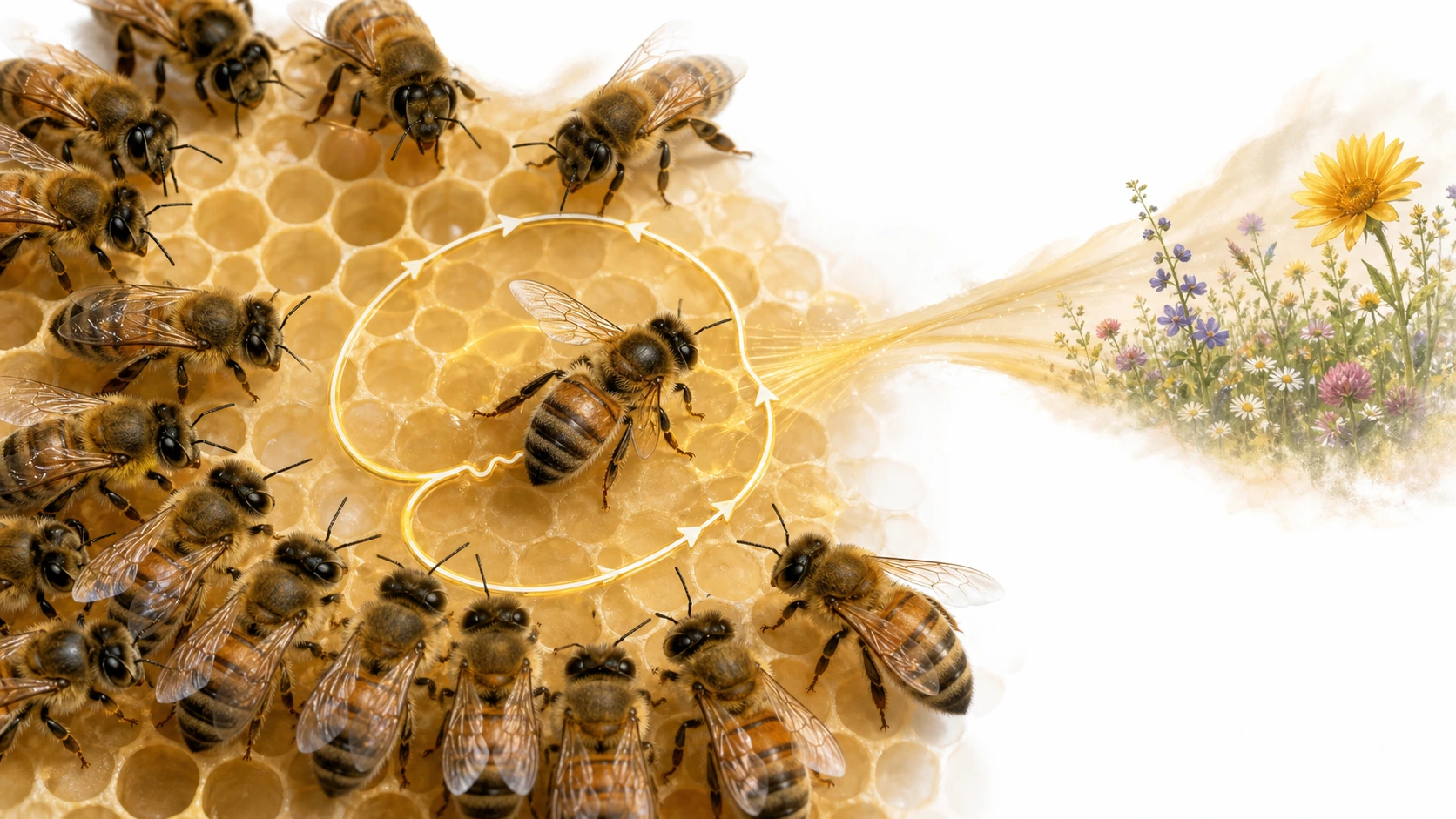
Visual answer
The Waggle Dance Decoded
A straight waggle run points relative to vertical, which represents the Sun; the run duration represents distance to the resource.
Scout finds food
A forager memorizes direction, distance, scent, and quality.
Scout recruits
She dances on the comb and attracts nearby workers.
Waggle angle encodes direction
Angle from vertical represents angle from the Sun.
Waggle duration encodes distance
The longer the straight run, the farther the source.
Followers decode by touch
In the dark hive, bees read the dance through antennae and vibration.
Sun movement is corrected
Bees adjust for the Sun's changing position over time.
Answer
The Quick Answer
Honeybees communicate food location with a waggle dance: direction is encoded by the angle of the waggle run relative to vertical, and distance is encoded by how long the waggle lasts.
A bee finds flowers two kilometers away, returns to the hive, and tells thousands of sisters where they are. Using dance.
Mechanism
Translating Landscape Into Dance
The waggle dance maps real-world space onto a vertical comb inside a dark hive.
- 1
Scout finds food
A forager memorizes direction, distance, scent, and quality. Analogy: A scout returning with bearings.
- 2
Scout recruits
She dances on the comb and attracts nearby workers. Analogy: Drawing on a map room wall.
- 3
Waggle angle encodes direction
Angle from vertical represents angle from the Sun. Analogy: Compass bearing translated onto a wall.
- 4
Waggle duration encodes distance
The longer the straight run, the farther the source. Analogy: Holding a note longer for farther places.
- 5
Followers decode by touch
In the dark hive, bees read the dance through antennae and vibration. Analogy: Reading a map by hand.
- 6
Sun movement is corrected
Bees adjust for the Sun's changing position over time. Analogy: A navigator correcting for a moving reference point.
Curiosities
Details That Make It Stranger
These are the facts that turn the simple explanation into a better story.
Swarms vote with dances
Scout bees dance for nest sites until consensus emerges.
The hive is dark
Followers feel the dance rather than watching it visually.
Bees have number sense
Experiments suggest bees can grasp simple quantities, including zero.
Robotic bees can recruit
Researchers have used robot dances to direct real foragers.
Story
Karl von Frisch's Impossible Discovery
Karl von Frisch decoded the waggle dance after decades of observation and faced skepticism because symbolic animal communication seemed too sophisticated.
His work changed animal cognition research and won a Nobel Prize.
Hidden mechanism
A Language That Maps The World
The waggle dance is symbolic: a body angle inside a dark hive stands for a direction outside in the landscape.
The deeper insight
Bees solved a spatial communication problem with a compact dance millions of years before humans built maps.
Myths
Common Myths
What people think
Bees dance for entertainment
Bees dance for entertainment
What actually happens
Reality
The dance is precise functional communication about external locations.
Another Misconception
What people think
All bees communicate this way
All bees communicate this way
What actually happens
Reality
The waggle dance is specific to honeybees; other bees use different systems.
Quick answers
Common questions
Can bees dance for things other than food? +
Yes. Scouts dance for potential nest sites during swarming.
How far can bees forage? +
Commonly a few kilometers, though longer trips are possible.
Do other insects do this? +
Some social insects recruit, but honeybee waggle communication is unusually precise.
Can humans decode it? +
Yes, scientists can measure dance angle and duration to predict food location.