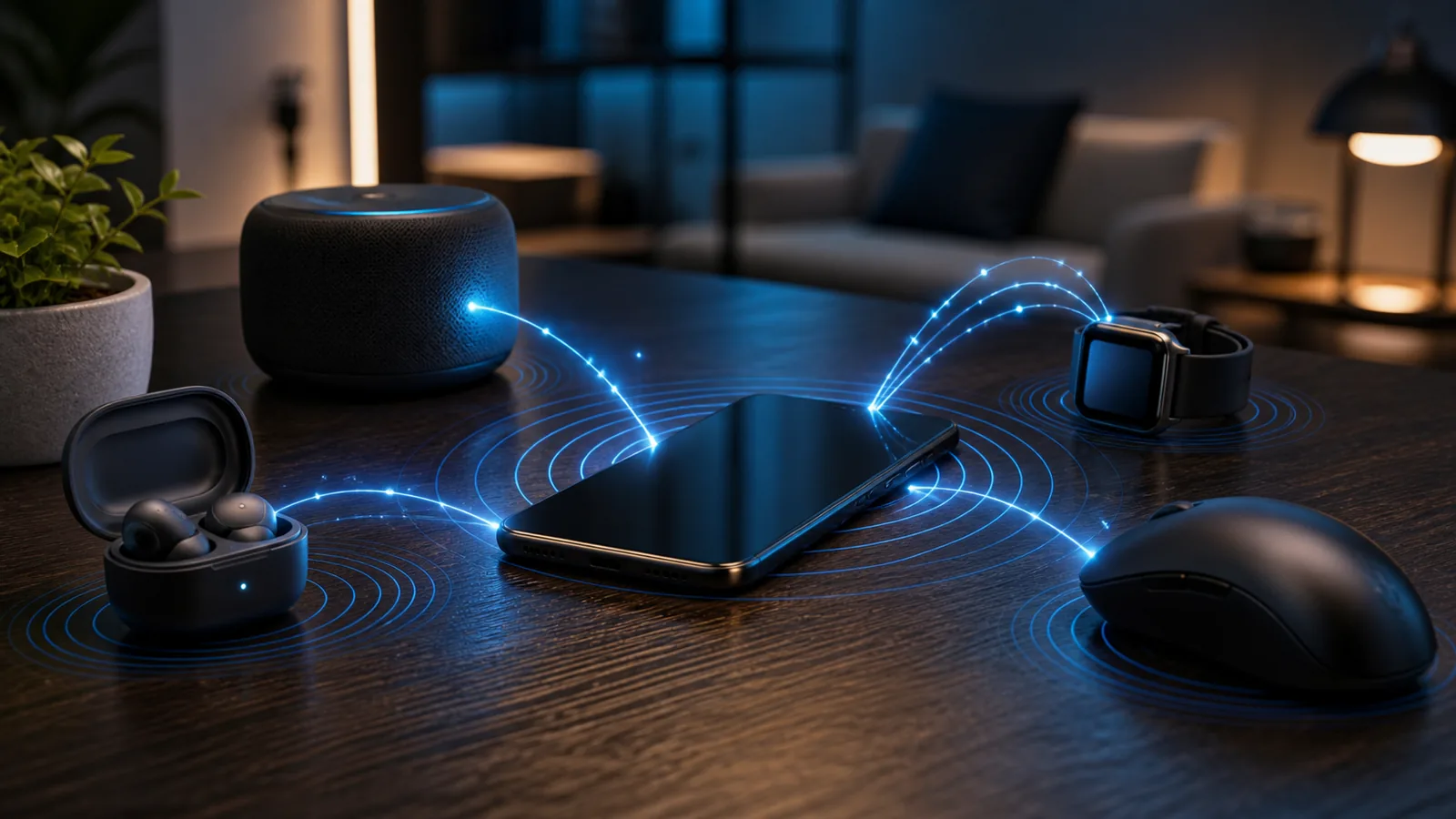
Visual answer
How Two Devices Connect Over Bluetooth
From switching Bluetooth on to data flowing wirelessly, the six steps that happen in seconds.
Bluetooth switches on
Both devices activate their Bluetooth radios and begin broadcasting a short signal that says, in effect, I am here.
Devices discover each other
One device scans for nearby Bluetooth signals and finds the other. The two devices exchange basic identification information.
Pairing request is sent
One device asks the other to connect. Depending on the devices, a PIN or confirmation step confirms both sides agree.
Secure connection is established
The devices perform a security handshake and encrypt the connection so other devices cannot intercept the data.
Data is transmitted
Audio, movement, sensor data, or files travel wirelessly as radio signals across the 2.4 GHz frequency band.
Connection is remembered
Both devices save the pairing. Next time they are near each other, they reconnect automatically without needing to go through the process again.
How it works
How Does Bluetooth Work?
Bluetooth is a way of sending data wirelessly over a short distance using radio waves. That is it. There are no wires, no cables, no internet connection required. Just two devices, each fitted with a small radio transmitter and receiver, talking to each other through the air.
The radio waves Bluetooth uses operate at 2.4 GHz, the same general band as many Wi-Fi networks and microwave ovens. To avoid interference, Bluetooth constantly shuffles between 79 different sub-frequencies up to 1,600 times per second. This technique is called frequency hopping. It means that even in a room full of wireless signals, your headphones stay locked onto your phone and nothing else.
The range is short by design, typically up to 10 metres for everyday devices, though some specialist Bluetooth hardware can reach much further. The limited range is partly what makes it power-efficient, which is why Bluetooth devices can run for hours on a tiny battery.
How pairing works
How Does Bluetooth Pairing Work?
Pairing is the handshake that happens before two devices start trusting each other. When you put a pair of headphones into pairing mode, they start broadcasting a signal that says they are available. Your phone scans nearby frequencies, spots the headphones, and the two devices swap identifying information.
For some devices, a PIN or a tap-to-confirm step checks that a human on each side agrees to the connection. For simpler devices like keyboards or headphones, the confirmation is minimal. For devices handling sensitive data, like medical equipment, the security handshake is more rigorous.
Once paired, both devices remember each other. The phone saves the headphones. The headphones save the phone. The next time they come within range, the connection happens automatically, usually in seconds, without you doing anything at all.
Sending data wirelessly
How Does Bluetooth Send Data Through the Air?
Every sound, movement, or file that travels over Bluetooth is converted into a stream of binary data, ones and zeros. That stream is then used to modulate a radio wave, which means it slightly changes the wave's properties in a pattern that encodes the data.
The receiving device's antenna picks up that radio wave, reads the pattern, and converts it back into something useful, music in your ears, a cursor moving on screen, a sensor reading on an app.
The 2.4 GHz frequency Bluetooth uses is a good middle ground: it passes through air easily, requires relatively little power to transmit, and the short wavelength means the antennas can be tiny enough to fit inside a chip the size of a fingernail.
Headphones, speakers and more
How Does Bluetooth Work With Headphones, Speakers, Mice and Other Devices?
Headphones receive a stream of compressed audio data from your phone or laptop. A tiny chip inside decodes it back into an audio signal and drives the speakers in your ear cups. The delay is usually so small, a few milliseconds, that your brain cannot detect it.
Bluetooth speakers work the same way as headphones, just through a larger driver. The speaker receives the audio stream wirelessly and plays it through its own amplifier and speaker cone. Some Bluetooth speakers also connect to multiple devices at once and let you switch between them.
A Bluetooth mouse sends movement data and click events to a receiver chip in your computer. The data packets are tiny and the transmission is near-instant, so the lag is imperceptible during normal use.
Bluetooth hearing aids connect to phones and TVs to stream audio directly into the ear canal, bypassing background noise. This works through a profile called LE Audio, a newer Bluetooth standard designed for low-latency, low-energy audio streaming.
Bluetooth trackers like Apple AirTag or Tile work slightly differently. They emit a regular Bluetooth signal that other nearby devices detect passively. Those devices anonymously report the tracker's location to a network, which lets the owner see roughly where their lost item is, without the tracker needing a GPS chip or mobile data of its own.
No Wi-Fi needed
Does Bluetooth Need Wi-Fi or Internet?
Bluetooth and Wi-Fi are two completely separate things that happen to use the same frequency band. Wi-Fi connects your device to a router, which connects to the internet. Bluetooth connects your device directly to another device nearby. One is about reaching the world. The other is about talking to whatever is in the same room.
You can use Bluetooth headphones, speakers, mice, keyboards, and file transfers with no Wi-Fi and no internet connection at all. The signal goes straight from device to device, the router is not involved.
The confusion comes because many devices do both. Your phone has Wi-Fi and Bluetooth built in, and both use radio waves. But they are separate radios running separate protocols. Turning off Wi-Fi does not turn off Bluetooth, and vice versa.
Through walls
How Does Bluetooth Work Through Walls?
Radio waves at 2.4 GHz can pass through most building materials, plasterboard, wood, glass, and thin brick. This is why you can often use Bluetooth headphones while your phone sits in another room. The signal weakens as it passes through obstacles, but for typical domestic walls it usually weakens rather than disappears entirely.
Concrete, metal, and water are much more problematic. Dense materials absorb or reflect radio waves and can reduce Bluetooth range significantly. A phone sitting inside a metal drawer, for example, may not be reachable at all.
Human bodies also absorb 2.4 GHz signals, which is why Bluetooth range can drop when there are lots of people between devices. In a crowded space, your 10-metre signal might effectively feel like 3 or 4 metres.
Planes, water and space
Does Bluetooth Work in Airplane Mode, Water, or Even Space?
Airplane mode on most modern phones turns off cellular and Wi-Fi but allows you to manually re-enable Bluetooth. Airlines increasingly permit Bluetooth headphones during flights because the signal is short-range and does not interfere with aircraft systems. Many planes now even have in-seat Bluetooth pairing built in.
Water is very effective at absorbing 2.4 GHz radio waves. Bluetooth signals degrade extremely quickly underwater, typically within a centimetre or two of the surface. Waterproof Bluetooth speakers work fine poolside, but once submerged, the signal is essentially gone. Specialist underwater communication systems exist, but they use very different frequencies.
In space, Bluetooth would technically work between two devices in the same pressurised module, radio waves travel fine in a vacuum and through the air inside a spacecraft. Astronauts on the International Space Station do use Bluetooth devices. The challenge is range, not physics. Step outside into a vacuum and the question becomes less about Bluetooth and more about other problems.
The Viking king
Why Is Bluetooth Called Bluetooth?
In the late 990s, a Danish king named Harald Gormsson united the warring tribes of Denmark and Norway under a single rule. He was known by a nickname, Blåtand in Old Norse, which roughly translates as Bluetooth. The story goes that he had a conspicuously dark or discoloured tooth, though historians debate the exact origin of the name.
In 1996, engineers at Intel, Nokia, and Ericsson were working on a short-range wireless standard to connect devices the way Harald had connected kingdoms. A Swedish engineer named Jim Kardach proposed Bluetooth as a working codename. It was only supposed to be temporary. It stuck.
The Bluetooth logo is Harald's initials in runic script, the Younger Futhark runes for H and B, merged into a single symbol. Every time you see that logo on a device, you are looking at a thousand-year-old Viking king's monogram.
Misconception
Common Misconception
What people think
Bluetooth uses the internet to connect devices.
Bluetooth uses the internet to connect devices.
What actually happens
Reality
Bluetooth is a direct device-to-device radio connection. It does not touch your router, your network, or the internet. You can use Bluetooth completely offline, on a plane, in a field, or anywhere with no signal at all.
Quick answers
Common questions
Does Bluetooth work without Wi-Fi? +
Yes, completely. Bluetooth is its own separate radio system. It connects devices directly to each other without involving a router or a network. You can use Bluetooth headphones, speakers, and keyboards with Wi-Fi switched off entirely.
Does Bluetooth work without internet? +
Yes. Bluetooth does not use the internet at all. It is a short-range local connection between two devices. Playing music through Bluetooth headphones, using a Bluetooth mouse, or transferring files over Bluetooth all work with no internet connection.
How does Bluetooth pairing work? +
Pairing is a one-time process where two devices exchange identifying information, confirm the connection is intentional, and set up an encrypted link. Once paired, both devices remember each other and reconnect automatically whenever they are in range.
How does Bluetooth work with headphones? +
Your phone compresses the audio and sends it as a stream of data over a radio signal. A chip inside the headphones receives the signal, decodes it, and drives the speakers. The whole process takes a few milliseconds, too fast for the human ear to notice.
How far can Bluetooth reach? +
Standard Bluetooth in everyday devices like headphones and speakers typically reaches up to 10 metres in open air. Some Bluetooth 5.0 devices can reach up to 40 metres or more. Walls, metal, and dense materials reduce the effective range.
Can Bluetooth pass through walls? +
Often yes, through lightweight materials like plasterboard and wood. The signal weakens but does not disappear. Concrete, metal, and water are more challenging and can block the signal significantly over short distances.
Why is Bluetooth called Bluetooth? +
It is named after Harald Bluetooth, a tenth-century Danish king who united Scandinavia. The name was chosen because the technology was designed to unite devices the way he united kingdoms. The logo is his initials in runic script.
Does Bluetooth work underwater? +
Not practically. Water absorbs 2.4 GHz radio waves very effectively. Bluetooth signal degrades within centimetres of the water surface. Waterproof Bluetooth speakers work fine next to water, but submerge them and the signal is gone.