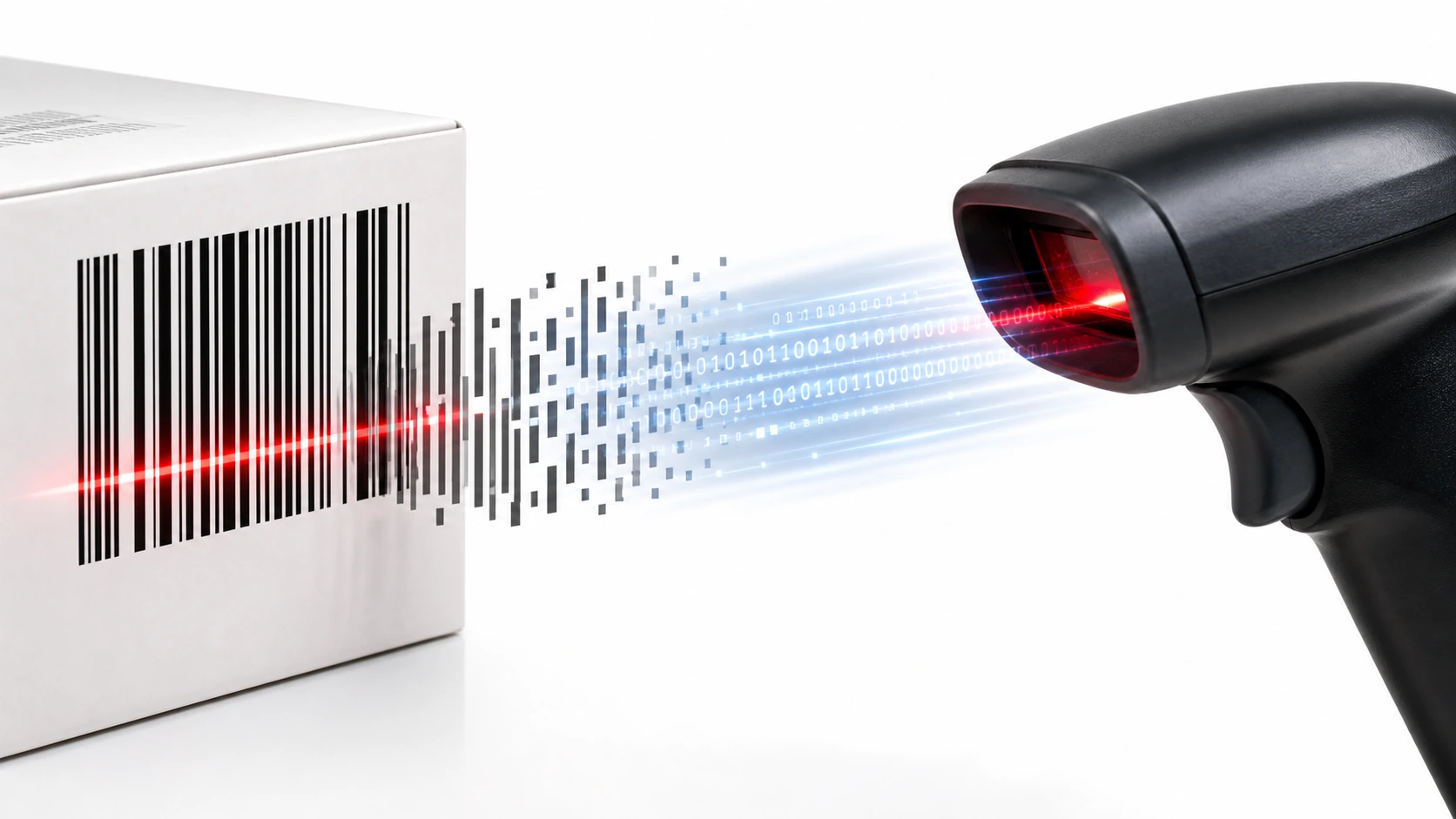
Visual answer
Barcode Structure
Guard bars, number patterns, quiet zones, and a check digit let scanners decode and validate a product identifier reliably.
Light hits the code
A laser or camera illuminates the bars and spaces.
Reflection varies
White spaces reflect; black bars absorb.
Widths are measured
The scanner reads transitions and relative widths.
Digits are decoded
Patterns map to numbers using barcode rules.
Checksum validates
The scanner verifies the final digit against the rest.
Database lookup happens
The number retrieves product, price, and inventory data.
Answer
The Quick Answer
Barcodes encode numbers as patterns of black bars and white spaces. A scanner reads reflected light, converts the pattern into digits, validates it with a check digit, and looks up the product in a database.
A pattern of black lines scanned for a tenth of a second can tell a machine everything it needs to know about a product.
Mechanism
From Light To Number To Product
A barcode is a printed lookup key for a database.
- 1
Light hits the code
A laser or camera illuminates the bars and spaces. Analogy: A flashlight across piano keys.
- 2
Reflection varies
White spaces reflect; black bars absorb. Analogy: Loud and quiet echoes.
- 3
Widths are measured
The scanner reads transitions and relative widths. Analogy: Morse code with printed bars.
- 4
Digits are decoded
Patterns map to numbers using barcode rules. Analogy: A combination lock for each digit.
- 5
Checksum validates
The scanner verifies the final digit against the rest. Analogy: Built-in spellcheck.
- 6
Database lookup happens
The number retrieves product, price, and inventory data. Analogy: A library card number pointing to a record.
Curiosities
Details That Make It Stranger
These are the facts that turn the simple explanation into a better story.
The original was circular
Early barcode concepts used bull's-eye patterns inspired by Morse code.
Hospitals scan patients
Medical wristbands reduce wrong-patient and medication errors.
Phones use image processing
Camera scanning can decode skewed or poorly lit codes.
RFID has tradeoffs
RFID tracks items without line of sight, but costs more than printed codes.
Story
The Engineer Who Drew In Sand
Norman Woodland reportedly dragged his fingers through beach sand while thinking about Morse code and grocery checkout, seeing how lines could encode information.
The idea arrived decades before scanners and computers were cheap enough to make it universal.
Hidden mechanism
The Supply Chain Encoded In A Number
Barcode standards let products be identified consistently across manufacturers, warehouses, stores, and checkout systems.
The deeper insight
The barcode did not just speed checkout. It helped make modern inventory and global retail coordination practical.
Myths
Common Myths
What people think
The barcode contains the price
The barcode contains the price
What actually happens
Reality
The price lives in a database. The barcode usually contains only a product identifier.
Another Misconception
What people think
Every item has a unique barcode
Every item has a unique barcode
What actually happens
Reality
Standard retail barcodes identify product type, not each individual object.
Quick answers
Common questions
Can two products share a barcode? +
Standards aim to prevent this, but counterfeit or mistaken labels can cause conflicts.
Barcode versus QR code? +
A barcode is one-dimensional; a QR code stores data in two dimensions.
Why do barcodes fail? +
Damage, poor contrast, distortion, or missing quiet zones are common causes.
Will RFID replace barcodes? +
RFID will grow, but printed barcodes remain cheaper and simple.