Quick Facts
Quick Facts
Hawking was given two years to live when he was diagnosed with ALS. He lived 55 more years.
He was the Lucasian Professor of Mathematics at Cambridge, a chair once held by Isaac Newton.
His book 'A Brief History of Time' sold over 25 million copies.
He appeared on 'The Simpsons,' 'Star Trek: The Next Generation,' and 'The Big Bang Theory.'
He famously held a party for time travelers. No one showed up.
Visual answer
The Legacy of Stephen Hawking
His contributions to science and culture.
Hawking Radiation
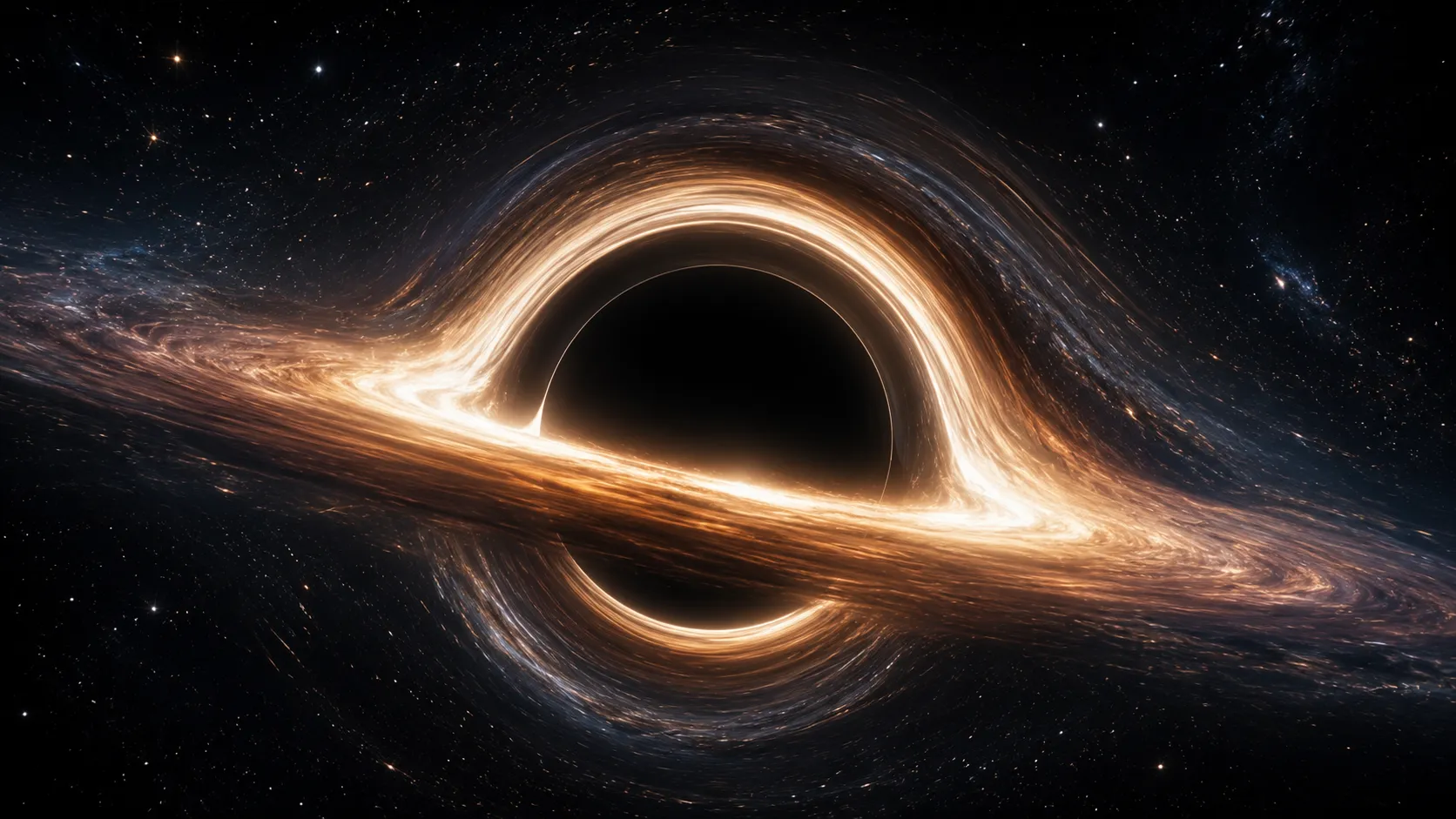
Black holes are not completely black. They emit radiation and eventually evaporate.
Singularity Theorems
With Roger Penrose, he proved that the universe began as a singularity (the Big Bang).
A Brief History of Time
The bestselling science book of all time. It made cosmology accessible.
Pop Culture Icon
He appeared in TV shows, movies, and commercials. He was a celebrity.
Symbol of Courage
His battle with ALS inspired millions. He refused to give up.
Story in brief
Story in Brief
1963
Hawking is diagnosed with ALS. He is 21 years old. He is given two years to live.
He falls into a depression. Then he meets his future wife, Jane. He decides to work.
1974
Hawking proposes that black holes emit radiation. The idea is controversial. It later becomes known as Hawking radiation.
1979
Hawking becomes the Lucasian Professor of Mathematics at Cambridge.
The chair was once held by Isaac Newton. Hawking has reached the pinnacle of British science.
1988
A Brief History of Time is published. It becomes an international bestseller.
Hawking becomes a global celebrity. He appears on TV. He is recognized on the street.
2000s-2010s
Hawking makes cameo appearances on 'The Simpsons,' 'Star Trek,' and 'The Big Bang Theory.'
2018
Hawking dies at age 76. He lived 55 years longer than doctors predicted.
He is buried in Westminster Abbey, near Isaac Newton and Charles Darwin.
The Story
How a Scientist Became a Superstar
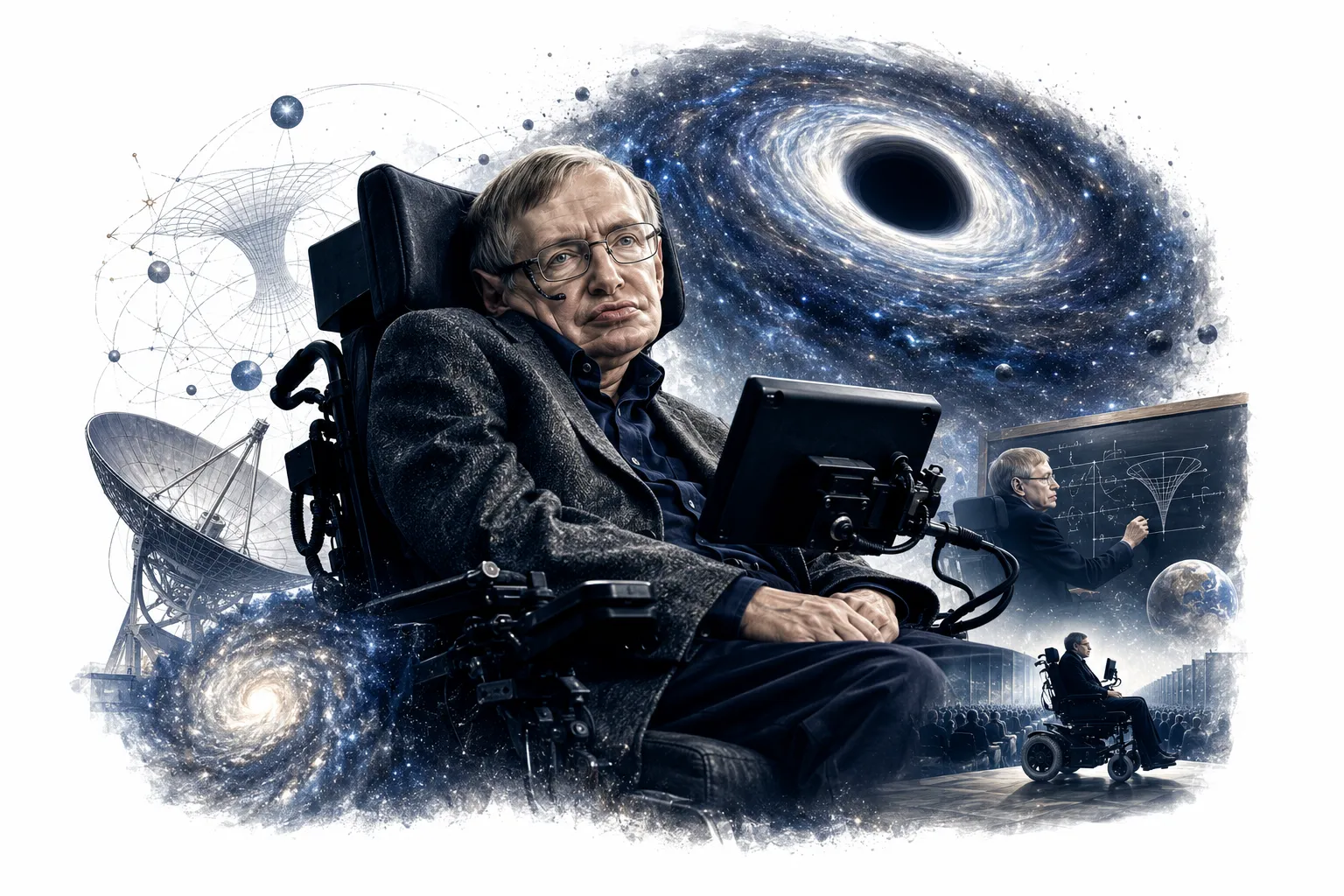
Stephen Hawking was a theoretical physicist. He studied black holes, the Big Bang, and the nature of time. His most famous discovery, Hawking radiation, showed that black holes are not completely black. They emit radiation and eventually evaporate. It was a revolutionary idea.
But Hawking was not famous just because he was a great physicist. Many physicists are great. Hawking was famous because he could explain his work to ordinary people. He wrote 'A Brief History of Time,' a book about cosmology that sold over 25 million copies. People who knew nothing about physics bought it, read it, and felt smarter.
He was also famous because of his disability. He had ALS. He could not walk, talk, or move most of his body. He communicated through a computer that tracked his eye movements. He used that computer to write books, give lectures, and appear on TV. He became a symbol of courage. He showed that a mind could be free even when the body was trapped.
Famous Quote
"However difficult life may seem, there is always something you can do and succeed at."
, Stephen Hawking
He lived this philosophy. He was given two years to live. He lived 55 more. He did more than most people with full mobility.
Evidence
Why Hawking Is Remembered
His discovery of Hawking radiation revolutionized black hole physics.
StrongA Brief History of Time is one of the bestselling science books ever.
StrongHis battle with ALS made him a global symbol of courage.
StrongHis pop culture appearances made him a household name.
StrongKey Points
Key Points So Far
Hawking discovered that black holes emit radiation (Hawking radiation).
He wrote 'A Brief History of Time,' a bestselling book about cosmology.
He had ALS and was given two years to live at age 21. He lived to 76.
He became a pop culture icon, appearing on TV shows.
He was buried in Westminster Abbey near Isaac Newton.
Analogy
Like a Prisoner Who Escapes Through Thought
The familiar part
Imagine a prisoner in solitary confinement. He cannot move. He cannot speak. But his mind is free. He thinks. He imagines. He creates.
How it applies
That was Hawking. His body was a prison. His mind was free. He explored the universe from a wheelchair. He did not need to walk. He needed to think.
Where the analogy breaks
Prisoners eventually are released. Hawking's body was never released. He died in the prison. But his mind escaped every day.
Curiosity Notes
Details Most People Miss
Why this still matters
Why This Still Matters
Stephen Hawking is still famous because he was a symbol. A symbol of intelligence. A symbol of courage. A symbol of the power of the human mind. He showed that a body does not have to be free for the mind to be free. He showed that science can be exciting. He showed that a physicist can be a rock star. That is his legacy. Not just his discoveries. His example.
Key Findings
- ✓Core findingHawking discovered Hawking radiation, which showed that black holes emit radiation.
- ✓Strong evidenceHe wrote 'A Brief History of Time,' a bestselling science book.
- ⚠Main consequenceHe had ALS and was given two years to live at age 21. He lived to 76.
- ✓Wider legacyHe became a pop culture icon, appearing in TV shows and movies.
- ★Bottom lineHe was buried in Westminster Abbey near Isaac Newton.
Final insight
A Last Thought
Stephen Hawking was famous because he explained the universe. He was also famous because he did it from a wheelchair. He was given two years to live. He lived 55 years. He wrote books that sold millions. He appeared on 'The Simpsons.' He was buried next to Newton. He did not let his body stop him. That is the lesson. Not just about physics. About life. Hawking did not have a choice about his body. He had a choice about his mind. He chose to use it. That is why we remember him.
Quick answers
Common questions
What is Hawking radiation? +
The theoretical radiation that black holes emit. It causes black holes to slowly lose mass and eventually evaporate. It has never been directly observed, but most physicists believe it exists.
Did Stephen Hawking win a Nobel Prize? +
No. The Nobel Prize is usually awarded for discoveries that have been experimentally confirmed. Hawking radiation has not been observed. Many physicists think he deserved one anyway.