Visual answer
Freud's Model: Repression, Symptoms, and Sublimation
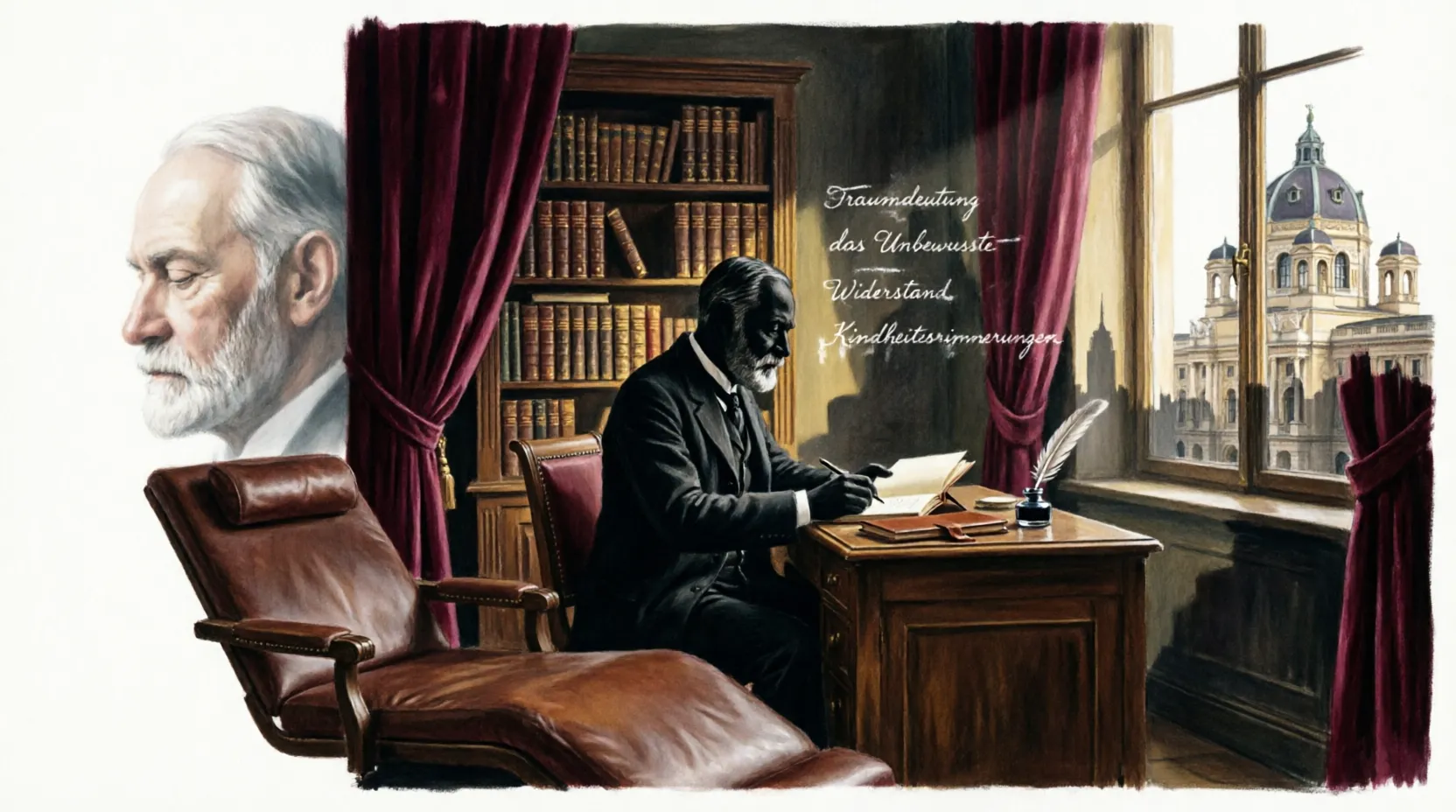
In Freud's view, repressed sexual energy leads to neurotic symptoms, disguised expression in dreams, or redirection into creativity (sublimation).
Victorian Society
Rigid suppression of sexuality in public life.
Repression
Unconscious burial of forbidden desires.
Libido
The underlying psychic energy that must be discharged.
Outcomes
Neurotic symptoms, dreams (disguised expression), or sublimation (art, ambition).
Short answer
The Short Answer
Freud was not personally fixated on sex in the way the question implies. He was a neurologist who noticed a pattern.
His patients - mostly middle-class women in Vienna during the 1880s and 1890s - kept presenting with mysterious symptoms. Paralysis with no physical cause. Obsessive thoughts. Irrational fears. Recurring nightmares. When Freud talked with them deeply and carefully, sexual experiences and desires kept surfacing.
His conclusion: sexuality was not just one part of human psychology. It was the central engine.
That conclusion was deeply shaped by his time and place. Freud worked in a society where sexuality was almost entirely suppressed in public life. He believed this suppression was the cause of enormous psychological suffering. And he built an entire theory of the human mind around that belief.
Was he right? Partly. Was he wrong about some things? Significantly. But to understand why Freud became so associated with sex, you have to understand the world that made him think that way.
Why he seemed obsessed
Why Freud Seemed Obsessed With Sex
Freud's reputation as being obsessed with sex comes from one central pattern in his work: when in doubt, his theories traced problems back to sexuality.
Nightmares about falling? Sexual symbolism. Fear of snakes? Sexual symbolism. Forgetting someone's name? A suppressed sexual association. A child's love for its mother? An early form of sexual attachment. Ambition, creativity, artistic achievement? Redirected sexual energy.
Reading Freud today, it is easy to roll your eyes. The sheer relentlessness of it looks like a man who found his hammer and decided everything was a nail.
But there is a logic behind the pattern that made sense in its historical moment.
Freud believed sexuality was the most powerful force in human psychology - and the force most systematically suppressed by society. If the most powerful psychological force is also the one most violently pushed underground, then its effects would show up everywhere. It would distort dreams. It would create fears. It would block memories. It would emerge sideways in behaviors that seemed to have nothing to do with sex at all.
That is the argument. You do not have to accept it to understand why Freud kept returning to it. He thought he had found the hidden mechanism behind the entire range of human suffering. Once you believe that, sex shows up everywhere, because you are looking for it everywhere.
What he meant by sexuality
What Freud Actually Meant By Sexuality
Here is where most popular accounts of Freud go wrong.
When Freud talked about sexuality, he did not mean only adult physical desire. He meant something far broader.
Freud used the German word Sexualität to describe what he also called libido - a kind of psychic energy or life force that drives human beings toward pleasure, connection, and vitality. In his framework, libido is present from early childhood. It does not begin at puberty. It shapes behavior from infancy onward.
This is why Freud wrote about infant sexuality, oral and anal stages, and the emotional attachments of very young children to their parents. He was not describing what people today would recognize as sexual behavior. He was describing the earliest forms of pleasure-seeking and emotional bonding that he believed laid the foundation for adult psychology.
Critics then and now found this framework unconvincing - and sometimes offensive. But it is important to understand that Freud was not claiming infants experience adult sexuality. He was claiming that the energy underlying adult sexuality has its roots in very early childhood experiences of pleasure and emotional connection.
Whether you find that persuasive or not is a separate question. But if you only understand Freud as the man who thought everything was about sex in the crude popular sense, you are missing what he was actually arguing.
Victorian Vienna
The World Freud Grew Up In
To understand Freud's fixation on sexuality, you have to understand 19th-century Vienna.
The Victorian era - roughly 1837 to 1901, though its social attitudes extended well into the 1900s - was a period of rigid moral propriety in much of Europe. Sexuality was discussed as little as possible in polite society. Women were expected to be sexually passive and morally pure. Men were supposed to control themselves. Any deviation from these ideals carried enormous social shame.
But the reality underneath that propriety was something else entirely. Freud's patients were people who had grown up in a world that denied and suppressed human sexuality at every turn. And many of them were suffering psychologically in ways that conventional medicine could not explain.
Freud came to believe the gap between what society required and what human beings actually experienced was causing mass psychological harm. The repression itself was the wound. People could not acknowledge their own desires, even to themselves - and that suppression was curdling into anxiety, obsession, and physical symptoms.
This is the context that made Freud's theory feel not merely interesting but urgent. He was not writing about sexuality for shock value or personal titillation. He was writing about a medical crisis he believed he could see all around him, caused by the society he lived in.
Libido
The Idea Of Libido
Libido is one of the most important and most misunderstood concepts in Freud's work.
In everyday English, libido has come to mean sex drive - a person's level of interest in physical sexual activity. When people say their libido is low, they mean they are not feeling particularly interested in sex.
Freud meant something considerably larger.
For Freud, libido was psychic energy - a force that drives human beings toward life, pleasure, connection, and creativity. Think of it less like a sex drive and more like a battery that powers the entire human psychological system. When that battery is healthy and discharging normally, a person functions well. When it is blocked, suppressed, or misdirected, it causes psychological symptoms.
Freud believed libido could be redirected - a process he called sublimation. When sexual energy cannot be expressed directly, it gets channeled into other activities. A great artist might be sublimating enormous libidinal energy into creative work. A driven entrepreneur might be channeling the same energy into ambition.
This is why Freud connected sexuality to almost everything in human life. It was not that he thought art, ambition, and creativity were literally about sex. It was that he thought they were powered by the same underlying energy - and that energy had a sexual origin.
Modern psychology does not accept the libido concept as Freud framed it. But the broader idea that blocked drives can be redirected into other behaviors has survived in more limited, evidence-based forms.
Psychosexual stages
Freud's Psychosexual Development Theory
Freud's most controversial contribution - and one of the most frequently criticized - was his theory of psychosexual development.
He proposed that children pass through a series of developmental stages in which different parts of the body become the focus of pleasure and psychological energy. He named these the oral stage, the anal stage, the phallic stage, the latency period, and the genital stage.
In the oral stage, roughly the first year of life, an infant's psychological world is centered on the mouth - feeding, sucking, and oral stimulation. In the anal stage, attention shifts to control and release. In the phallic stage, roughly ages three to six, children become aware of their own genitals and, according to Freud, develop complex emotional attachments to the parent of the opposite sex.
The phallic stage is where Freud introduced the Oedipus complex - his theory that young boys develop an unconscious attachment to their mothers and see their fathers as rivals. He proposed a parallel but less developed theory for girls, sometimes called the Electra complex.
The idea that small children have anything resembling these emotional dynamics struck many people as outrageous when Freud proposed it. It strikes many people as outrageous today.
Modern developmental psychology does not support the specific stages Freud proposed, and the Oedipus complex in particular is widely rejected as a universal developmental stage. But the broader idea that early childhood experiences shape adult emotional patterns remains a cornerstone of developmental psychology, even if the mechanisms Freud proposed are not accepted.
Childhood matters
Why Freud Connected Childhood To Adult Life
One of Freud's most lasting contributions - and one that has survived far better than his sexual theories - is the idea that adult psychology is shaped by early childhood experience.
Before Freud, mainstream medicine tended to treat psychological disorders as diseases of the brain or nervous system, often with a biological or hereditary cause. The idea that a woman's paralysis might have its roots in something she experienced as a child, or in a relationship dynamic she could not consciously acknowledge, was not a mainstream medical position.
Freud changed that.
He argued that the experiences of early childhood leave lasting imprints on the psyche. That unresolved emotional conflicts from childhood do not simply disappear - they get pushed into the unconscious and continue to shape behavior from there. That the relationship between a child and its parents creates patterns that play out in adult relationships, sometimes for a lifetime.
This framework - not the specific sexual stages, but the general principle that childhood shapes adult life - has been enormously influential. Attachment theory, developed by John Bowlby in the mid-20th century, is one of the most well-supported theories in modern psychology. It describes how the quality of early bonds between children and caregivers shapes emotional functioning across an entire lifespan. It is not Freudian theory, but it owes something to the intellectual tradition Freud helped establish.
The specific mechanisms Freud proposed have not survived scientific scrutiny. The basic insight that early life matters enormously has.
Myths vs reality
Common Misconceptions About Freud
What people think
Freud thought everything was about sex in a crude physical sense
He believed all human behavior reduces to sexual intercourse.
What actually happens
He used 'sexuality' to mean a broad life force called libido
Libido included pleasure-seeking, emotional bonding, creativity, and ambition - not just physical acts.
Controversy
Why Freud Became So Controversial
Freud attracted intense criticism from multiple directions, and he still does.
From the scientific side, the central problem is that Freudian theories are very difficult to test. What experiment could confirm or disprove the Oedipus complex? What measurement could verify the existence of the id, ego, and superego? Science requires hypotheses that can be tested and potentially disproven. Many of Freud's central claims resist that kind of testing almost by design.
The philosopher Karl Popper used Freudian theory as one of his primary examples of pseudoscience - a system of thought so flexible that it could explain any outcome, which meant it actually explained nothing in a scientific sense.
From the feminist side, Freud's theories about women have been widely criticized as reflecting Victorian prejudice rather than scientific observation. His claim that women suffer from penis envy - a belief that girls feel psychologically incomplete because they lack male anatomy - has been almost universally rejected. His tendency to dismiss his female patients' reports of sexual abuse as fantasy rather than fact has been criticized as a serious ethical and scientific failure.
From within psychology itself, controlled studies have repeatedly failed to support many of Freud's specific claims. The particular stages of psychosexual development have not held up. The hydraulic model of libido has not held up. Dream analysis as a reliable window into the unconscious has not held up.
And yet Freud remains one of the most cited and discussed figures in the history of psychology. Why?
Modern psychology
What Modern Psychology Thinks Today
Modern psychology has largely moved on from Freud in terms of specific mechanisms, while retaining some of his broader frameworks.
The idea of the unconscious - that much of mental processing happens outside conscious awareness - is now well supported by neuroscience and cognitive psychology. The specific Freudian unconscious, populated by repressed desires and governed by id, ego, and superego, is not what modern researchers mean by unconscious processing. But the basic insight that consciousness is only a partial window into mental life has survived.
The idea that early childhood experiences have lasting effects on adult emotional life is well supported. Attachment research, adverse childhood experiences studies, and developmental neuroscience all confirm that the early years matter enormously. The mechanism Freud proposed is not the accepted one, but the empirical finding is consistent with his general direction.
The idea that defense mechanisms exist - that people use psychological strategies like denial, projection, and rationalization to manage uncomfortable emotions - has survived in modified form. The specific mechanisms Freud named are still used in clinical contexts, even if the theoretical framework around them has changed.
What has not survived well: the specific sexual stages, the Oedipus complex as a universal developmental experience, libido as a hydraulic energy system, dream interpretation as a reliable clinical tool, and the broad claim that sexuality underlies all human motivation.
Modern psychology is a much more empirically grounded discipline than Freud practiced. It relies on controlled experiments, measurable outcomes, and replication. By those standards, much of Freud's specific output fails. By the standard of intellectual influence on how Western culture understands itself, he remains enormous.
Surviving ideas
Which Freud Ideas Survived
The parts of Freud's legacy that have genuinely survived - in modified, evidence-tested form - are worth knowing.
The unconscious matters. Not the Freudian unconscious exactly, but the principle that a great deal of mental processing occurs below the level of conscious awareness. Priming studies, implicit bias research, and cognitive neuroscience all confirm this in ways Freud could not have imagined.
Defense mechanisms are real. The specific list Freud developed - repression, projection, rationalization, displacement - describes patterns that therapists and researchers still find useful. The theoretical framework around them has changed; the observed patterns have not.
The therapeutic relationship matters. One of Freud's lasting contributions is the insight that the relationship between therapist and patient is itself a therapeutic tool. The concept of transference - the way patients bring their emotional patterns from past relationships into the therapeutic relationship - is still taken seriously in clinical psychology.
Talk therapy works. Freud did not invent conversation as a medical treatment, but he did more than anyone else to establish the principle that talking through psychological problems with a trained listener produces genuine relief. Modern cognitive behavioral therapy, psychodynamic therapy, and many other approaches all trace part of their lineage to that basic Freudian innovation.
Early experience shapes development. The specific mechanism Freud proposed is not accepted, but the empirical finding is robust. What happens to children in their earliest years leaves marks. Freud was right about the importance of that territory, even if his map of it was wrong.
Legacy summary
What Survived and What Didn't
Survived (in modified form)
Unconscious processing, defense mechanisms, importance of early childhood, talk therapy, therapeutic relationship (transference).
Did not survive
Psychosexual stages (oral, anal, phallic, etc.), Oedipus complex as universal, libido as hydraulic energy, dream interpretation as clinical tool, penis envy, sexuality as root of all motivation.
Was he wrong?
Was Freud Wrong About Everything?
No. But he was wrong about a significant portion of what he claimed with great confidence.
The fairest summary is probably this: Freud was a brilliant and courageous thinker who asked the right questions in roughly the right direction, but whose specific answers were shaped as much by the cultural biases and methodological limitations of his time as by careful science.
He was right that the unconscious mind is real and powerful. He was wrong about the specific hydraulic energy model he used to describe it.
He was right that childhood experiences shape adult psychology. He was wrong about the specific sexual stages and complexes he proposed.
He was right that sexuality was systematically suppressed in Victorian society and that this suppression caused harm. He may have been wrong to conclude that sexuality was the root cause of essentially all psychological suffering.
He was right that talking through problems can heal. He was wrong to think his interpretations of those conversations were scientifically reliable.
What makes Freud so enduring is not the correctness of his theories. It is that he changed the questions we ask about ourselves. Before Freud, the inner life of the individual - their desires, fears, childhood experiences, and unconscious patterns - was not the central subject of medicine. After Freud, it was.
That shift in what we consider important about human beings is his most lasting achievement. And it happened, for better and worse, primarily through his sustained, relentless focus on sexuality as the hidden engine of human life.
Quick answers
Common questions
Why was Sigmund Freud so sexual? +
Freud believed repressed sexuality was the primary cause of psychological disorders in his Victorian patients. He concluded from clinical observation that sexuality - which he defined as a broad life force called libido - was the central engine of human psychology, and that suppressing it caused enormous harm.
Was Freud obsessed with sex? +
In a clinical sense, yes - he believed sexuality was the dominant force in human psychology. But he was not personally salacious. He was a neurologist who concluded from his patients that sexual repression was causing widespread psychological suffering.
What is Freud's psychosexual theory? +
Freud proposed that children pass through developmental stages - oral, anal, phallic, latency, genital - during which different body areas become the focus of psychological energy. Most of these specific claims are not accepted by modern developmental psychology.
Why was Freud controversial? +
Freud claimed that unconscious sexual forces controlled human behavior, that children had a form of sexuality from infancy, and that society's repression of sexuality caused mass psychological suffering. These ideas violated Victorian norms and have faced serious scientific criticism.
What is libido? +
In everyday usage, libido means sex drive. In Freud's original theory, libido was a psychic energy or life force that drives human beings toward pleasure, connection, and vitality - not just physical desire.
Do psychologists still believe Freud? +
Modern psychology has retained some broader insights - unconscious processing, importance of early childhood, defense mechanisms - while rejecting most specific claims like the psychosexual stages and the Oedipus complex.