Visual answer
Why crossing buttons feel useless
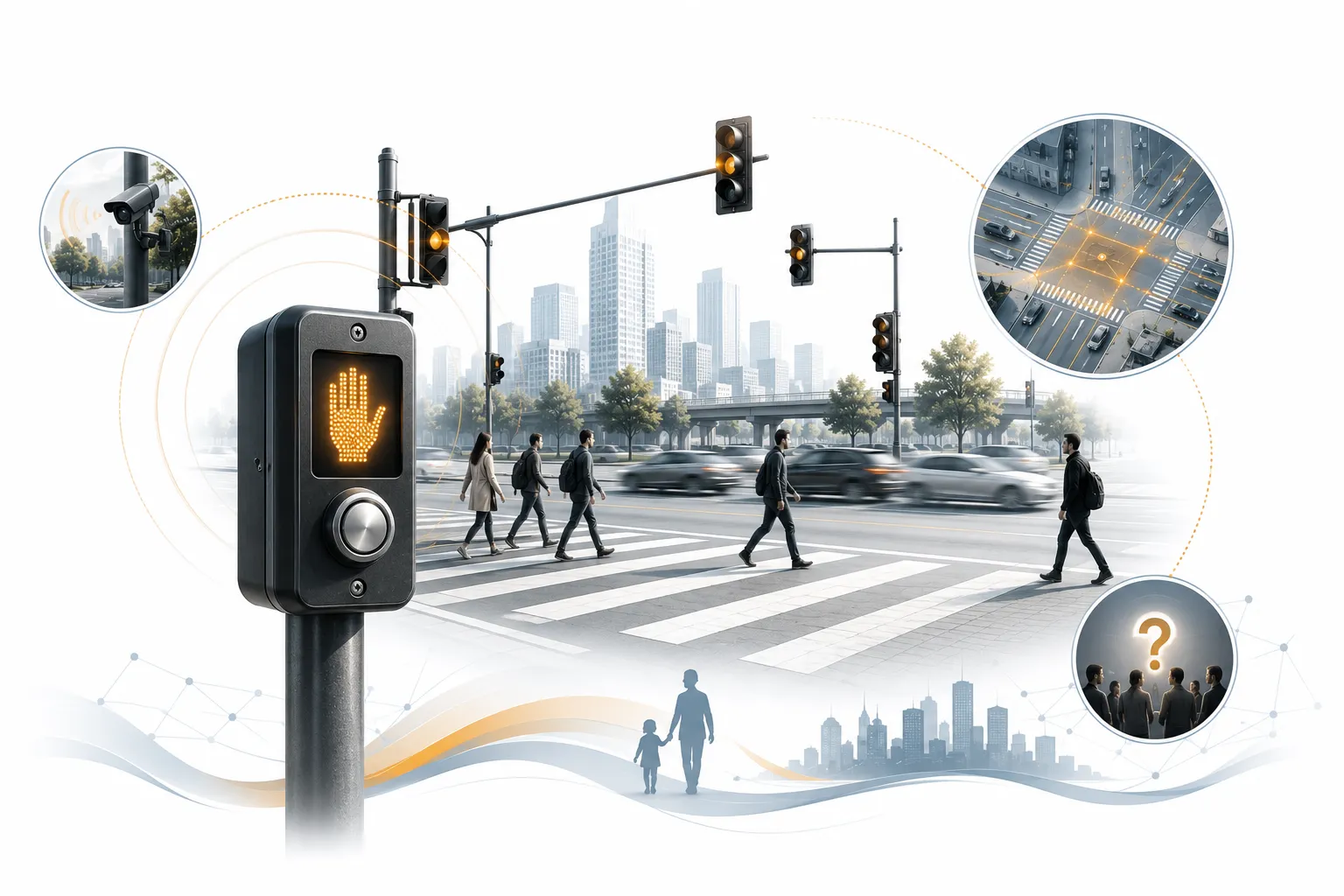
The diagram shows how a pedestrian press can be overridden by central traffic timing while still giving useful feedback to the person waiting.
Button press
The pedestrian signals a request and often gets a light, click, or beep in return.
Signal program
At busy junctions, the central timing plan may decide when the walk phase happens.
Perceived agency
Pressing something can make the wait feel more tolerable even when timing does not change.
The Placebo Story
The City That Left 2,500 Broken Buttons in the Ground
Current state
New York City's Department of Transportation confirmed in 2004 that the vast majority of the city's pedestrian crossing buttons had been deactivated when the city upgraded to computerised signal timing in the 1990s. More than 2,500 buttons were left in place but disconnected. They were cheaper to abandon than to remove.
What supports this
This is not unique to New York. Many large cities that have moved to centralised, computer-controlled traffic management systems have rendered their pedestrian buttons non-functional during peak hours. The central system calculates optimal traffic flow across the entire network, giving individual pedestrians the ability to trigger signals would disrupt that optimisation. However, many of these systems do reactivate the button functionality at night or during off-peak periods, when the crossing demand is low and the system has more flexibility to respond.
What could change this
There is a genuine debate in urban planning about whether responsive pedestrian signals are actually better for overall traffic flow. Some modern cities, particularly in Northern Europe, are experimenting with fully demand-responsive systems where buttons do always work, but the system is smart enough to balance the competing needs of pedestrians and vehicles in real time.
The Psychology
The Button Is a Kind Lie
The familiar part
Office thermostats in shared buildings are often locked so the central building management system controls the temperature. But fake thermostats are sometimes installed anyway, and studies have found that people in offices with dummy thermostats report feeling more comfortable than those with no thermostat at all, even though the temperature is identical.
How it applies
The pedestrian button works the same way. Pressing something, doing something, makes the wait feel more bearable. You have participated. You have registered your intention. The psychological sense of agency reduces the frustration of waiting, even when the button changes nothing.
Where the analogy breaks
If people know the button does nothing, the placebo effect disappears. Which is presumably why cities don't publicise the list of non-functional buttons.
Final insight
Agency Is Comfortable, Even When It's Imaginary
The placebo crossing button is a tiny but telling example of how design manages human psychology. The city needs to optimise traffic flow. You need to feel that your presence matters. The button satisfies both needs at once, at least until you know how it works.
Quick answers
Common questions
How can I tell if a crossing button is actually working? +
Most functioning buttons give a clear feedback signal, a clicking sound that speeds up when the button is active, or an illuminated indicator. If the button gives no feedback at all, it may be a placebo. But the most reliable indicator is whether pressing it appears to trigger a change in the light cycle timing.
Do crossing buttons ever work? +
Yes, particularly in smaller towns, suburban areas, and at off-peak times in cities. They're most likely to genuinely work when you're at a crossing that doesn't receive much pedestrian traffic and the signal wouldn't have triggered a walk phase at all without your input.