Quick Facts
Quick Facts
Oppenheimer was a brilliant student. He entered Harvard at 18 and graduated in three years.
He studied physics in Europe and returned to the US to teach at Berkeley and Caltech.
He was known for his charisma and his ability to explain complex ideas simply.
After the war, he lobbied for international control of nuclear weapons.
His security clearance was revoked in 1954 during the McCarthy era.
Visual answer
Oppenheimer's Path to the Bomb
From physicist to father of the atomic bomb.
1942
Oppenheimer is appointed scientific director of the Manhattan Project. He is 38 years old.
1943
Los Alamos Laboratory is established in New Mexico. Oppenheimer leads 6,000 scientists and staff.
July 16, 1945
Trinity test. The first atomic bomb is successfully detonated. Oppenheimer quotes Hindu scripture: 'Now I am become Death.'
August 6, 1945
Hiroshima is destroyed by a uranium bomb. Three days later, Nagasaki is destroyed by a plutonium bomb.
1945-1954
Oppenheimer lobbies for nuclear disarmament. He opposes the hydrogen bomb.
1954
Oppenheimer's security clearance is revoked. He is publicly humiliated.
Story in brief
Story in Brief
1942
The US government launches the Manhattan Project. Oppenheimer is chosen to lead the scientific effort.
He had no management experience. He was a brilliant choice.
1943
Los Alamos Laboratory opens. Oppenheimer brings together the greatest scientific minds of the era.
July 16, 1945, 5:29 AM
Trinity test. The first atomic bomb explodes with a force equivalent to 20,000 tons of TNT.
Oppenheimer later said he recalled a line from the Bhagavad Gita: 'Now I am become Death, the destroyer of worlds.'
August 6, 1945
Hiroshima is bombed. 80,000 people die immediately. Tens of thousands more die from radiation.
August 9, 1945
Nagasaki is bombed. 40,000 die immediately.
1946
Oppenheimer advises the US government on nuclear policy. He recommends international control.
His advice is rejected. The arms race begins.
1954
Oppenheimer's security clearance is revoked. He is accused of being a security risk.
The father of the atomic bomb is publicly humiliated.
The Story
The Man Who Built the Bomb and Regretted It
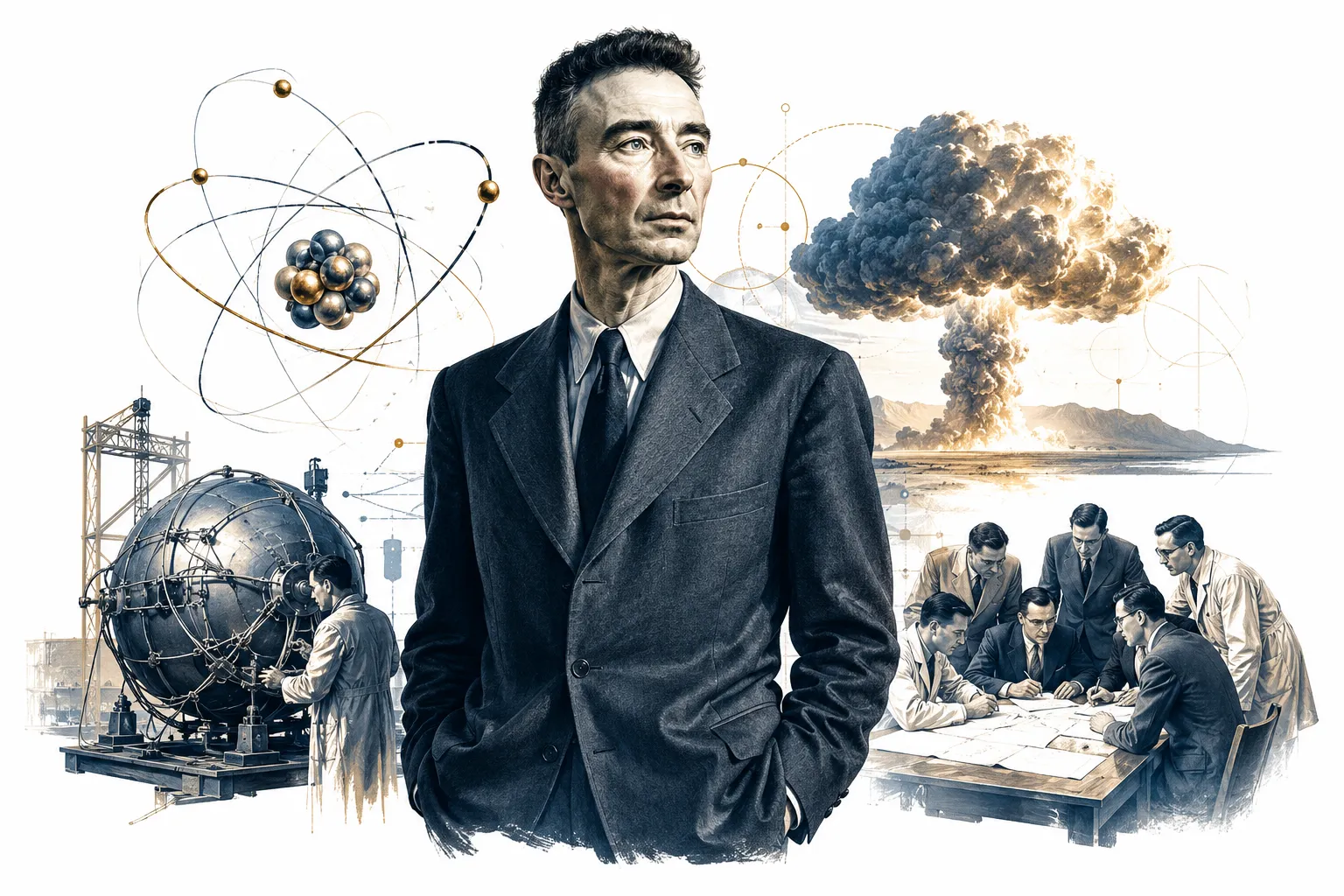
Robert Oppenheimer was a theoretical physicist. He had never run a large project. He had never built a weapon. But he was brilliant, charismatic, and he understood the science better than anyone. General Leslie Groves, the military head of the Manhattan Project, chose him to lead the scientific effort.
Oppenheimer built Los Alamos Laboratory from nothing. He recruited the best scientists. He solved impossible problems. He pushed his team to work faster, harder, smarter. In less than three years, they built the bomb.
When the first bomb exploded at the Trinity test, Oppenheimer watched in silence. He later said he thought of a line from the Hindu scripture, the Bhagavad Gita: 'Now I am become Death, the destroyer of worlds.' He had built the bomb. He had won the war. And he was horrified by what he had done.
Famous Quote
"Now I am become Death, the destroyer of worlds."
, J. Robert Oppenheimer, July 16, 1945
He quoted the Bhagavad Gita. The line comes from a passage where the god Vishnu reveals his cosmic form to a prince. It is a moment of awe and terror. Oppenheimer felt both.
Evidence
Why Oppenheimer Is Called the Father
He was the scientific director of the Manhattan Project.
StrongHe led the team that designed and built the first atomic bomb.
StrongHe was present at the Trinity test and witnessed the explosion.
StrongHis famous quote captured the moral weight of the bomb.
StrongKey Points
Key Points So Far
Oppenheimer was the scientific director of the Manhattan Project.
He led the team that built the first atomic bomb at Los Alamos.
The Trinity test was successful on July 16, 1945.
Bombs were dropped on Hiroshima and Nagasaki three weeks later.
After the war, Oppenheimer opposed the hydrogen bomb and was stripped of his security clearance.
Analogy
Like a Father Who Regrets His Child
The familiar part
Imagine a father who creates something beautiful. Then he watches it destroy everything he loves.
How it applies
Oppenheimer created the atomic bomb. He watched it destroy two cities. He spent the rest of his life trying to control what he had unleashed. He failed.
Where the analogy breaks
Children usually do not kill hundreds of thousands of people. The bomb did.
Curiosity Notes
Details Most People Miss
Why this still matters
Why This Still Matters
Robert Oppenheimer is still remembered because he represents the moral dilemma of modern science. He built a weapon that could end the world. He knew it. He did it anyway. Then he spent the rest of his life trying to contain what he had unleashed. He failed. The nuclear age continues. Oppenheimer's ghost haunts it. He is the father of the bomb. He is also its conscience.
Key Findings
- ✓Core findingOppenheimer was the scientific director of the Manhattan Project.
- ✓Strong evidenceHe led the team that built the first atomic bomb at Los Alamos.
- ⚠Main consequenceThe Trinity test was successful on July 16, 1945.
- ✓Wider legacyBombs were dropped on Hiroshima and Nagasaki three weeks later.
- ★Bottom lineAfter the war, he opposed the hydrogen bomb and was stripped of his security clearance.
Final insight
A Last Thought
Robert Oppenheimer is called the father of the atomic bomb because he built it. He is also remembered because he regretted it. He gave the world the most destructive weapon in history. Then he tried to take it back. He could not. The bomb is still here. Oppenheimer is gone. His warning remains. We have not listened.
Quick answers
Common questions
Did Oppenheimer regret building the bomb? +
Yes. He spent the rest of his life advocating for nuclear disarmament. He famously told President Truman, 'I have blood on my hands.' Truman was furious and never invited him back to the White House.
What happened to Oppenheimer after the war? +
He became a professor at Princeton. He advised the government on nuclear policy until his security clearance was revoked in 1954. He died in 1967.