Quick Facts
Quick Facts
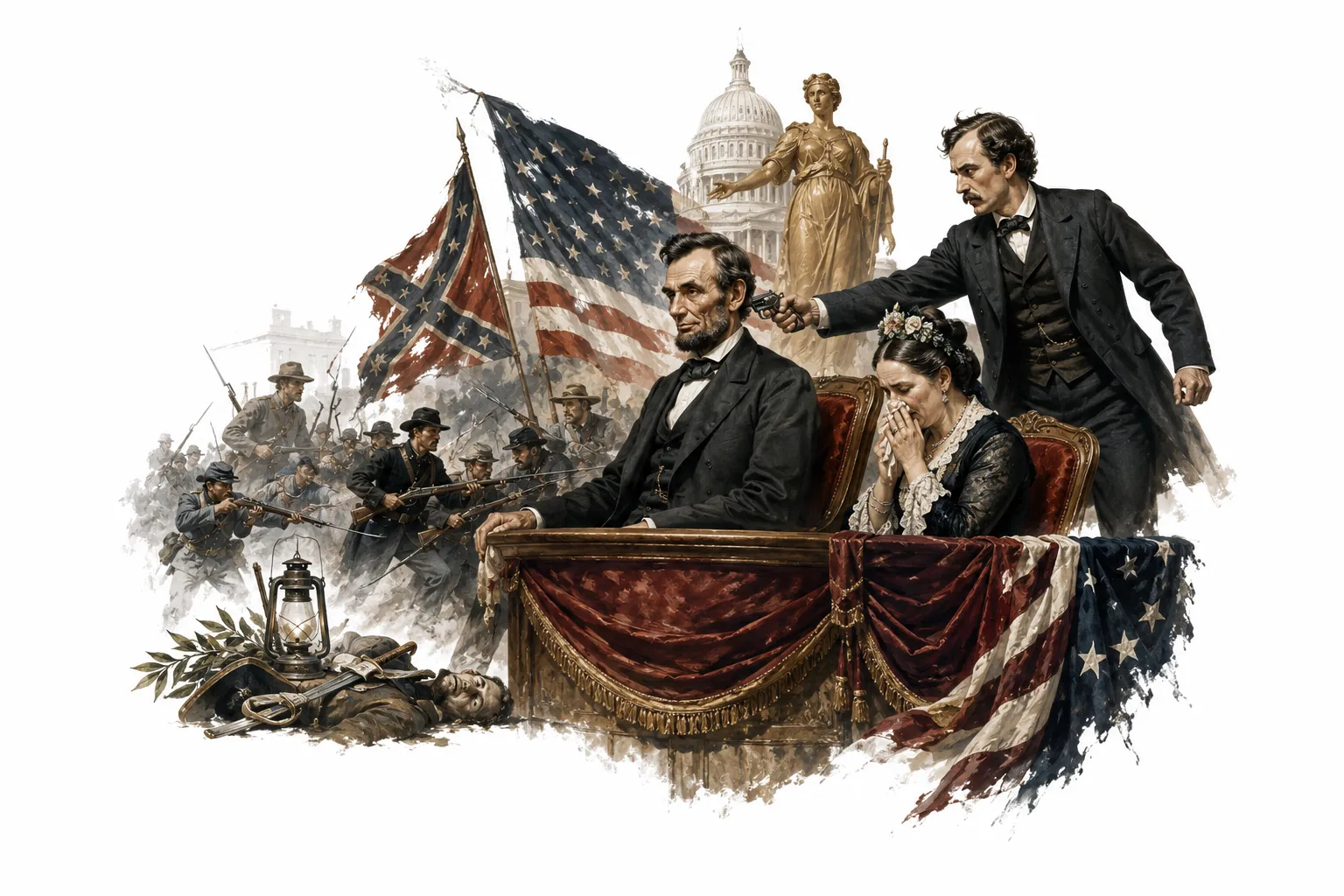
Lincoln was watching a play called 'Our American Cousin' when he was shot.
Booth was a famous actor. He knew the theater intimately.
Booth originally planned to kidnap Lincoln, not kill him. He changed his mind after the Confederate surrender.
Booth escaped on horseback and evaded capture for twelve days.
He was cornered in a Virginia tobacco barn and shot dead by Union soldiers.
Visual answer
The Plot to Kill Lincoln
Booth's plan and its aftermath.
April 9, 1865
General Robert E. Lee surrenders. The Civil War is effectively over.
April 14, 1865
Booth shoots Lincoln at Ford's Theatre. Lincoln dies the next morning.
Same Night
Booth escapes on horseback. Co-conspirators attack Secretary of State Seward (wounded) and fail to attack Vice President Johnson.
April 26, 1865
Booth is cornered in a Virginia tobacco barn. He is shot dead by Union soldiers.
July 7, 1865
Four co-conspirators are hanged. Booth's body is buried in secret.
Story in brief
Story in Brief
April 9, 1865
Lee surrenders to Grant at Appomattox. The Civil War ends.
April 14, 1865
Lincoln attends a play at Ford's Theatre. Booth enters the presidential box and shoots him.
Lincoln is carried to a boarding house across the street. He dies the next morning.
April 15, 1865, 7:22 AM
Abraham Lincoln dies. Secretary of War Edwin Stanton says, 'Now he belongs to the ages.'
April 26, 1865
Booth is cornered in a barn in Virginia. He refuses to surrender. Soldiers set the barn on fire. Booth is shot dead.
Booth's body is buried in secret. It is later exhumed and reburied several times.
May 4, 1865
Lincoln is buried in Springfield, Illinois. His funeral train traveled through 180 cities. Millions of Americans mourned.
The Story
Booth's Desperate Gamble
John Wilkes Booth was a famous actor. He was also a white supremacist who idolized the South. When the Civil War began, Booth wanted to join the Confederate army. His mother begged him not to. He stayed home, but his hatred for Lincoln grew.
Booth originally planned to kidnap Lincoln and exchange him for Confederate prisoners. But the war ended before he could act. Lee surrendered on April 9. Booth was furious. He wrote in his diary: 'Our cause being lost, something decisive and great must be done.' He decided to kill.
On April 14, Booth learned that Lincoln would be at Ford's Theatre that night. He knew the theater well. He walked in, entered the presidential box, and fired a single shot into the back of Lincoln's head. Then he jumped onto the stage, breaking his leg. He shouted 'Sic semper tyrannis!' (Thus always to tyrants) and escaped through the back door. He evaded capture for twelve days before being cornered and killed.
Famous Quote
"Now he belongs to the ages."
, Secretary of War Edwin Stanton, April 15, 1865
Stanton said these words as Lincoln died. They have become part of American memory.
Evidence
Why Booth Killed Lincoln
Booth was a white supremacist and Confederate sympathizer.
StrongHe believed killing Lincoln would throw the Union into chaos and revive the Confederacy.
StrongHis original plan to kidnap Lincoln failed. He escalated to assassination.
StrongHe wanted to become a hero to the South. He became a villain to history.
StrongKey Points
Key Points So Far
Lincoln was assassinated by John Wilkes Booth on April 14, 1865.
Booth was a white supremacist who could not accept Confederate defeat.
He shot Lincoln at Ford's Theatre during a play.
Lincoln died the next morning. Booth was killed twelve days later.
The assassination did not revive the Confederacy. It made Lincoln a martyr.
Analogy
Like a Gambler Who Shoots the Dealer
The familiar part
Imagine a gambler who loses everything at a poker table. He blames the dealer. He pulls out a gun.
How it applies
Booth was that gambler. The Confederacy lost. He blamed Lincoln. He pulled the trigger. The dealer died. The gambler still lost.
Where the analogy breaks
Gamblers usually survive. Booth did not.
Curiosity Notes
Details Most People Miss
Why this still matters
Why This Still Matters
The assassination of Abraham Lincoln is still remembered because it was the first presidential assassination in American history. It marked the end of the Civil War and the beginning of a long, painful Reconstruction. Lincoln died just as he had won. He did not get to see the peace. He did not get to heal the nation. That task fell to others. And they struggled. Lincoln's ghost still haunts American politics. We wonder what might have been.
Key Findings
- ✓Core findingLincoln was assassinated by John Wilkes Booth on April 14, 1865.
- ✓Strong evidenceBooth was a white supremacist who could not accept Confederate defeat.
- ⚠Main consequenceHe shot Lincoln at Ford's Theatre during a play.
- ✓Wider legacyLincoln died the next morning. Booth was killed twelve days later.
- ★Bottom lineThe assassination did not revive the Confederacy. It made Lincoln a martyr.
Final insight
A Last Thought
Abraham Lincoln was assassinated because he had won. The war was over. The Confederacy was dead. Slavery was abolished. John Wilkes Booth could not accept that. So he killed the man who had made it possible. It was the act of a loser who could not face defeat. He did not revive the Confederacy. He did not throw the Union into chaos. He did nothing except murder a good man. And then he died in a burning barn. That is the legacy of John Wilkes Booth. He is a footnote. Lincoln is a monument.
Quick answers
Common questions
What happened to Booth's co-conspirators? +
Four were hanged in July 1865. Others were sentenced to prison. Mary Surratt, who ran the boarding house where the conspirators met, was the first woman executed by the US government.
Where is Lincoln buried? +
Lincoln is buried in Oak Ridge Cemetery in Springfield, Illinois. His tomb is a state historic site. Visitors can see his marble sarcophagus.