Visual answer
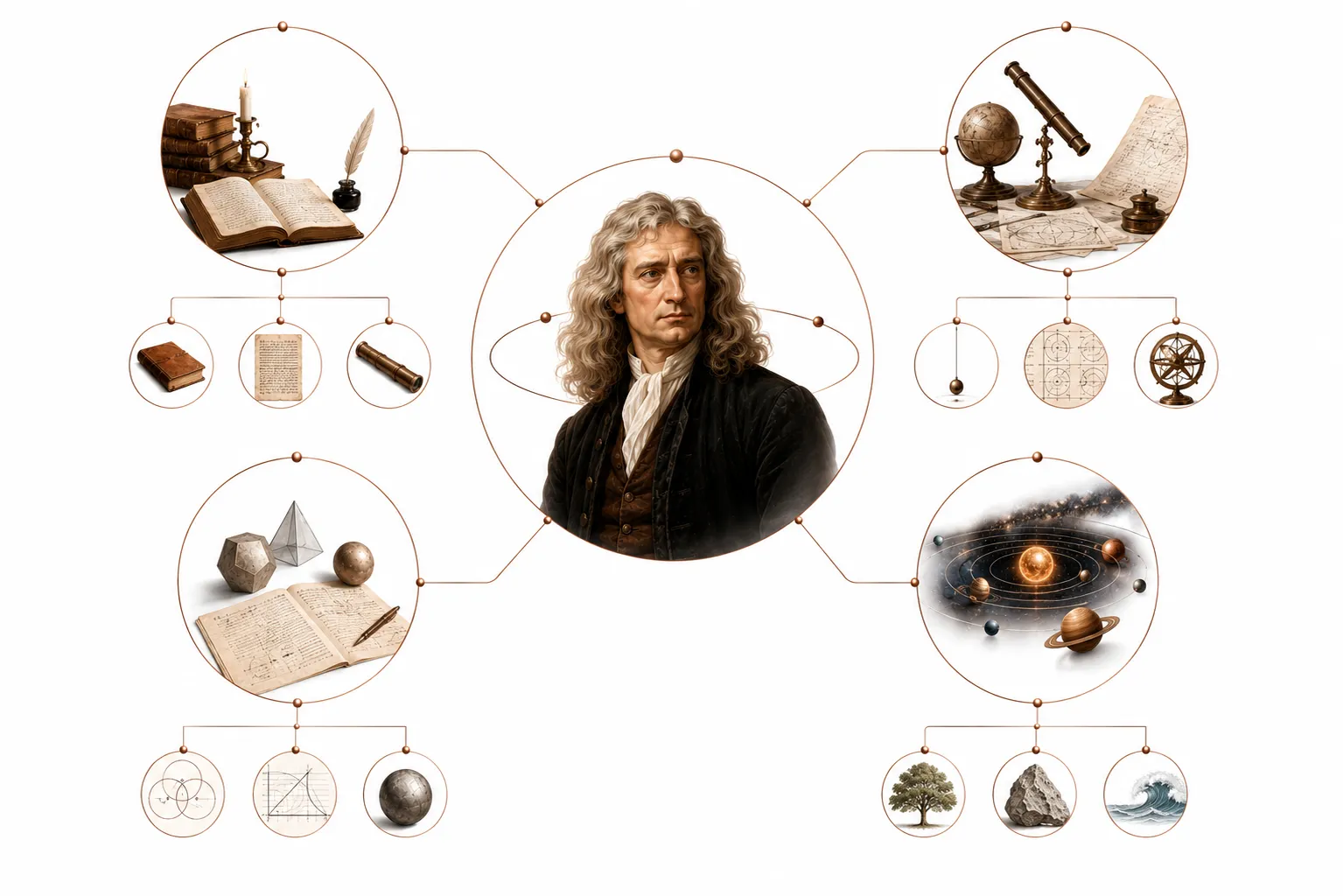
Newton's four contributions and how they connect
How gravity, motion, calculus, and optics form a single intellectual system rather than four separate discoveries
Calculus
The mathematical tool Newton invented to describe continuous change without it, the laws of motion couldn't be expressed precisely
Laws of motion
Three laws describing how forces affect objects the framework that makes gravity calculable
Universal gravitation
The single force governing falling apples and orbiting planets only expressible because calculus and the motion laws existed first
Optics
Largely independent of the other three Newton's demonstration that white light contains all colours, and his invention of the reflecting telescope
Why famous
Verdict
Newton is famous because he made the universe legible and did it in a way nobody has matched before or since
Before Newton, motion, gravity, and the behaviour of planets were separate puzzles with separate, often contradictory, explanations. Newton connected them into a single mathematical framework that could predict the path of a cannonball, the orbit of the Moon, and the timing of the tides using the same equations. His Principia Mathematica, published in 1687, is the document that turned natural philosophy into what we now call physics. Scientists ran on Newton's ideas essentially unchanged for two hundred years, until Einstein found the edges in 1905.
Useful analogy
Imagine a city where every neighbourhood has its own traffic rules, its own road signs, and no one from one district can reliably navigate another. Newton arrived and said: actually, there are three rules, they apply everywhere, and here they are. The city didn't change. But suddenly everyone could get where they were going.
The catch
Newton's genius was real and enormous, but the mythology around him has grown to match. The apple almost certainly didn't hit him on the head. He sat on his gravitational theory for twenty years because he wasn't satisfied with his own calculations. And his later years were consumed by alchemy, Biblical prophecy, and a vicious priority dispute with Leibniz over calculus that he pursued with considerably more energy than was becoming of the world's greatest scientist.
What he discovered
What did Isaac Newton discover or invent?
Newton's four major contributions are gravity, the laws of motion, calculus, and optics and the remarkable thing is that any one of them would have secured his reputation. The gravity work alone would have done it. The laws of motion alone would have done it. Most scientists spend a career hoping for one.
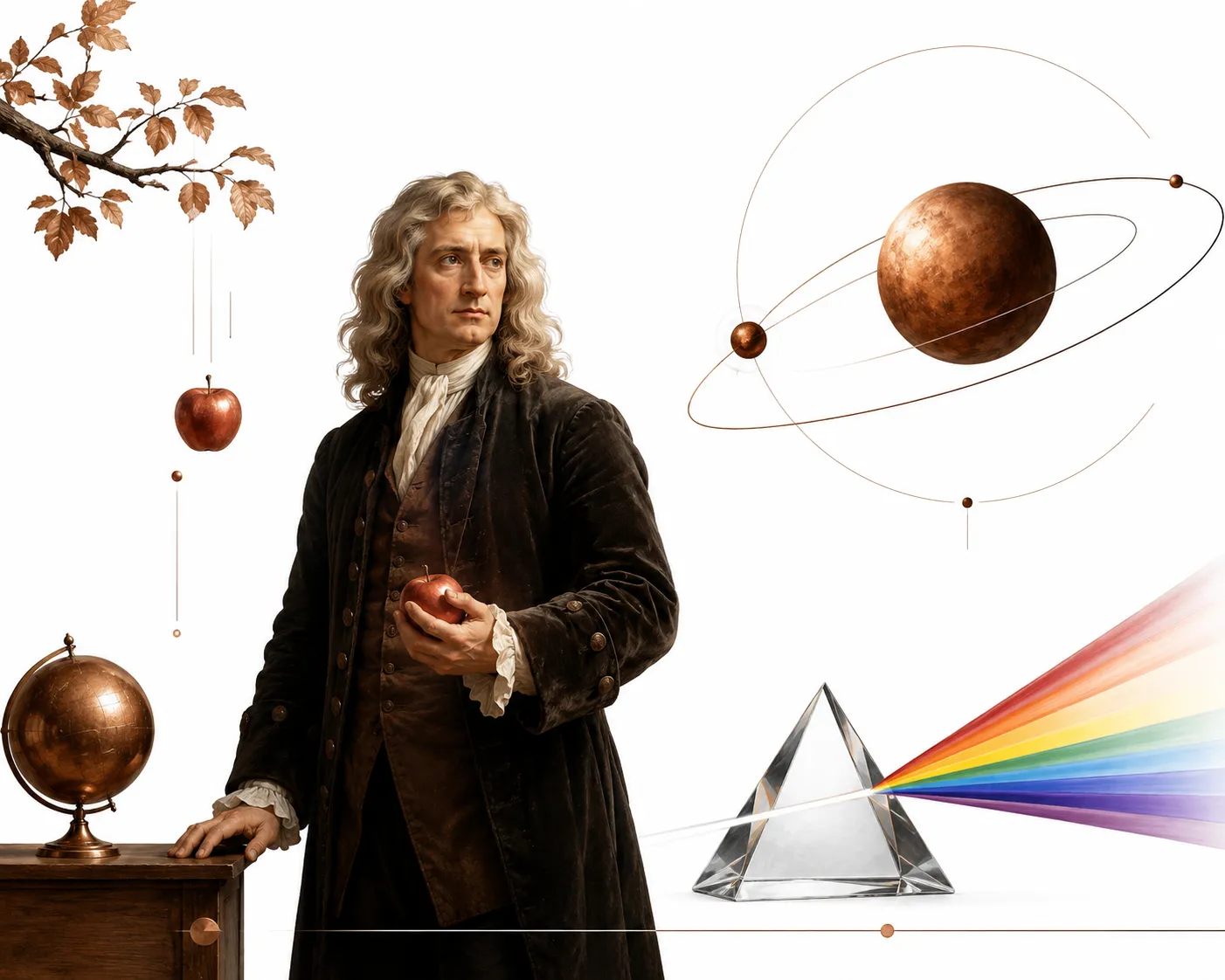
On gravity: Newton did not discover that things fall. That had been noticed. What Newton discovered was that the force pulling an apple toward the ground is the same force holding the Moon in its orbit around the Earth a universal force, operating by the same rules, at every scale, across the entire cosmos. This is the leap. It sounds obvious now because we grew up knowing it. In 1666 it was extraordinary.
On calculus: Newton needed mathematics that didn't yet exist to describe how things change continuously over time the mathematics of motion. So he invented it, calling it 'the method of fluxions.' Gottfried Leibniz invented an equivalent system independently a few years later and published it first, which led to one of the nastiest priority disputes in scientific history. We use Leibniz's notation today, which Newton would have found infuriating and probably did.
Discoveries
What is Isaac Newton known for, and what each thing actually means
Universal gravitation
The same invisible force that pulls objects to the ground also governs the orbits of every planet. One law, operating everywhere. This had never been proposed before.
Three laws of motion
Objects stay still or moving unless acted on by a force; force equals mass times acceleration; every action has an equal and opposite reaction. Three sentences that describe the behaviour of everything from billiard balls to spacecraft.
Calculus
A mathematical system for describing continuous change essential for everything from engineering to economics. Newton invented it to solve his physics problems and then largely kept it to himself for decades.
Optics and light
Newton used a prism to show that white light is not pure it contains all colours, which the prism separates. He also built the first working reflecting telescope, which used mirrors instead of lenses and avoided the colour distortion that plagued earlier instruments.
Principia Mathematica
Published in 1687, this single book contained the laws of motion, the theory of universal gravitation, and mathematical tools to apply them. Newton deliberately wrote it in a difficult style to avoid being 'baited by little smatterers.' It worked on both counts.
The apple
Did an apple fall on Newton's head and give him the idea for gravity?
What people think
An apple hit Newton on the head and he instantly discovered gravity
This is the version everyone learns, complete with a satisfying bonk and a flash of inspiration. It reduces one of the greatest intellectual achievements in history to a slapstick accident.
What actually happens
The apple may have been real; the instant revelation certainly wasn't
Newton himself told the apple story in old age as a prompt for thought, not a blow to the skull. He saw or imagined an apple falling and asked himself: how far does gravity reach? Could it extend to the Moon? That question took him years to answer, and he wasn't satisfied with his first attempt. The apple, if it existed, was the beginning of a very long conversation with himself not the end of one.
How he changed the world
How Isaac Newton changed the world
Cambridge sent everyone home during the plague. Newton retreated to Woolsthorpe and developed the foundations of calculus, the theory of gravity, and his experiments on light.
1665–1666This eighteen-month period is sometimes called Newton's annus mirabilis his miraculous year. Almost everything he is famous for began here.
Newton published his first paper, on the nature of light and colour, in the Philosophical Transactions of the Royal Society.
1672It immediately attracted criticism from Robert Hooke, beginning a feud that would last until Hooke's death in 1703. Newton responded to scientific criticism the way most people respond to personal insults.
Principia Mathematica was published, funded largely by the astronomer Edmond Halley after Newton refused to pay for it himself.
1687The book established mechanics as a mathematical science and gave the world its first complete, predictive model of how physical objects behave. It is arguably the most influential scientific publication in history.
Newton was appointed Warden of the Royal Mint and moved to London, where he spent the rest of his working life prosecuting counterfeiters.
1696Newton took the job seriously, attending hangings and aggressively pursuing cases. He was, by all accounts, a ferociously effective civil servant. He had not softened with age.
Engineers, astronomers and physicists applied his laws to bridges, ships, cannons, tides, planets, and eventually spacecraft.
After NewtonNewtonian mechanics remained the operating system of physics until Einstein in 1905. NASA still uses Newton's equations for most spacecraft navigation today they are accurate enough for everything except the very fast and the very massive.
Final insight
Newton didn't discover the rules. He proved the universe had them.
The truly radical thing Newton did wasn't any individual discovery. It was the demonstration that the physical world operates by consistent, mathematical rules that apply everywhere and always rules that a sufficiently patient person, armed with the right tools, can actually figure out. Before Newton, that was not obvious. The heavens and the Earth seemed to operate differently; the universe seemed fundamentally mysterious. After Newton, it seemed for the first time legible. Every scientist since has been working in that assumption. It is the most consequential idea in the history of science, and Newton didn't publish it until he was 44, having sat on it for twenty years because he wasn't quite satisfied with the arithmetic.
Quick answers
Common questions
Was Isaac Newton the smartest person who ever lived? +
He is frequently named in that conversation, alongside Einstein and a handful of others. The question is probably unanswerable, but what distinguishes Newton from most candidates is the combination of range and depth: he made fundamental contributions to physics, mathematics, and optics separately, not as part of a single project. Einstein himself said that Newton was the greatest mind in the history of science. That is not a trivial endorsement.
Did Isaac Newton discover gravity? +
He explained it, which is much harder. The fact that things fall had been observed since the first person tripped. Newton's discovery was that gravity is a universal force the same one that pulls an apple down also holds the Moon in its orbit, keeps the planets circling the Sun, and operates by identical rules everywhere in the universe. That is not an observation. It is one of the greatest intellectual leaps in human history.
Did Isaac Newton invent calculus? +
Yes and so did Leibniz, working independently at roughly the same time. Newton developed his version first but published it last, which is the kind of decision that haunts a person. The two men spent years locked in a bitter dispute over priority, with Newton covertly orchestrating a Royal Society investigation that found, somewhat unsurprisingly, in his favour. Modern mathematicians use Leibniz's notation almost exclusively. Newton won the argument. Leibniz won posterity.
Why is Isaac Newton important today? +
Because his framework still works. The equations Newton wrote in the 1680s are what engineers use to design bridges, what physicists use to track satellites, and what NASA uses to navigate spacecraft across the solar system. Einstein showed that Newton's laws break down at extreme speeds and masses but for everything a human being is likely to encounter, Newton's three laws of motion and his law of universal gravitation are accurate enough to stake a life on. Many people do, every time they fly.