Visual answer
How Hemoglobin Carries and Releases Oxygen
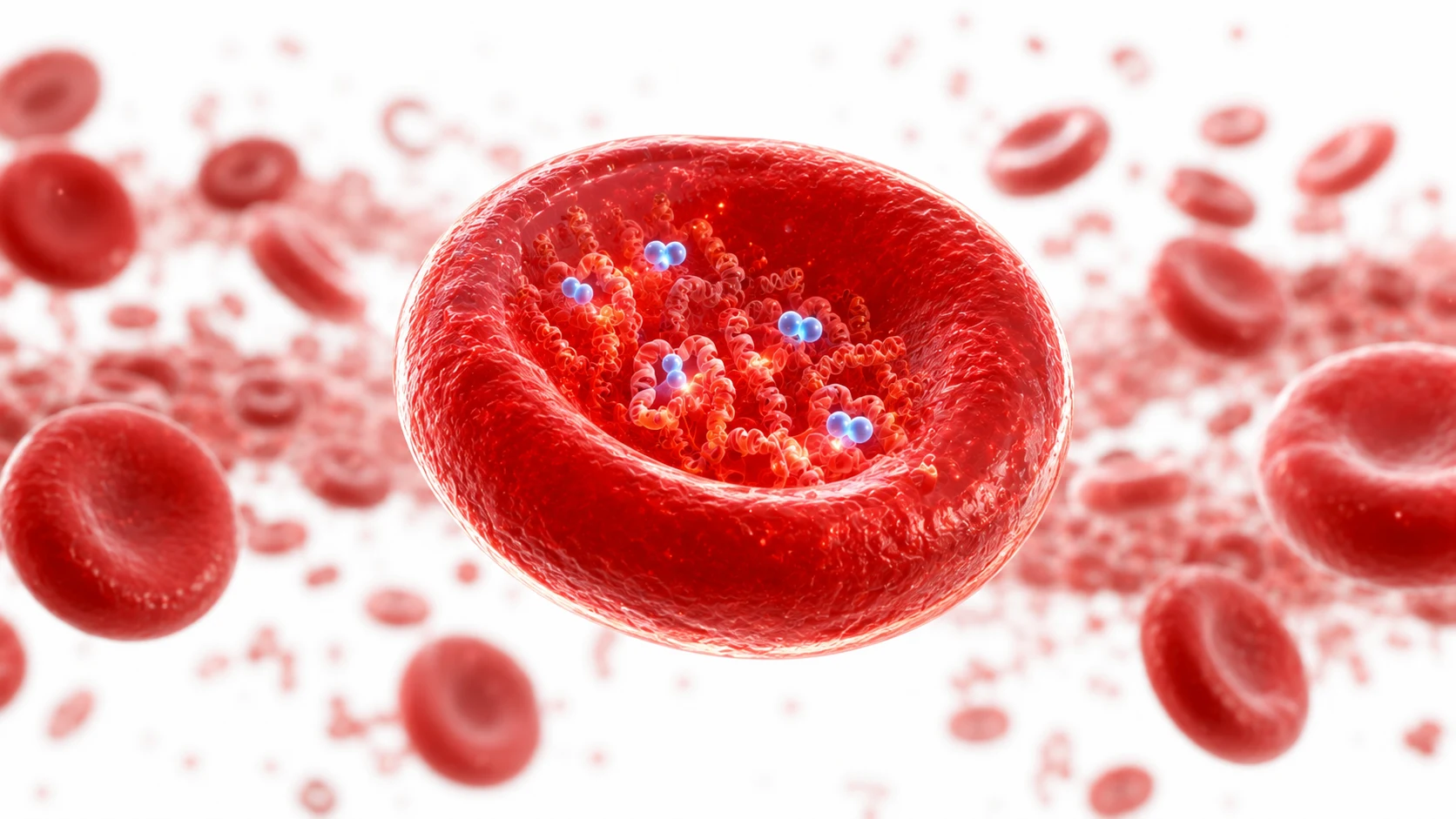
A single hemoglobin molecule can carry four oxygen atoms, loading and unloading them as it travels the body.
Heme group
Each hemoglobin molecule has four heme groups, each containing one iron atom capable of binding one oxygen molecule.
Oxygen loading (lungs)
In the high-oxygen environment of the lungs, iron atoms bind oxygen. Blood becomes bright red.
Oxygen delivery (tissues)
In tissues where oxygen is scarce and CO₂ is abundant, hemoglobin releases oxygen and picks up carbon dioxide. Blood becomes dark red.
Return to lungs
CO₂ is expelled in the lungs, oxygen reloads, and the cycle repeats, roughly 60 to 70 times per minute.
Why blood is red
The Molecule Responsible for Blood's Color
Blood is red for the same reason gold looks golden and copper looks copper-colored. The color comes from the way a substance interacts with light.
In blood, the key player is hemoglobin. This remarkable protein sits inside red blood cells and spends its entire existence transporting oxygen around the body.
At the center of every hemoglobin molecule are iron-containing structures called heme groups. When oxygen attaches to them, the molecule's interaction with light changes slightly.
The result is a rich red color. Every heartbeat sends billions of these tiny oxygen carriers rushing through your body, creating the familiar color we associate with blood.
So blood is not red because it contains iron alone. Blood is red because of the way iron, oxygen, and hemoglobin work together.
Why shades change
Why Blood Can Look Bright Red or Dark Red
If you've ever scraped your knee and noticed bright red blood, then later seen darker blood during a blood test, you may have wondered whether they were somehow different.
They are. Just not in the way most people think.
When blood leaves the lungs, hemoglobin is loaded with oxygen. In this state it reflects a brighter, scarlet shade of red.
As blood travels through the body, tissues remove that oxygen for energy. Hemoglobin gradually releases its cargo and changes the way it absorbs light.
The blood becomes darker and deeper in color, often appearing burgundy or maroon.
What it never becomes is blue. Even blood that has given up most of its oxygen remains red.
Blue veins
If Blood Is Red, Why Do Veins Look Blue?
This is one of those questions that almost everyone wonders about at some point.
Look at your wrist and the veins often appear blue or blue-green. It seems like obvious proof that blood changes color inside the body.
It doesn't.
The illusion comes from the way light travels through skin. Different colors of light penetrate tissue to different depths and scatter differently on the way back out.
The combination of skin, tissue, and the dark red blood beneath creates an optical effect that makes veins appear blue.
Doctors and surgeons do not see blue veins inside the body. They see dark red blood flowing through dark red veins.
Evolution
Why Did Evolution End Up With Red Blood?
Evolution was never trying to create red blood.
Its only challenge was finding an efficient way to move oxygen from one place to another.
Over hundreds of millions of years, iron-based hemoglobin proved extremely effective at that job. It could pick up oxygen where it was abundant and release it where it was needed.
The red color came along for the ride.
If a green, purple, or blue oxygen-carrying molecule had worked better, life on Earth might have ended up looking very different.
Blood is red not because red is special, but because hemoglobin turned out to be one of evolution's best oxygen transport solutions.
Other blood colors
Not Every Animal Has Red Blood
Humans often assume red blood is universal because it is all we have ever known.
Nature, however, experimented with several different solutions.
Octopuses, squids, and horseshoe crabs use a copper-based molecule called hemocyanin instead of hemoglobin. When oxygenated, it gives their blood a striking blue color.
Some marine worms possess green blood pigments. Others use molecules that appear violet or pink.
The important thing is not the color itself. The important thing is transporting oxygen efficiently.
Evolution discovered multiple ways to solve that problem, and each solution produced its own unexpected color palette.
Myth vs reality
Myth vs Reality
What people think
Blood in veins is blue
Many anatomy diagrams color veins blue, and veins often appear blue through skin. As a result, many people assume the blood inside them must also be blue.
What actually happens
Human blood is always a shade of red
Oxygen-rich blood is bright red. Oxygen-poor blood is darker red. The blue appearance of veins is caused by light interacting with skin, not because the blood itself changes to blue.
Quick answers
Common questions
What makes arterial blood brighter than venous blood? +
Arterial blood carries freshly oxygenated hemoglobin (oxyhemoglobin), which reflects bright red. Venous blood carries hemoglobin that has released its oxygen (deoxyhemoglobin), which reflects a darker, more burgundy red.
Can blood be any color other than red in humans? +
Normally no. Certain rare conditions can alter blood color: high methemoglobin levels (from certain toxins or genetic conditions) turns blood chocolate-brown; sulfhemoglobin (from some medications) turns it greenish.
Why is horseshoe crab blood so valuable? +
Horseshoe crab blood contains amebocytes that clot extremely rapidly in the presence of bacterial endotoxins. It is used to test injectable medications and medical devices for contamination. A liter of horseshoe crab blood can sell for over $15,000.