Visual answer
How the Moon's Position in Its Orbit Creates Each Phase
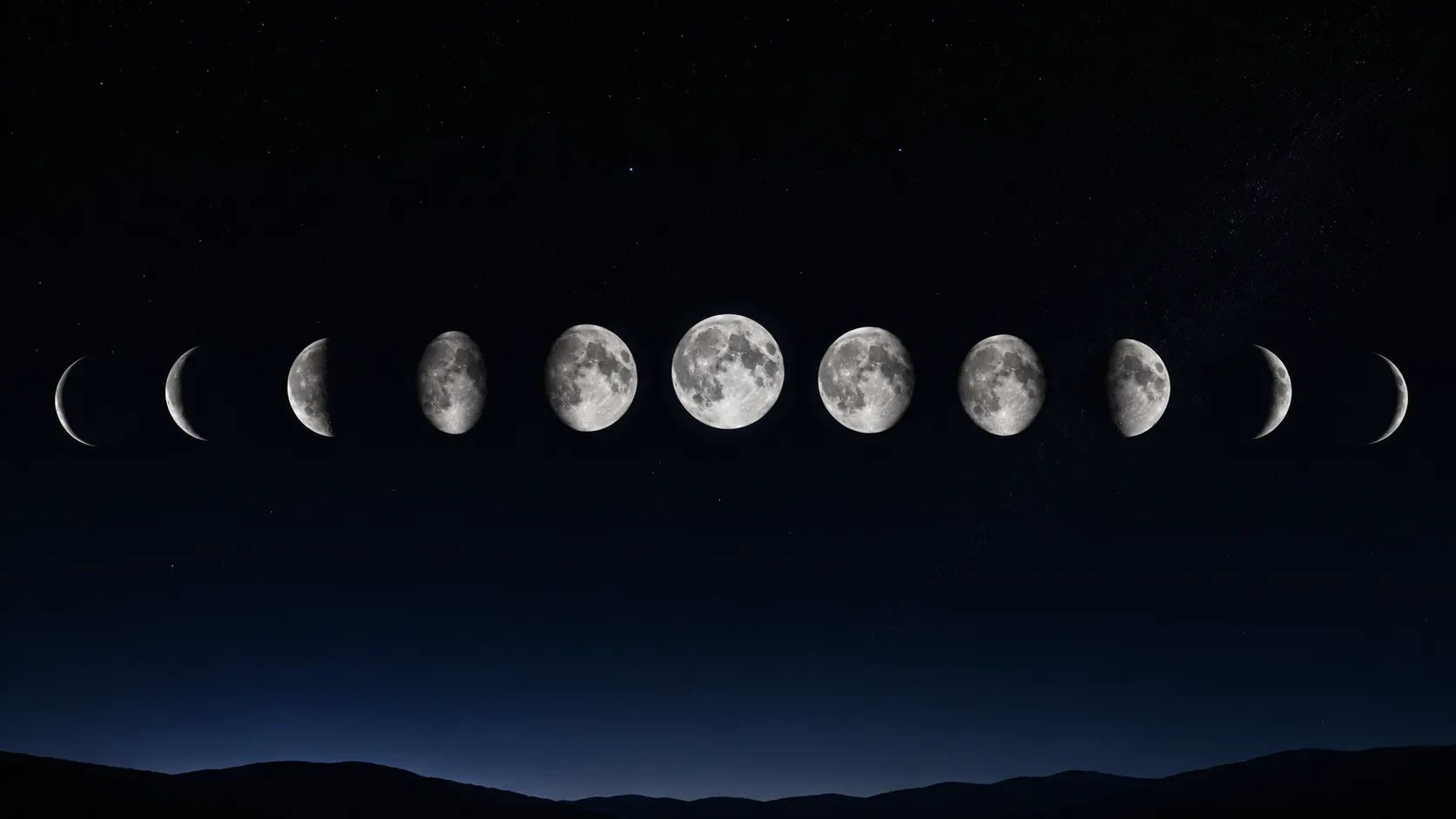
The moon is always half-lit. Which part faces Earth changes as the moon orbits.
New moon: lit side faces away
The moon is between Earth and the sun, so the illuminated side faces away from us.
Quarter moon: half the lit side is visible
At about 90 degrees from the sun, we see half of the illuminated hemisphere.
Full moon: lit side faces Earth
The moon is opposite the sun from our view, so the fully lit hemisphere faces Earth.
The cycle reverses
After full moon, the visible lit portion shrinks through gibbous, quarter, and crescent phases.
The geometry
The Phases Are Entirely About Angles
A ball in a lit room is a useful model. The light always illuminates one side, but as you move around it, you see different amounts of that lit side.
Sunlight reaches the Earth-moon system in nearly parallel rays. The phase depends on the angle between the sun, moon, and observer.
A quarter moon looks half-lit because it is one-quarter or three-quarters of the way through the cycle, not because only one-quarter of it is illuminated.
Myth vs reality
Myth vs Reality
What people think
The moon's phases are caused by Earth's shadow
Earth's shadow causes lunar eclipses, which happen only when alignment is nearly perfect.
What actually happens
Phases are caused by the moon's orbital position
As the moon orbits Earth, we see different fractions of the sunlit hemisphere.
Phase summary
The Main Lunar Phases
New moon
Lit side faces away from Earth. Rises and sets with the sun.
Waxing crescent
A growing sliver visible after sunset.
First quarter
Half the visible disc is lit. Rises around noon.
Full moon
The visible face is fully lit. Rises around sunset.
Waning phases
The visible lit portion shrinks back toward new moon.
Quick answers
Common questions
Does the moon actually change shape? +
No. The moon remains a sphere; we see different portions of its sunlit half.
What causes a lunar eclipse if not regular phases? +
A lunar eclipse occurs when the moon passes through Earth's shadow during a full moon alignment.
Why do we never see the far side of the moon? +
The moon is tidally locked, rotating once per orbit so the same side always faces Earth.
How long is the lunar cycle? +
About 29.5 days from one new moon to the next.