The Mechanism
Two Small Parts That Save Lives
Current state
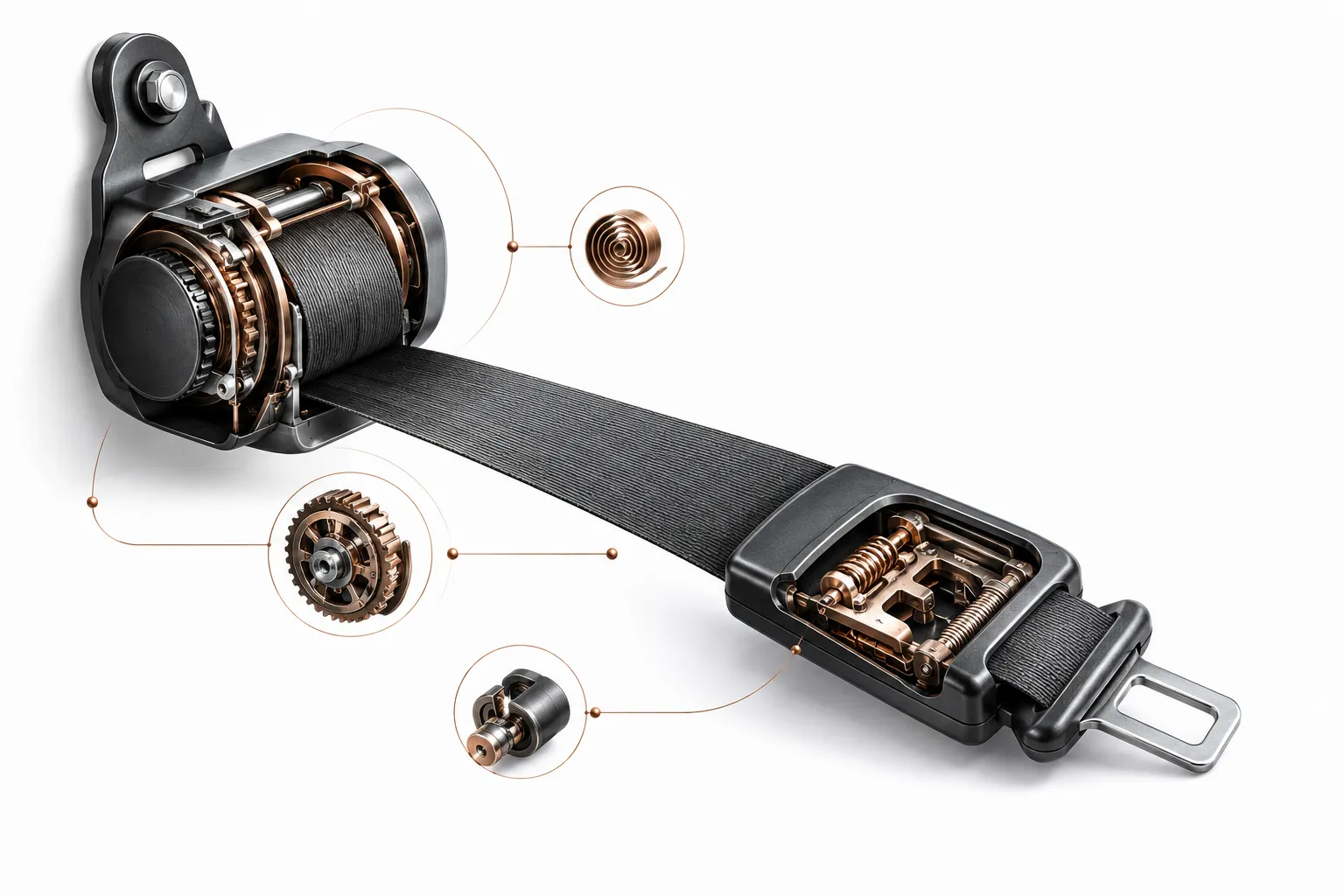
Inside the seatbelt retractor housing there are two key components working together. The first is a centrifugal clutch on the belt spool itself a mechanism that allows the belt to feed out freely when pulled slowly but engages and locks when the belt is pulled rapidly. This is why reaching slowly for something allows the belt to extend normally, but jerking it quickly causes it to lock.
What supports this
The second mechanism is a vehicle-sensitive sensor typically a small weighted ball or pendulum sitting in a little cup. Under normal driving, the ball sits centrally and everything moves freely. In a crash, emergency stop, or sharp tilt, the ball rolls to one side (or the pendulum swings forward) and triggers a locking pawl that engages with the spool's ratchet teeth, locking the belt solid within milliseconds. Together, these two mechanisms mean the belt locks in response to either a fast belt pull or a sudden change in the car's motion covering the two main scenarios where you need the belt to hold you.
What could change this
Modern cars also add pretensioners pyrotechnic devices that actively tighten the belt in a crash, pulling slack out of the system within milliseconds of impact detection. These work alongside the ELR mechanism, not instead of it.
The Simple Version
Think of It Like a Ratchet Strap
The familiar part
A ratchet strap used for securing cargo on a trailer feeds freely in one direction but locks tight when loaded. It can tell the difference between 'someone is adjusting this' and 'this is under load' and responds accordingly.
How it applies
The seatbelt retractor makes a similar distinction, but based on speed rather than direction. Slow movement means adjustment. Fast movement means something has gone wrong. The mechanism is simple, mechanical, and requires no electronics to work which is exactly why it's reliable.
Where the analogy breaks
Sometimes the vehicle-sensitive sensor triggers on steep hills or driveways the ball tilts slightly and the belt locks unnecessarily. This is usually a minor annoyance rather than a fault. Some older retractors can also become sticky or lock prematurely if the mechanism is dirty or worn, requiring cleaning or replacement.
Final insight
Simple, Mechanical, Reliable
The seatbelt retractor is a reminder that the most life-saving engineering doesn't have to be complicated. A small pendulum. A ratchet. A spring. No batteries, no software, no network connection required. It has been saving lives in essentially the same form since the 1960s. Sometimes the best design is the one that works without thinking.
Quick answers
Common questions
Why does the seatbelt sometimes lock on a steep hill? +
The vehicle-sensitive pendulum inside the retractor can tip when the car is on a steep incline, triggering the lock even without a crash. This is normal behaviour the sensor is responding correctly to the tilt angle.
What is the difference between ELR and ALR seatbelts? +
ELR (Emergency Locking Retractor) is standard it locks in emergencies but feeds freely otherwise. ALR (Automatic Locking Retractor) locks after you pull the belt out to a specific length used mainly for securing child seats, which require a fixed, non-feeding belt.
Does a seatbelt that locks too easily need replacing? +
If a belt locks during normal, gentle movements, the retractor mechanism may be dirty or worn. Cleaning with a dry lubricant can sometimes resolve this; if not, the retractor should be replaced as it may not release correctly in a real emergency.