Visual answer
Why wiper blades leave streaks
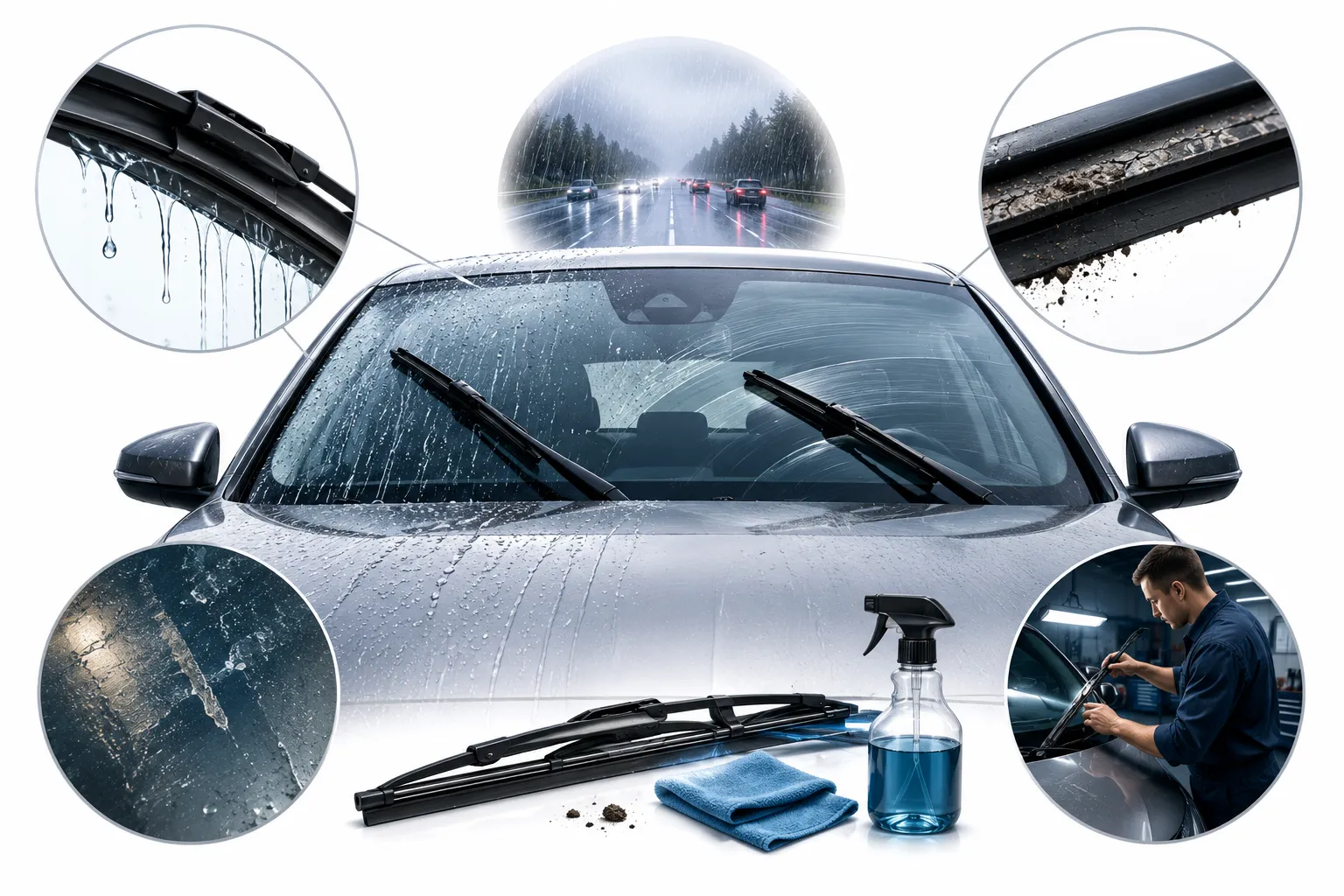
The diagram shows how rubber condition, blade angle, glass contamination, and uneven contact turn a clean wipe into streaks.
Rubber edge
The blade needs a flexible, clean edge to maintain continuous contact.
Uneven contact
Hardening, cracks, or deformation leave gaps where water remains.
Dirty glass
Oil, wax, and road film can smear even when the blade is still usable.
Why Rubber Fails
The Blade Is a Precision Tool That Wears Quickly
Current state
A wiper blade works by maintaining a thin, continuous line of contact between a flexible rubber edge and a curved glass surface. The rubber needs to be soft enough to conform to the glass's curvature at high speed, yet firm enough to push water cleanly ahead of it. When new, quality rubber achieves this. Over time, it doesn't.
What supports this
Rubber degrades through exposure to UV light, ozone, heat, cold, and friction. The edge, which is only a millimetre or two thick, gradually hardens and may develop micro-cracks or deformations. When this happens, the blade no longer lies flat against the glass. It bounces, skips or maintains uneven contact, leaving patches of water behind, which appear as streaks. The problem is accelerated by running wipers on a dry screen (enormous friction), leaving the car in direct sunlight for extended periods, and using screen wash that leaves a waxy residue.
What could change this
Newer beam blade designs, which flex across their entire length rather than using a rigid frame, conform better to curved windscreens and tend to last longer than traditional bracket-style blades. Silicone blades are more resistant to UV degradation than standard rubber. But all blades wear eventually.
The Simple Version
Think of It Like a Worn Squeegee
The familiar part
A new window squeegee leaves glass perfectly clear. An old one with a slightly bent or hardened rubber edge leaves long streaks. You've seen both, the difference is visible immediately.
How it applies
Your wiper blade is doing exactly the same job as that squeegee, at roughly 60 swipes per minute, in rain, heat, cold and grit. The rubber simply can't maintain the perfect flat edge indefinitely under those conditions.
Where the analogy breaks
Sometimes streaking isn't the blade at all, it's the glass. A windscreen coated in oil film (from engine exhaust, car wax overspray or road spray) will repel water in smears regardless of how good the blade is. Cleaning the glass thoroughly with a proper glass cleaner sometimes resolves streaking even with an older blade.
Final insight
A Millimetre of Rubber Between You and a Blurry Road
The wiper blade is one of the most underappreciated safety components on a car, and one of the cheapest to replace. The difference between a clear view and a dangerous smear is often a few pounds and ten minutes. Replace them before the first serious rain of winter, not during it.
Quick answers
Common questions
How often should wiper blades be replaced? +
Most manufacturers recommend replacing blades every 6–12 months. In practice, replace them when you notice streaking, skipping or squeaking, those are the signs the rubber has degraded beyond useful performance.
Is there a quick fix for streaky wipers? +
Yes, wiping the rubber blade edge with rubbing alcohol removes wax build-up and softens the surface slightly, which can restore decent performance for a while. It's not a permanent fix but can buy a few more weeks before replacement.
Can the glass cause streaking rather than the blade? +
Yes. An oily or waxy film on the windscreen repels water in streaks regardless of blade condition. Clean the glass thoroughly with a glass-specific cleaner before concluding the blade needs replacing.