Visual answer
Class 1 Lever Physics & Force Distribution in Shears
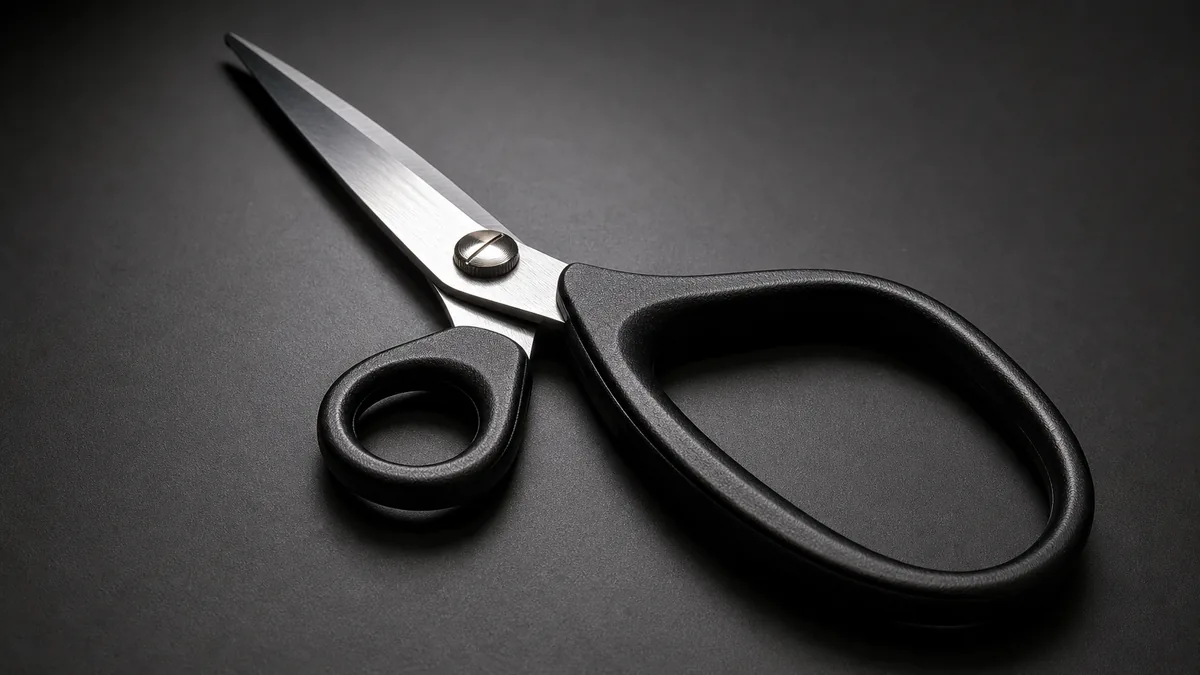
Scissors operate as two counter-rotating Class 1 levers joined at a central pivot screw (fulcrum).
Thumb Drive Loop (Small)
Applies precise directional force; moves through a wider arc than the index fingers.
Multi-Finger Loop (Large)
Groups index, middle, and ring fingers to distribute pressing force without pinches.
Central Fulcrum Pivot
The screw or rivet holds the blades at micro-angled tension so edges sheer cleanly.
Shearing Cutting Blades
Concentrates mechanical force onto a tiny advancing point of contact along the paper.
Functional Division
1. Functional Division: Isolating Control vs Multiplying Force
In human hand anatomy, the thumb possesses unique opposition movements driven by the Thenar muscle group, whereas the index, middle, and ring fingers operate sequentially via the Flexor Digitorum tendons. By pairing the thumb in an isolated small loop and grouping the remaining fingers in a large loop, scissor designers match tool ergonomics directly to hand kinesiology.
The fingers in the larger loop generate steady downward force, while the thumb controls blade opening aperture and fine directional tracking.
Lever Physics
2. The Physics of Mechanical Advantage in Shears
A pair of scissors is mechanically defined as a compound Class 1 lever. The central screw acts as the fulcrum ($F$), the handles serve as the effort arm ($d_e$), and the blades act as the load arm ($d_l$).
Mechanical Advantage ($MA$) is calculated as:
$$MA = \frac{\text{Distance from Pivot to Handle}}{\text{Distance from Pivot to Cut Point}}$$
When cutting thick cardboard near the pivot screw, $d_l$ is extremely short, yielding high mechanical advantage and maximum force. When cutting near the blade tips, $MA$ drops, favoring speed over force.
Offset Handles
3. Bent Trimmers vs Equal-Loop Craft Scissors
Not all scissors feature asymmetrical handles, and the variations exist for specific tasks:
• **Bent Dressmaker Shears**: Feature a dramatic upward bend in the handle loop, allowing the bottom blade to rest flat against a cutting table so fabric is not lifted while being cut.
• **Equal-Loop Craft Scissors**: Small precision scissors (like embroidery or medical dissection scissors) feature identical circular loops because both sides require equal index-and-thumb delicate tactile feedback.
Left-Handed Design
4. The Physics of True Left-Handed Shears
Why can't a left-handed person simply flip a right-handed scissor upside down?
When a right-handed person squeezes standard scissors, natural hand anatomy pushes the thumb outward and fingers inward. This lateral force presses the upper and lower blades together along their inner cutting edges.
If a left-handed person grips right-handed scissors, that same lateral thumb motion forces the blades *apart*, causing paper to fold or jam between the blades instead of shearing. True left-handed scissors reverse the physical overlap of the blades so the top blade is on the left side.
Common Myth
Myth vs Ergonomic Reality
What people think
The larger loop is designed for people with bigger hands.
Many people assume the large loop is meant to accommodate large hands or gloved thumbs.
What actually happens
Designed for Multi-Finger Force Distribution
The larger loop is engineered specifically to hold two to three fingers simultaneously, maximizing leverage regardless of individual hand size.
Quick answers
Common questions
Why do dressmakers use bent-handle shears? +
The angled handle allows the lower blade to slide flat along the workbench, keeping fabric perfectly still while cutting.
What happens if you use right-handed scissors with your left hand? +
Natural thumb movement pulls the blades away from each other at the pivot point, causing thin paper or fabric to bend between the edges rather than cut.
Who invented pivoted scissors? +
While spring scissors date back to ancient Egypt and Mesopotamia (3000 BCE), pivoted shears with a central fulcrum were developed by the Romans around 100 CE.