Visual answer
Why Bedwetting Happens
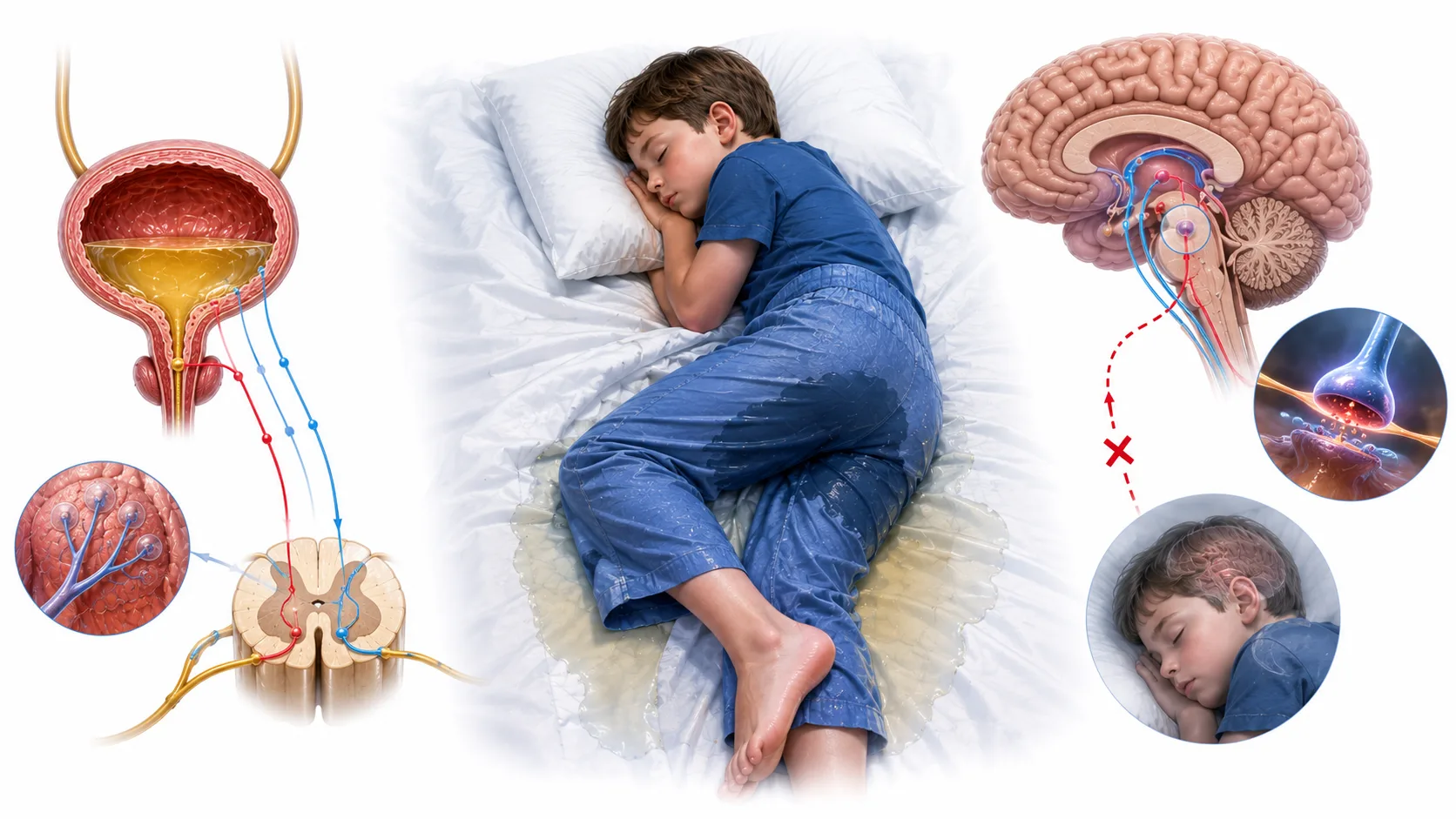
Bedwetting often occurs when bladder signals fail to wake a sleeping child.
Bladder fills
Urine continues collecting during the night while the child sleeps.
Signal sent
Stretch receptors in the bladder send messages to the brain that it is becoming full.
No awakening
The sleeping brain does not wake enough to respond to the signal.
Bedwetting occurs
Urination happens before conscious control can take over.
Not intentional
The Most Important Thing to Understand
Children do not choose to wet the bed.
This may sound obvious, but for generations many adults believed otherwise.
Children were punished, shamed, and blamed for something happening entirely outside their control.
Bedwetting occurs during sleep, when conscious decision-making is offline.
The child is not ignoring the urge to urinate.
The child never becomes aware of the urge in the first place.
Understanding this changes the entire conversation.
Brain and bladder
A Developmental Timing Problem
Bedwetting is often described as a bladder problem.
In reality, it is usually a communication problem.
The bladder and brain must work together throughout the night.
As the bladder fills, signals travel to the brain warning that it is becoming full.
The brain then has two choices: wake up or suppress urination until morning.
Young children are still learning to coordinate this system.
Sometimes the bladder does its job perfectly while the sleeping brain misses the call.
Deep sleep
Some Children Simply Sleep Too Well
Parents often describe bedwetters as extremely deep sleepers.
There is some truth to that observation.
Many children who wet the bed are remarkably difficult to wake.
Their brains remain deeply committed to sleep even when the bladder is sending increasingly urgent signals.
This does not mean they are lazy or ignoring their bodies.
It means the mechanisms that connect bladder signals to awakening are still developing.
In some children, sleep wins the argument.
Genetics
Bedwetting Often Runs in Families
One of the strongest clues comes from family history.
If one parent wet the bed as a child, their children are more likely to do the same.
If both parents experienced bedwetting, the likelihood rises even further.
Scientists have identified several genetic influences associated with nighttime bladder control.
This helps explain why bedwetting often appears in otherwise healthy children with no obvious medical problems.
Sometimes the answer is not something the child did. It is something they inherited.
Urine production
Some Children Make More Urine at Night
The body normally reduces urine production during sleep.
It does this using a hormone called vasopressin.
In some children, nighttime hormone patterns have not fully matured.
As a result, they produce more urine while sleeping than their bladder can comfortably hold.
Even a normally functioning bladder may struggle under those conditions.
The result is a simple mathematical problem: too much urine and not enough waking.
When to seek help
When Bedwetting Deserves Attention
Most bedwetting is a normal developmental variation.
But there are situations where professional evaluation is worthwhile.
A child who suddenly starts wetting the bed after being dry for a long time may need assessment.
Daytime accidents, pain during urination, unusual thirst, constipation, or other symptoms can also point to medical issues worth investigating.
Fortunately, these situations are the exception rather than the rule.
For most children, time is the most effective treatment.
Myth vs reality
Myth vs Reality
What people think
Children wet the bed because they are lazy
Many people assume children could stay dry if they simply tried harder or cared more.
What actually happens
Bedwetting happens during sleep, not choice
The child is asleep when the event occurs. Bedwetting is usually related to bladder development, sleep depth, urine production, and genetics rather than motivation or behavior.
Quick answers
Common questions
At what age is bedwetting considered normal? +
Bedwetting is common in younger children and can remain normal well into the early school years. Doctors usually evaluate concerns based on the child's age, frequency of episodes, and overall health.
Should children be punished for bedwetting? +
No. Bedwetting happens during sleep and is not under conscious control. Punishment is ineffective and can increase shame and anxiety.
Does drinking before bed cause bedwetting? +
Drinking large amounts of fluid before bedtime can contribute, but it is rarely the sole cause. Most bedwetting involves developmental factors as well.
Is bedwetting inherited? +
Yes. Family history is one of the strongest predictors of childhood bedwetting.
When should parents talk to a doctor? +
Parents should seek medical advice if bedwetting begins suddenly after a long dry period, occurs alongside daytime symptoms, causes significant distress, or is accompanied by other concerning health changes.