Visual answer
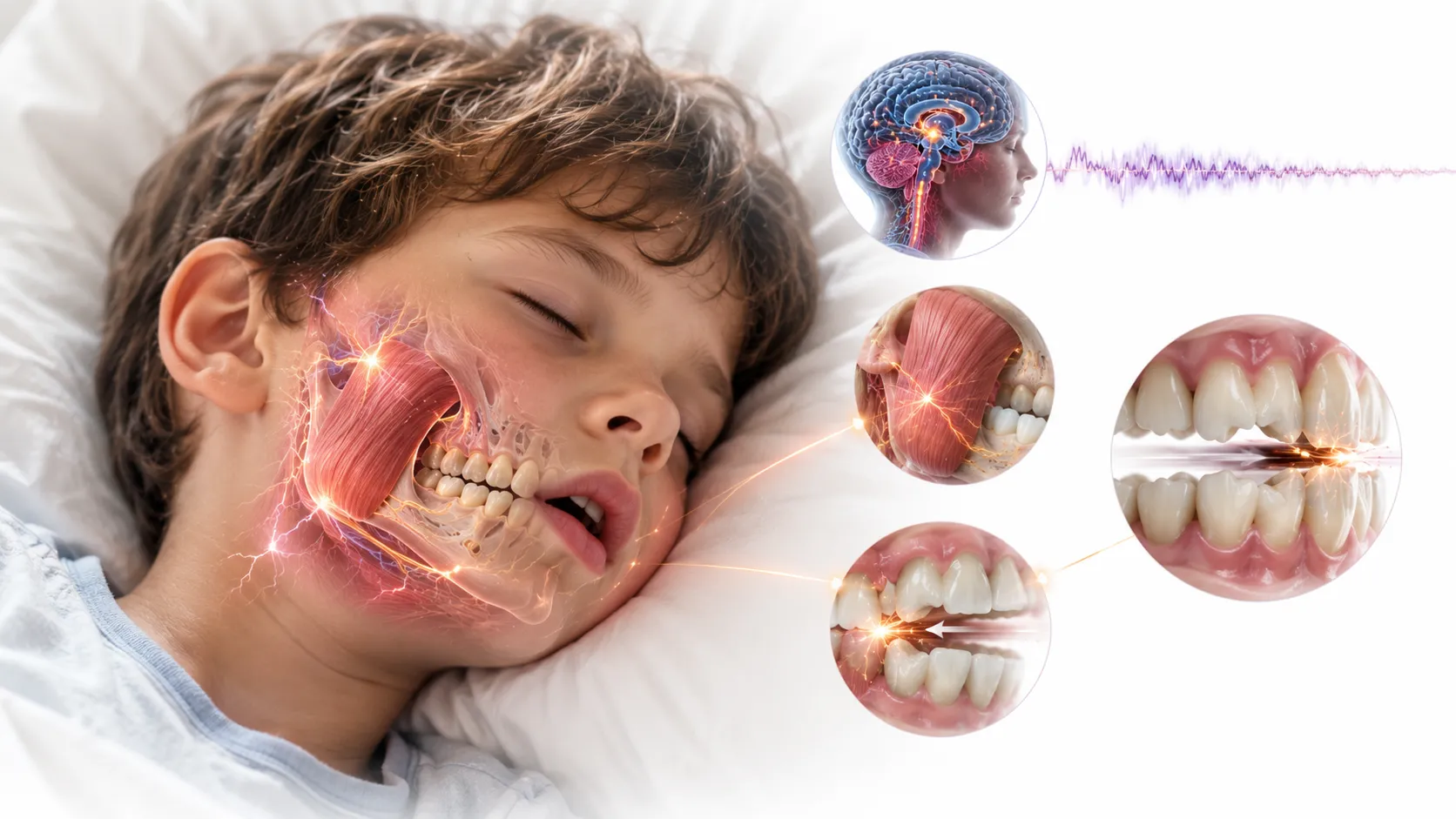
How Teeth Grinding Happens During Sleep
Brief activations of the jaw muscles can occur while the child remains asleep.
Sleeping brain
The child remains asleep while the nervous system continues regulating movement and arousal.
Brief activation
The jaw muscles receive a temporary activation signal during sleep.
Grinding motion
The upper and lower teeth rub together repeatedly.
Return to sleep
The episode usually ends quickly, often without waking the child.
What it is
A Surprisingly Powerful Sleep Behavior
Most people think of sleep as a period of stillness.
The reality is more complicated.
Even while sleeping, the brain continues regulating breathing, posture, movement, temperature, and countless other processes.
Sometimes the jaw muscles become active too.
When that activation causes the teeth to clench or rub together, the result is called bruxism.
To parents, it often sounds alarming. To researchers, it is one of several unusual ways the sleeping brain can influence the body.
Why children
Why Children Grind Their Teeth More Often
Childhood is a period of constant neurological change.
Sleep patterns, brain networks, muscle control systems, and sensory processing are all developing at the same time.
Researchers believe this ongoing development may make temporary sleep behaviors more common.
Sleepwalking, sleep talking, night terrors, and teeth grinding all occur more frequently in children than in adults.
The brain is still learning how to coordinate sleep and movement efficiently.
Most children eventually grow out of these behaviors as those systems mature.
Stress
Is Stress Really the Cause?
Stress is often blamed for teeth grinding.
In adults, there is some truth to that idea.
But childhood bruxism is more complicated.
Many children who grind their teeth appear relaxed, healthy, and emotionally secure.
Stress may increase the likelihood of grinding in some children, but it cannot explain most cases on its own.
Researchers increasingly view bruxism as a sleep-related movement behavior rather than simply a response to anxiety.
Sleep arousals
The Brain May Be Briefly Waking Up
One of the strongest theories involves tiny events called sleep arousals.
These are brief increases in brain activity that happen without fully waking the child.
During these moments, heart rate may change, muscles may activate, and parts of the nervous system become temporarily more alert.
Teeth grinding often appears around these partial arousals.
The child never becomes conscious enough to remember anything, but the jaw muscles may briefly receive a stronger activation signal.
The result is a few seconds of grinding before sleep settles back into its normal rhythm.
When it matters
When Should Parents Pay Attention?
Most childhood teeth grinding is harmless.
Many parents discover it only because they hear it at night.
Problems become more likely when grinding is severe, frequent, or persistent.
A dentist may notice unusual wear on the teeth, or a child may complain of jaw discomfort, headaches, or morning soreness.
In those cases, professional evaluation can help determine whether treatment is necessary.
Fortunately, serious complications remain uncommon.
Myth vs reality
Myth vs Reality
What people think
Children grind their teeth because they are anxious
Many people assume stress is the primary cause of childhood bruxism.
What actually happens
Most childhood bruxism appears linked to sleep development
Stress can contribute in some cases, but many children who grind their teeth show no signs of significant anxiety. Sleep-related neurological development appears to play a major role.
Quick answers
Common questions
Is teeth grinding normal in children? +
Yes. Teeth grinding is relatively common during childhood and is usually considered a normal developmental behavior.
Can teeth grinding damage my child's teeth? +
Mild grinding rarely causes serious problems. Severe or long-lasting grinding can sometimes wear down teeth and should be evaluated by a dentist.
Does stress cause teeth grinding? +
Stress may contribute in some cases, but it does not explain most childhood bruxism. Many children who grind their teeth show no signs of emotional distress.
Should my child wear a night guard? +
Most children do not need one. A dentist can determine whether a protective device is appropriate if grinding is causing significant wear or discomfort.
When should I talk to a dentist? +
Consult a dentist if you notice significant tooth wear, jaw pain, headaches, or if the grinding seems unusually severe or persistent.