Visual answer
Where Sleepwalking Happens in the Sleep Cycle
Sleepwalking usually begins during deep NREM sleep, when the brain partially wakes without full awareness.
Light sleep
The child is easy to wake, and the brain is transitioning away from full alertness.
Deep sleep
Sleepwalking usually starts here, during slow-wave sleep, when the brain is hardest to wake fully.
Partial arousal
Movement systems activate, but awareness and memory do not fully come online.
REM sleep
This is the dream-heavy stage, but ordinary sleepwalking usually does not happen here.
Half-awake brain
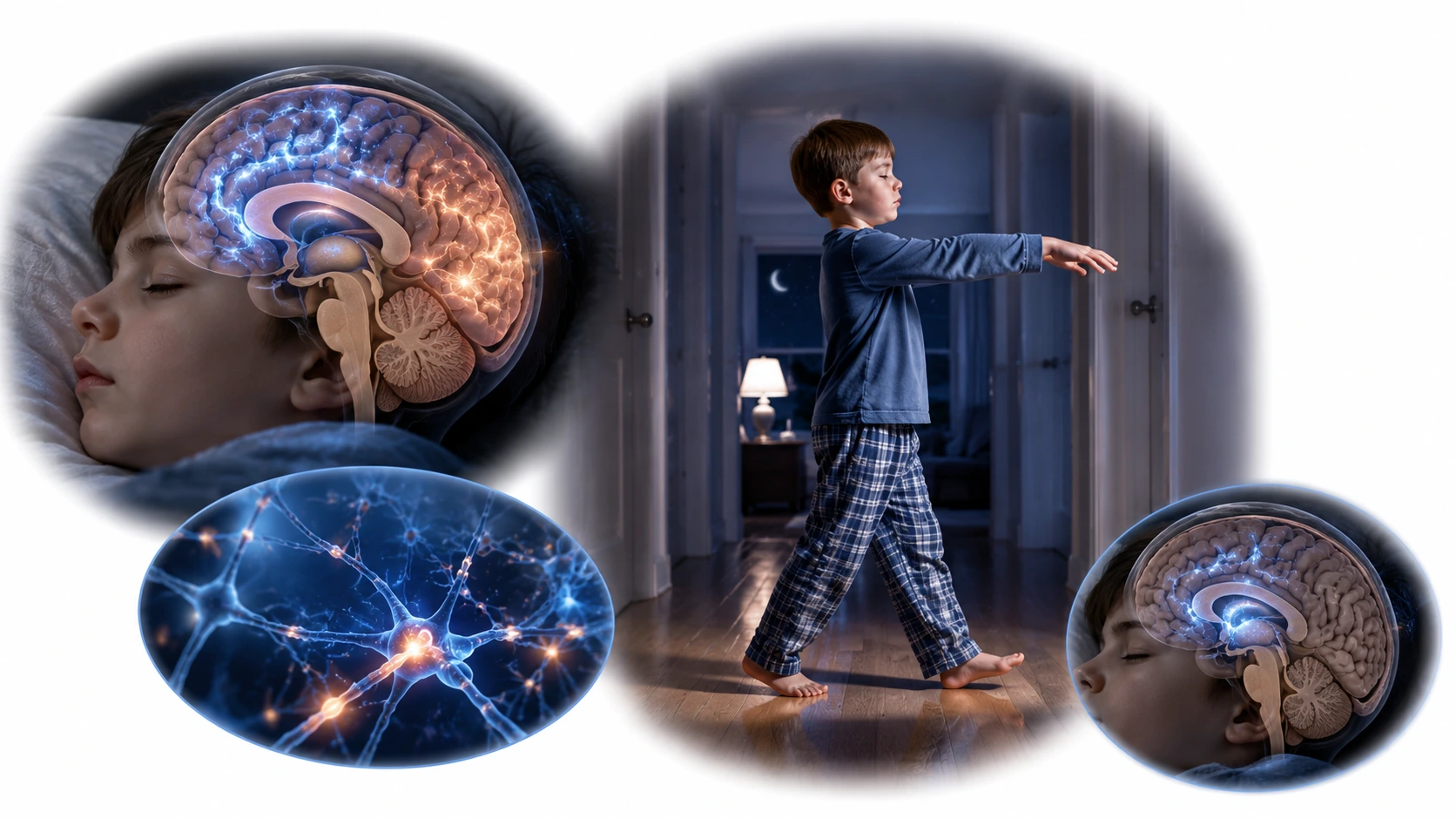
The Brain Is Awake in Pieces
Sleepwalking seems impossible only if we imagine sleep as one simple state.
It is not.
Different parts of the brain can be in different levels of sleep and wakefulness at the same time.
During sleepwalking, the systems that handle movement and basic navigation become active enough to move the body through a familiar space.
But the parts of the brain responsible for judgment, self-awareness, and memory remain mostly offline.
That is why a child can walk through a room but have no idea what they are doing.
The body is moving. The conscious narrator is absent.
Deep sleep
Why It Happens During Deep Sleep
Most people assume sleepwalking must come from dreams.
It usually does not.
Sleepwalking tends to begin during deep NREM sleep, especially in the first part of the night.
This is the heavy, slow-wave sleep where the brain is difficult to wake and the body is doing much of its repair and growth work.
If something partially disturbs the brain during this stage, the child may not wake completely.
Instead, the result is a strange halfway state: awake enough to move, asleep enough to remember nothing.
Why children
Why Children Sleepwalk More Than Adults
Children spend more time in deep sleep than adults do.
That alone gives sleepwalking more opportunity to happen.
Their brains are also still learning how to move cleanly between sleep stages. The systems that keep sleep organized are not fully mature yet.
Sometimes a child is pulled partly toward waking but does not complete the transition.
The motor system comes online. Awareness does not.
As children grow, sleep becomes more stable and the episodes often fade on their own.
Triggers
What Makes Sleepwalking More Likely
Sleepwalking often appears when sleep is under pressure.
Sleep deprivation is a common trigger. When a child is overtired, the brain may sink into deeper slow-wave sleep, making partial arousals more likely.
Fever can do something similar by making sleep deeper and more disrupted.
Stress, irregular sleep schedules, unfamiliar sleeping places, and a full bladder can also increase the chances of an episode.
These triggers do not create sleepwalking from nowhere. They make an already vulnerable sleep system more likely to slip into that half-awake state.
What to do
What Parents Should Actually Do
The goal during a sleepwalking episode is not to interrogate the child or shake them fully awake.
The goal is safety.
Speak softly, guide them gently back to bed, and keep the environment calm.
If they wake up, they may seem confused or upset. That is normal. They have been pulled suddenly out of deep sleep.
For children who sleepwalk often, prevention matters more than the episode itself.
A regular sleep schedule, enough rest, locked doors, stair gates, and removing hazards can make the behavior far less risky.
Waking myth
Myth vs Reality
What people think
You should never wake a sleepwalker
Many people believe waking a sleepwalker can shock them, harm them, or even cause a heart attack.
What actually happens
Waking them is not dangerous, but it can be disorienting
There is no evidence that waking a sleepwalker causes physical harm. They may be confused or frightened, so it is usually better to guide them back to bed gently unless safety requires waking them.
Quick answers
Common questions
Will my child remember sleepwalking? +
Usually no. Sleepwalking happens while the memory-forming parts of the brain are not fully active, so most children have no memory of the episode.
Is sleepwalking caused by dreams? +
Usually not. Sleepwalking most often occurs during deep NREM sleep, not REM sleep, where vivid dreaming is more common.
Should I wake my child if they sleepwalk? +
You can wake them if safety requires it, but it is often better to calmly guide them back to bed. Waking them is not dangerous, just potentially confusing.
When should I talk to a doctor? +
Speak with a pediatrician if episodes are frequent, dangerous, very disruptive, or begin suddenly in an older child with no previous history.
Do children outgrow sleepwalking? +
Most do. Sleepwalking often decreases as the brain matures and sleep patterns become more stable.