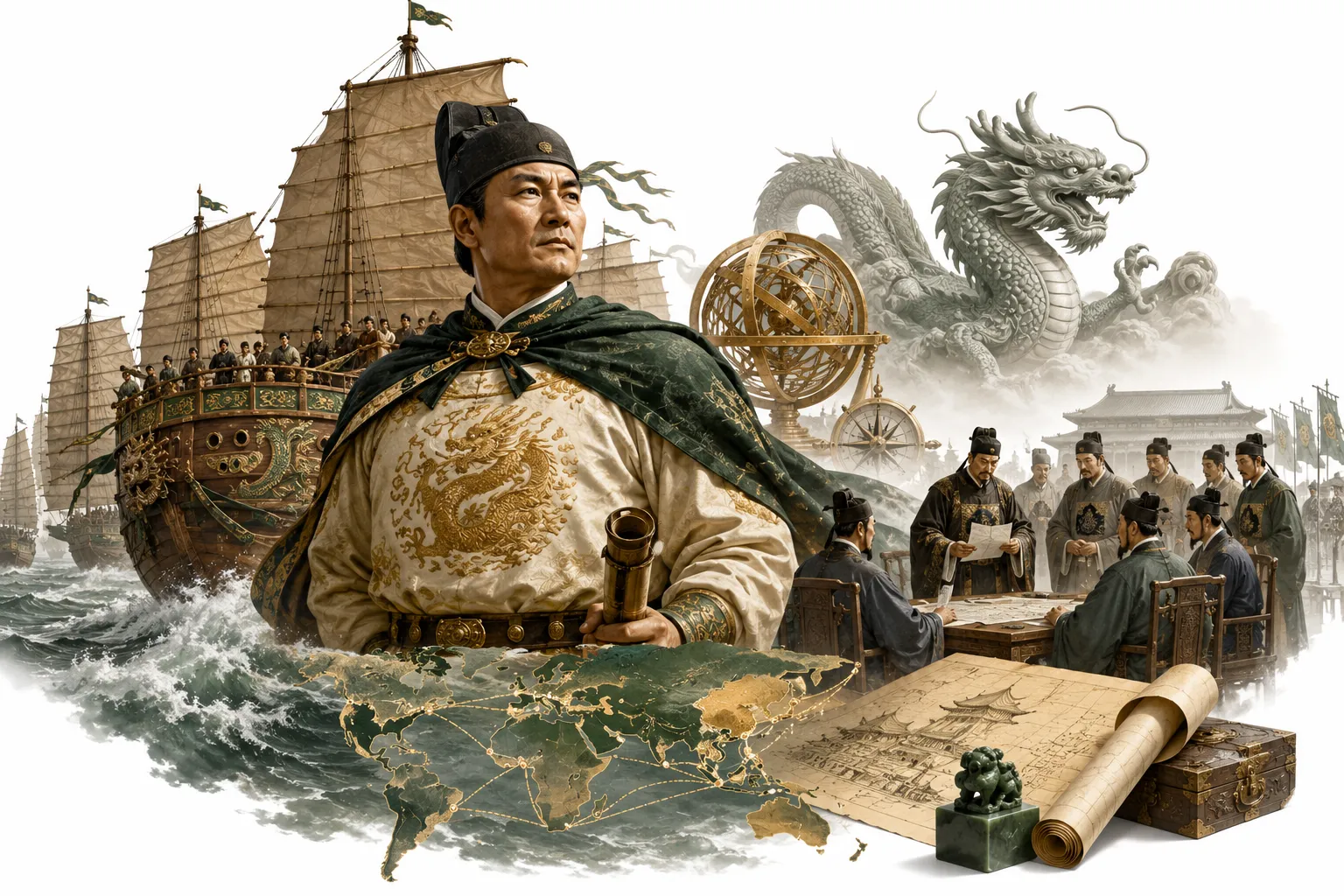
Quick Facts
Quick Facts
Zheng He was a Muslim eunuch from Yunnan province.
He was captured as a child and made a servant in the imperial palace.
His treasure ships were reportedly 400 feet long, though some historians think this is an exaggeration.
He brought back exotic animals, including a giraffe, which was mistaken for a qilin (a mythical creature).
The voyages cost an enormous amount of money. That is why they were stopped.
Visual answer
The Rise and Fall of Zheng He's Fleet
Why China stopped exploring.
1405
First voyage. Zheng He commands 317 ships and 28,000 men.
1407-1424
Six more voyages. The fleet reaches Africa.
1424
Yongle Emperor dies. Hongxi Emperor takes power.
1425
Hongxi orders the fleet dismantled. The ships are burned or left to rot.
1431
Zheng He attempts a final voyage. He dies in 1433, possibly at sea.
Story in brief
Story in Brief
1405
First voyage of Zheng He. The fleet sails to Southeast Asia, India, and the Middle East.
China announces its presence as a maritime superpower.
1407-1424
Six more voyages. The fleet reaches Africa. Giraffes and zebras are brought back.
1424
Yongle Emperor dies. His son, Hongxi, becomes emperor.
1425
Hongxi orders the fleet dismantled. Shipyards are closed. Sailing is forbidden.
The treasure voyages end. Zheng He's career is over.
1431
The new emperor, Xuande, allows one final voyage. Zheng He is old and sick.
1433
Zheng He dies, possibly at sea. His fleet returns to China. No further voyages are authorized.
The age of Chinese exploration is over. It will not resume for 500 years.
The Story
How China Turned Its Back on the Sea
In 1405, the Chinese emperor Yongle launched the greatest fleet the world had ever seen. The treasure ships were enormous, possibly 400 feet long (Columbus's Santa Maria was 60 feet). The fleet carried 28,000 men, including sailors, soldiers, interpreters, and doctors.
Over the next 28 years, Zheng He commanded seven voyages. He sailed to Southeast Asia, India, the Middle East, and Africa. He brought back ambassadors, exotic animals, and tribute. China was the superpower of the world. And it was a maritime superpower.
Then the emperor died. His son, Hongxi, was a Confucian traditionalist. He thought the voyages were a waste of money. He ordered the fleet dismantled. The ships were burned or left to rot. The shipyards were closed. Sailing was forbidden. Within a decade, the greatest navy in history had vanished. China turned inward. It would not look outward again for 500 years.
From the Records
"We have traversed more than 100,000 li of immense water spaces and have beheld in the ocean huge waves like mountains rising in the sky."
, Inscription from Zheng He's voyages
The inscription was carved in stone. It commemorates the voyages. It also marks their end. After Zheng He, there were no more.
Evidence
Why the Voyages Stopped
The voyages were extremely expensive. The cost was not sustainable.
StrongThe new emperor was a Confucian traditionalist who saw overseas adventures as wasteful.
StrongChina faced threats from the north. Money was diverted to defense.
StrongThe fleet was dismantled and the shipyards were closed.
StrongKey Points
Key Points So Far
Zheng He commanded seven voyages between 1405 and 1433.
His fleet was the largest the world had ever seen.
The voyages stopped because the emperor who supported them died.
The new emperor was a traditionalist who saw the voyages as wasteful.
The fleet was dismantled. China turned inward for 500 years.
Analogy
Like Having a Spaceship and Destroying It
The familiar part
Imagine a country that builds a fleet of starships. They explore nearby planets. Then a new leader says, 'This is too expensive.' The starships are scrapped.
How it applies
That was China. The treasure ships were the starships of their era. They were scrapped. China chose the ground over the stars.
Where the analogy breaks
Spaceships are harder to build than wooden ships. But the analogy stands.
Curiosity Notes
Details Most People Miss
Why this still matters
Why This Still Matters
Zheng He's story is a reminder that history is not inevitable. China could have been a maritime superpower. It chose not to be. The decision was political, not technological. A change of emperors changed the course of history. That is the lesson: leadership matters. The choice to explore or retreat is not determined by geography or technology. It is determined by people. And people can be wrong.
Key Findings
- ✓Core findingZheng He commanded seven voyages between 1405 and 1433.
- ✓Strong evidenceHis fleet was the largest the world had ever seen.
- ⚠Main consequenceThe voyages stopped after the death of the Yongle Emperor.
- ✓Wider legacyThe new emperor saw the voyages as wasteful and ordered the fleet dismantled.
- ★Bottom lineChina turned inward for 500 years.
Final insight
A Last Thought
Zheng He stopped sailing because a new emperor decided that the sea was not worth the cost. The fleet was burned. The shipyards were closed. The knowledge was lost. China turned inward. Five hundred years later, European ships arrived in Chinese waters, demanding trade. China had no fleet to oppose them. The decision to stop sailing was not inevitable. It was a choice. And it was a mistake. Zheng He's ships are gone. But the lesson remains: exploration is expensive. Retreat is more expensive.
Quick answers
Common questions
Did Zheng He discover America? +
Probably not. There is no credible evidence that Chinese ships reached the Americas before Columbus. Some fringe theories claim they did. Mainstream historians reject them.
What happened to Zheng He's ships? +
Most were burned or left to rot. Some may have been preserved as museum pieces. None survived. The knowledge of how to build them was lost.