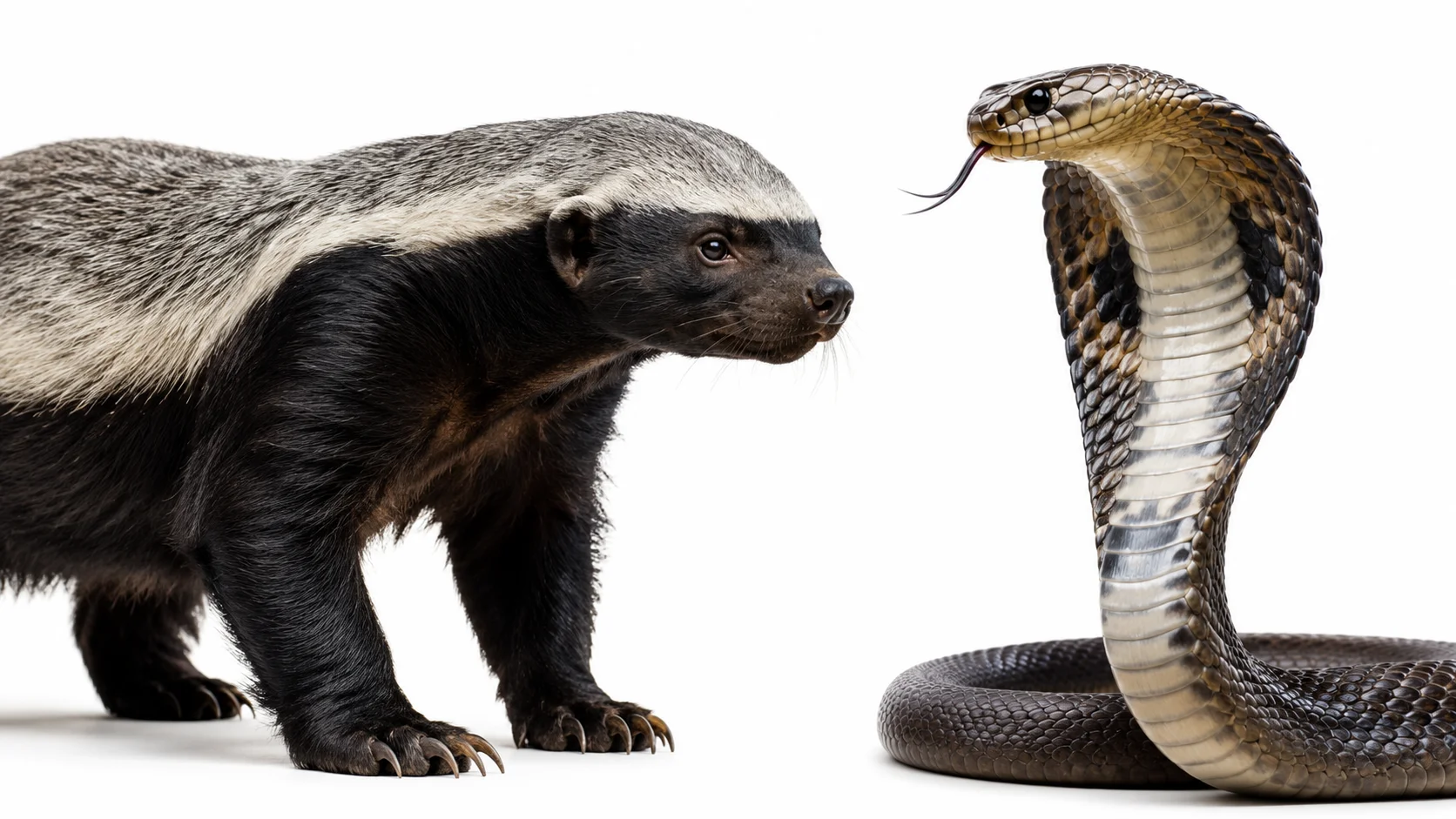
Visual answer
The Honey Badger's Biological Defenses
Each physical feature contributes to why the honey badger can survive encounters that would kill most similarly sized animals.
Thick, loose skin
The skin is approximately 6mm thick and only loosely attached to the underlying muscle. This allows the badger to rotate inside its own skin when grabbed, enabling it to bite back even when held by a larger predator.
Modified venom receptors
Genetic mutations in nicotinic acetylcholine receptors reduce the effectiveness of neurotoxic snake venom. This does not make honey badgers immune but significantly slows the venom's impact, giving them time to recover.
Powerful claws and digging strength
Their front claws can reach 4cm in length and are backed by disproportionately strong forearms. Honey badgers can break open concrete-reinforced beehives, tear apart termite mounds, and dig faster than most predators can follow.
Exceptionally strong jaw
The honey badger's jaw can crush tortoise shells and thick animal bones. Their bite force is extreme relative to body size, and they are documented to eat every part of a prey animal including bones, feathers, and shell.
Introduction
Why Does Such a Small Animal Act Like It Fears Nothing?
The honey badger weighs between 7 and 16 kilograms. It is roughly the size of a medium dog. And yet it is documented charging lions, stealing kills from leopards, and fighting off packs of wild dogs without retreating.
To understand why a small carnivore behaves this way, you have to look at what it has evolved to survive. The honey badger is not acting recklessly. It is acting in accordance with a body that has been optimized over millions of years to be extremely difficult to kill and extremely costly to fight.
When your armor is good enough that even a lion frequently gives up, aggression stops being a liability and starts being one of the most effective survival strategies available.
Actually Fearless?
Are Honey Badgers Actually Fearless?
Fearlessness in animals is not an emotion in the way humans experience it. What researchers observe in honey badgers is more accurately described as an extremely high threshold for threat assessment combined with a behavioral tendency toward aggression rather than flight.
Most animals perform a rapid cost-benefit calculation when encountering a threat. For animals with high predation risk and limited defenses, fleeing is usually the correct response. Honey badgers have such robust physical defenses that standing and fighting is often the better option, and their nervous system and behavior appear calibrated accordingly.
Whether they subjectively feel fear is unknown. What is observable is that their behavior consistently resembles an animal that has calculated, correctly, that it is very hard to kill.
Thick Skin
The Secret Weapon: Thick, Loose Skin That Predators Struggle to Grip
The most important physical defense the honey badger has is not its claws or its jaws. It is its skin.
Honey badger skin is approximately 6mm thick, which is comparable to the thickness of a buffalo hide. More importantly, it is only loosely attached to the underlying muscle layer. When a predator grabs a honey badger, the animal can rotate inside its own skin, twisting around to bite the attacker even while being held.
This single trait dramatically changes the cost calculation for any predator. A lion that grabs a honey badger does not have a secured target. It has an animal that is now biting its face while it tries to maintain a grip. Many large predators, including lions and leopards, have been observed releasing honey badgers and walking away rather than continuing an attack.
The skin also resists bee stings, porcupine quills, and the puncture attempts of snake fangs, though it is not impenetrable to all of these.
Snake Bites
Why Honey Badgers Can Survive Snake Bites That Kill Other Animals
Honey badgers are regularly observed attacking and eating highly venomous snakes, including black mambas and king cobras. In some documented cases, they have been bitten during the encounter and appeared to recover within hours.
The resistance comes from a genetic mutation in their nicotinic acetylcholine receptors, which are the proteins that neurotoxic venoms target. The alpha-neurotoxins in cobra and mamba venom work by blocking these receptors and causing paralysis. In honey badgers, the binding site for these toxins is structurally different, reducing how effectively the venom can attach and disrupt nerve signaling.
This is the same type of mutation found in mongooses and hedgehogs. It does not provide complete immunity. Honey badgers can still be seriously affected or killed by very large venom doses, but their resistance is genuine and has been confirmed through molecular analysis of their receptor proteins.
Physical Build
Built for Battle: Powerful Claws, Jaws, and Muscles
Honey badgers are built with a degree of physical strength that is disproportionate to their size. Their front claws can reach 4 centimeters in length and are supported by forearm muscles that allow them to break open reinforced beehives, tear apart termite mounds, and dig through compacted soil at speed.
Their jaw strength is similarly exceptional relative to their size. Honey badgers routinely consume entire prey animals including bones, shells, and tough hide. Tortoise shells, which resist significant pressure, are documented prey items. Their skulls are reinforced to handle the mechanical stress of this level of biting.
They also have a broad, flat body plan that keeps their center of gravity low and makes them difficult to flip or pin to the ground, an advantage when fighting much larger animals.
Fighting Larger Animals
Why Honey Badgers Fight Animals Much Larger Than Themselves
For most small animals, fighting a much larger predator is suicidal. The honey badger is one of the rare cases where the math works out differently.
Because of its thick loose skin, extreme bite force, and resistance to the most common weapons larger predators use, a honey badger fighting back imposes real costs on its attacker. Large cats risk significant facial wounds. Venomous snakes risk being eaten. Even cape buffalo have been documented being harassed by honey badgers without being able to effectively retaliate.
When fleeing is also an option, honey badgers do sometimes retreat. They are not suicidal. But when cornered or defending a food source, the combination of defensive advantages and aggressive capability makes standing and fighting a rational strategy in a way it simply is not for most animals of similar size.
Vs. Big Predators
Do Honey Badgers Really Attack Lions, Leopards, and Hyenas?
Yes, and these encounters are well documented on video and in wildlife research. Honey badgers have been filmed charging lions that approach them, chasing hyenas away from kills, and engaging leopards directly rather than fleeing.
In most documented cases involving lions and leopards, the larger predator eventually disengages. This does not mean the honey badger would win a prolonged fight to the death against a healthy adult lion. It means the lion calculates that the energy expenditure and injury risk from continuing is not worth it for a small prey item.
Honey badgers have also been documented stealing kills from much larger predators by simply walking up and refusing to leave, using aggression and persistence to displace an animal that could theoretically kill them easily.
Why Predators Back Off
Why Predators Often Decide a Honey Badger Isn't Worth the Risk
The key to understanding honey badger interactions with large predators is the concept of net cost. A lion that attacks a honey badger is not hunting for survival in most cases. It is investigating or responding to a perceived territorial intrusion.
The honey badger, however, fights back with its full arsenal immediately. Every second of the encounter risks injury to the predator's paws, face, and eyes. The honey badger's skin means the lion cannot quickly incapacitate it. And unlike prey animals, the honey badger does not panic, flee, or stop fighting.
For an animal that depends on physical condition for survival, absorbing wounds from a small animal over a meal that provides little nutritional value is a poor trade. This is why large predators frequently disengage, not because they fear the honey badger in an emotional sense, but because the calculation does not favor continuing.
Evolution
The Evolutionary Advantage of Aggression and Persistence
Honey badgers belong to the family Mustelidae, which includes wolverines, weasels, and otters. Several members of this family show similar patterns of disproportionate aggression relative to body size, which suggests the behavioral tendency has deep evolutionary roots.
For the honey badger specifically, its habitat in sub-Saharan Africa, the Middle East, and South Asia is one of the most competitive large predator environments on earth. Evolving the ability to deter rather than escape predators was likely driven by this intense competition for food and territory.
Genetic analysis suggests honey badger lineages are tens of millions of years old. The suite of traits they carry, thick skin, venom resistance, extreme jaw strength, and persistent aggression, is not random. It is the product of a very long selection process in which these traits consistently improved survival.
Raiding Beehives
How Honey Badgers Raid Beehives Without Giving Up
Honey badgers are one of the few animals that consistently raid active beehives for honey and larvae. The behavior that makes this possible is the combination of their thick sting-resistant skin, a tolerance for pain that researchers describe as unusually high, and in some cases a mutualistic relationship with a bird called the greater honeyguide.
The greater honeyguide leads honey badgers to beehives by calling and flying ahead of them. The honey badger breaks open the hive and both animals benefit, one of the most unusual inter-species collaborations documented in wildlife.
Thousands of bee stings occur during a typical raid. The honey badger absorbs them and continues feeding. This behavior illustrates not just physical toughness but a behavioral persistence in the face of continuous pain stimulation that is genuinely exceptional among mammals.
Pain Tolerance
Why Honey Badgers Seem Immune to Pain and Punishment
Honey badgers are not physiologically immune to pain. They have the same basic nociceptive nervous system that other mammals do. What they appear to have is an unusually high behavioral threshold for pain-driven withdrawal.
In observed encounters, honey badgers continue fighting through injuries, bee stings, and snake bites that cause other animals to retreat. Whether this reflects differences in pain receptor density, differences in how pain signals are processed in the brain, or simply a behavioral set point that prioritizes aggression over avoidance is not fully understood.
What researchers agree on is that the behavioral result, an animal that keeps fighting through significant physical trauma, is real and consistent, even if the exact neurological mechanism is not yet fully characterized.
Venom Resistance
Are Honey Badgers Immune to Venom or Just Highly Resistant?
The accurate answer is highly resistant, not immune. The distinction matters because immune implies zero effect, which is not true.
The genetic modifications to their acetylcholine receptors reduce the binding efficiency of alpha-neurotoxins significantly. This means a venom dose that would rapidly kill a dog or a human of comparable mass takes much longer to produce neurological effects in a honey badger, and the animal may recover from doses that would be lethal to others.
However, there are documented cases of honey badgers dying from snake bites, particularly from extremely venomous species or multiple bites. Their resistance is genuine, measurable, and biologically well-understood, but it has limits. The popular internet claim that honey badgers are completely immune to any venom is not accurate.
Natural Predators
Do Honey Badgers Have Any Natural Predators?
Adult honey badgers have very few animals that successfully prey on them regularly. Large lions and leopards can kill them, particularly young or injured individuals, and large raptors including martial eagles have been documented taking juvenile honey badgers.
In practice, most large predators learn to avoid honey badgers because the cost-to-benefit ratio of attacking one is poor. The animals that do occasionally kill honey badgers typically do so when the badger is young, sick, or caught in an unusual situation rather than through a standard predation encounter.
This near-absence of consistent predation pressure is itself part of why the honey badger's aggressive behavioral strategy works. If something large enough to kill them quickly and without injury existed in their environment at high frequency, the strategy would not have been selected for.
Vs. Snakes
Can a Honey Badger Really Kill a Snake?
Documented prey species
Black mamba, king cobra, puff adder, boomslang. Honey badgers actively hunt venomous snakes and consume them entirely.
Hunting method
They typically attack the snake's head first to prevent a bite, using speed and their powerful jaws to crush the skull.
When bitten
The honey badger may lose consciousness temporarily but typically recovers within hours due to its modified venom receptors.
Limitations
Very large snakes or multiple bites can still be lethal. The resistance is significant but not absolute.
Vs. Lions
Can a Honey Badger Really Kill a Lion?
One-on-one outcome
A healthy adult lion can kill a honey badger. The size and strength difference is too large to overcome in a sustained fight.
What actually happens
Lions frequently disengage from honey badger encounters before delivering a killing bite, because the cost in injury and effort is not worth it.
Documented cases
Multiple wildlife videos show lions grabbing and releasing honey badgers after sustained biting fails to incapacitate them.
Honey badger wins
The honey badger wins when the lion gives up, not by defeating the lion in a physical sense. These are different outcomes.
How They Got Famous
Why Honey Badgers Became Famous as the World's Most Fearless Animal
Honey badgers had been recognized by zoologists and wildlife biologists for their remarkable toughness long before they became a cultural phenomenon, but their mainstream fame traces largely to a 2011 viral YouTube video titled 'The Crazy Nastyass Honey Badger' which overlaid dramatic commentary onto National Geographic wildlife footage.
The video accumulated hundreds of millions of views and introduced the phrase 'honey badger doesn't care' into popular culture. The Guinness World Records listing of the honey badger as the world's most fearless animal, which predates the viral video, gave the claim a credible anchor that helped spread it widely.
The fame was built on real biology. The behaviors shown in wildlife footage, including confrontations with cobras, lions, and hyenas, were genuine. The cultural amplification exaggerated them into near-invincibility, but the underlying footage depicted real documented behavior.
The Myth
The Truth Behind the Honey Badger Doesn't Care Myth
The phrase captured something real but then ran ahead of it. Honey badgers do appear to have a high threshold for threat-driven behavior change, and they do continue fighting through injuries that cause other animals to stop. In that narrow sense, they behave as if they don't care about pain or danger.
But honey badgers do retreat sometimes. They do avoid certain threats. They do show wound-care behavior after fights. They are not indifferent to all stimuli in the way the meme implies.
The more accurate framing is that honey badgers have evolved to treat most threats as worth confronting rather than fleeing. That is a specific, well-supported biological claim. The generalization that they feel nothing and fear nothing is an entertaining exaggeration that obscures the genuinely interesting science.
Can They Die?
Can Honey Badgers Die? Separating Facts from Exaggeration
Can die from snake bites
Yes. Large doses of venom from highly venomous species can be fatal, especially with repeated bites.
Can die from large predators
Yes. Lions, leopards, and large raptors can kill honey badgers, particularly juveniles and injured individuals.
Can die from starvation and disease
Yes. They are subject to normal biological limitations like any mammal.
Average lifespan
Roughly 7 to 8 years in the wild, up to 24 years in captivity. Not immortal, but long-lived for a small carnivore.
Human Lessons
What Humans Can Learn from the Honey Badger's Survival Strategy
The honey badger's survival strategy centers on a single core principle: invest heavily in defenses that make you costly to attack, then use that investment as leverage to deter threats rather than escape them.
For humans, the analogy is less about physical toughness and more about the value of building real, demonstrable capability before adopting an aggressive or confident posture. The honey badger's boldness works because it is backed by genuine physical advantages. Aggression without underlying capability is just recklessness.
There is also something instructive in the honey badger's persistence. In the beehive raids, the animal does not give up when the first few thousand bee stings arrive. The goal remains fixed and the discomfort is absorbed. Whether that framing is useful for human challenges is a question of metaphor, but it is a consistent behavioral pattern that has proven evolutionarily successful.
Conclusion
The Real Reason Honey Badgers Seem Fearless
Honey badgers seem fearless because they have earned the right to be. Their thick, loose skin makes them difficult to grip and kill. Their modified venom receptors give them meaningful resistance to the bites of the most dangerous snakes in their range. Their jaw strength and claw power make them genuinely dangerous to any attacker. And their behavioral tendency toward aggression rather than flight is the rational response to having all of those advantages.
The meme version of the honey badger as an invincible, pain-immune force of nature is an exaggeration. The real animal can be killed, does get injured, and does sometimes retreat. But the biological foundation of its reputation is genuine.
It is not recklessness that makes honey badgers fight lions. It is millions of years of evolution producing an animal for which, unlike almost any other creature of similar size, the math of confrontation often works out better than the math of escape.
Quick answers
Common questions
Are honey badgers really fearless? +
They are not fearless in a strict physiological sense since they have a normal mammalian nervous system. What they have is a very high behavioral threshold for threat-driven retreat, backed by genuine physical defenses that make aggression a rational survival strategy. The result looks like fearlessness but is more accurately described as evolved boldness supported by real capability.
Why are honey badgers so aggressive? +
Their aggression is an evolutionary adaptation. Because their physical defenses make them costly to attack, standing and fighting is often more effective than fleeing. Over millions of years, the individuals that were more aggressive survived better in a competitive predator-dense environment, and that behavioral tendency was selected for.
Is the honey badger immune to venom? +
No, not immune. They carry genetic mutations in their nicotinic acetylcholine receptors that reduce the binding efficiency of alpha-neurotoxins found in cobra and mamba venom. This gives them significant resistance and recovery capability that most animals lack, but large doses can still be fatal. The resistance is real and well-documented but has limits.
Can a honey badger survive a king cobra bite? +
In many documented cases, yes. Honey badgers have been observed losing consciousness after king cobra bites and recovering within a few hours. Their modified venom receptors slow the neurotoxic effect significantly. However, survival is not guaranteed and depends on the dose received and the circumstances of the bite.
Can a lion kill a honey badger? +
Yes. A healthy adult lion has more than enough strength and mass to kill a honey badger if it commits fully to the attack. What happens in many documented encounters is that the lion disengages before delivering a killing blow because the honey badger fights back effectively enough to make continuing the attack not worth the risk of injury.
What animal can defeat a honey badger? +
Large lions and leopards can kill honey badgers when fully committed to the attack. Large raptors such as martial eagles can take juveniles. Very large venomous snakes delivering multiple bites can be fatal. The key pattern is that killing a honey badger typically requires either a significant size advantage combined with full commitment, or overwhelming venom delivery.
Why do honey badgers attack snakes? +
Snakes are prey. Honey badgers actively hunt venomous snakes as a food source, taking advantage of their venom resistance to access a protein-rich resource that most other predators of their size cannot safely pursue. The attacks are predatory behavior, not defensive, though honey badgers will also defend themselves against snake threats.
Why is the honey badger called the most fearless animal in the world? +
The Guinness World Records has formally recognized it with that title based on documented behavioral evidence of its willingness to confront much larger predators, raid defended beehives, and attack dangerous venomous snakes. The designation reflects observed behavior across multiple wildlife studies and is not purely based on internet mythology.
Do honey badgers have any natural predators? +
Very few consistent ones. Large lions, leopards, and martial eagles can kill them under certain conditions, particularly juveniles and injured individuals. Most large predators in their habitat learn to avoid honey badgers because the attack cost is high relative to the nutritional benefit. This near-absence of regular predation pressure is part of what made their aggressive behavioral strategy evolutionarily stable.
How strong is a honey badger compared to its size? +
Disproportionately strong. Their jaw strength can crush tortoise shells and animal bones. Their front claws can break open reinforced structures and dig through compacted earth faster than most pursuit predators can follow. Pound for pound, they are among the strongest carnivores on earth, comparable in relative terms to wolverines, which belong to the same family.