Visual answer
How Memento Mori works as a daily practice
The Stoics did not use Memento Mori to feel sad. They used it as a cognitive tool for clarity and gratitude.
Acknowledge mortality
This day will end. This person will not always be here. This situation will change. I will die.
Strip away the trivial
In the context of a finite life, which of today's irritations actually matter?
Feel the weight of what you have
The meal. The person across from you. The morning. These are not permanent. Which makes them precious.
Act accordingly
With your time clarified and your attention reset, make choices that reflect what you actually value.
Roman origin
The Roman general, the slave, and the most unusual job in history
In ancient Rome, when a general returned from a great military victory, he was awarded a triumph: a spectacular procession through the city, enormous crowds, the whole spectacle of empire celebrating one man's success.
According to historical accounts, including those of Tertullian and Dio Cassius, standing behind the general in his chariot for the duration of the parade was a slave. This slave had one job. He held a golden crown above the general's head. And he whispered, repeatedly, into the general's ear: Memento mori. Sometimes the phrase used was Respice post te, hominem te esse memento: Look behind you and remember that you are a man.
The purpose was explicit and unusual. The Romans were worried about hubris. A general at the height of triumph was exactly the person most likely to start believing he was a god. The slave was a built-in corrective. Amid all the glory, amid the crowds and the laurels and the empire on its knees before him, someone was required to say quietly: you are still mortal. You will die. Do not get confused about what you are.
Whether this practice was universal or occasional is debated by historians. What is certain is that the idea it represents was central to Roman Stoicism: that awareness of death was not weakness but wisdom, and that the people most likely to be destroyed by success were the ones who forgot their own mortality.
Marcus Aurelius
How Marcus Aurelius used Memento Mori every single day
Marcus Aurelius was the most powerful man in the known world. He commanded the Roman army, controlled the world's largest economy, and had no superior to answer to. He was also, privately, obsessed with the thought of his own death.
His private journal, written with no apparent intention of publication, which we now know as Meditations, returns to mortality on nearly every page. He writes: You could leave life right now. Let that determine what you do and say and think. He writes: Death can come for any of us at any moment. He writes about the emperors who came before him and how completely they have been forgotten. Alexander the Great, Julius Caesar, powerful men all, and what remains of them?
This was not depression. Aurelius was one of the most effective rulers Rome ever produced. His Memento Mori practice was a management tool. When you know you will die, you stop wasting time on things that do not matter. The petty grievances, the political vanity, the performance for an audience who will also die: all of it falls away when you hold death in view.
He also used a specific technique the Stoics called negative visualisation: instead of imagining things going well, you imagine losing what you currently have. The meal you are eating, imagine it is your last. The person you love, imagine they are already gone. Not to make yourself sad but to feel, in this moment, the full value of what is actually in front of you.
Not morbid
Myth: Memento Mori is a morbid, depressing obsession with death
What people think
Thinking about death constantly is unhealthy, anxiety-producing, and nihilistic.
The cultural assumption is that healthy people do not think about death. Death is what you think about when you have given up on life.
What actually happens
Decades of psychological research shows the opposite is true.
Terror Management Theory, developed by Jeff Greenberg and colleagues in the 1980s, has now been tested in hundreds of studies. When mortality awareness is engaged in the right way, it increases present-moment gratitude, reduces petty complaints, clarifies values, and improves wellbeing. The Stoics were describing a mechanism that psychology has since measured rigorously. Thinking about death is not the opposite of living fully. Done correctly, it is how you do it.
Memento Mori vs Carpe Diem
Myth: Memento Mori and Carpe Diem are basically the same thing
What people think
Both are about making the most of life because it is short. They are the same idea.
Both phrases involve mortality and urgency so they are often lumped together.
What actually happens
They point in similar directions but with fundamentally different emotional signatures.
Carpe Diem, seize the day, is Epicurean in origin. Its emphasis is on pleasure, experience, and not missing out. It tends toward hedonism. Memento Mori is Stoic. Its emphasis is on clarity, not pleasure. What matters before I die? Not: what is fun before I die? Carpe Diem is about the appetites. Memento Mori is about values. A person living by Carpe Diem might party harder. A person living by Memento Mori might call their father.
Stoicism vs Buddhism
Myth: Memento Mori in Stoicism and Buddhist death meditation are identical
What people think
Stoics and Buddhists both meditated on death, so the practice is the same.
Both traditions use death awareness as a central practice, which leads people to conflate them.
What actually happens
Same practice, different destination.
Buddhist death meditation, particularly maranasati, aims at detachment. The goal is to reduce the suffering caused by clinging to life and the fear of death. The endpoint is equanimity and non-attachment. Stoic Memento Mori aims at engagement. The goal is to use death awareness to be more present, more grateful, and more clear about what to do with the time you have. Buddhism wants you to hold your life lightly. Stoicism wants you to hold it tightly with clear eyes. Both involve sitting with mortality. But they are sitting for different reasons.
Memento Mori vs Amor Fati
Memento Mori vs Amor Fati, how they complement each other
What it asks you to remember
Memento Mori: you will die. Amor Fati: everything that happens is something you can love.
Primary emotion it cultivates
Memento Mori: gratitude and clarity. Amor Fati: acceptance and forward momentum.
What it works against
Memento Mori: wasted time, trivial complaints, unfelt gratitude. Amor Fati: regret, bitterness, resistance.
Time orientation
Memento Mori: present moment focus. Amor Fati: past acceptance and present willingness.
Core question it answers
Memento Mori: what matters before I die? Amor Fati: how do I feel about what has already happened?
Used together
Memento Mori clears the vision. Amor Fati clears the baggage. Together they produce someone who is present, grateful, and unencumbered by regret.
In art and jewellery
Memento Mori symbols in art, jewellery, and everyday objects
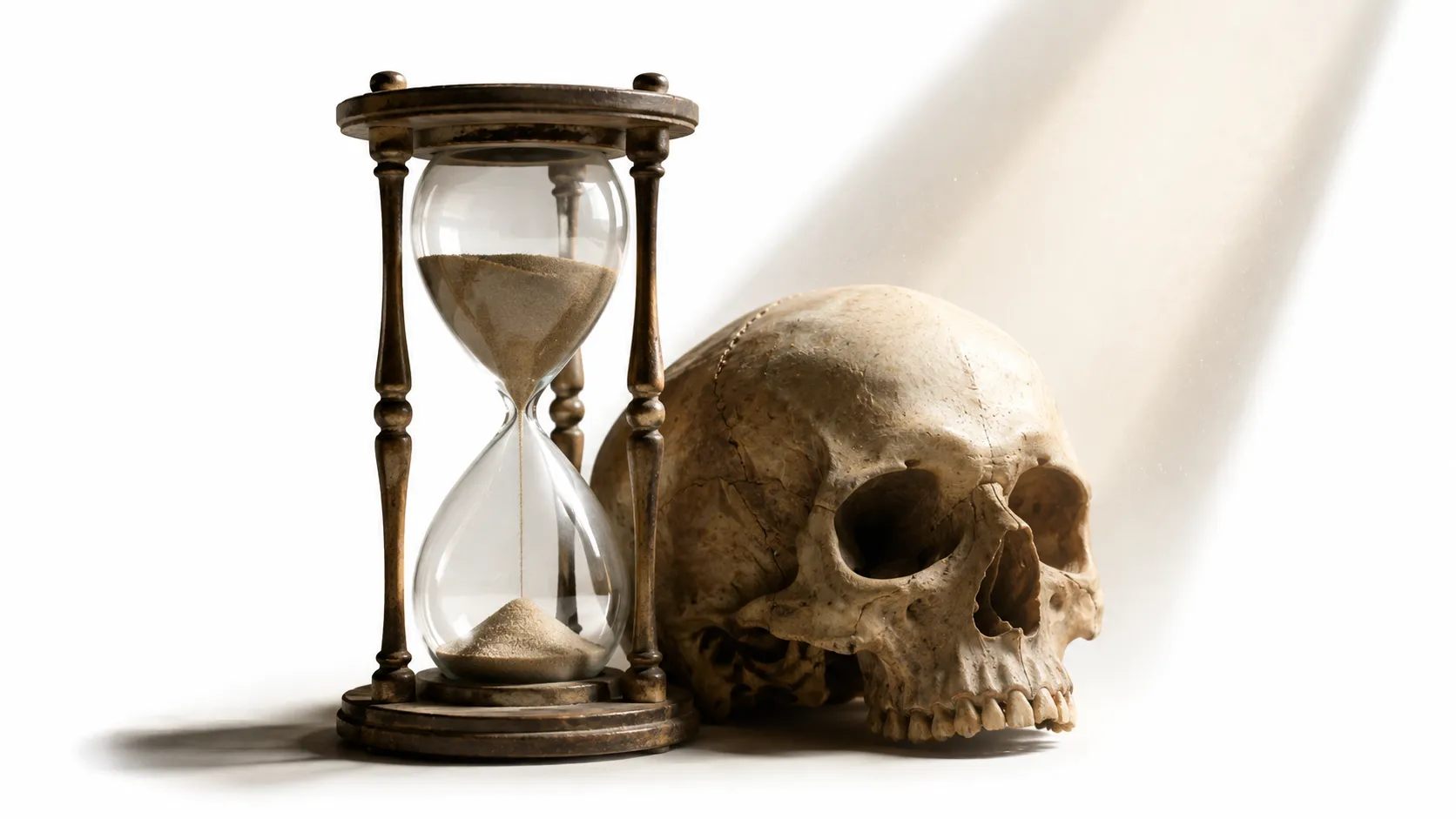
From the 16th century onward, Memento Mori became one of the dominant themes in European art and material culture. Vanitas paintings, a genre that flourished in the Netherlands in the 17th century, depicted skulls alongside beautiful objects: flowers, fruit, books, musical instruments, coins. The message was explicit. All of this is beautiful. All of this will rot.
Memento Mori jewellery was extremely common among the wealthy from the medieval period through the 19th century. Rings featuring skulls or skeletons, lockets containing a lock of a dead person's hair, brooches shaped as coffins. These were not considered morbid or unusual. They were considered tasteful and philosophically serious.
Queen Victoria wore Memento Mori jewellery throughout her decades of mourning Prince Albert. The genre was fashionable precisely among people who took their own mortality, and the deaths of those they loved, seriously.
In contemporary culture, the skull has become so ubiquitous as a design motif that the Memento Mori meaning has largely drained out of it. A skull on a t-shirt today carries about as much philosophical weight as a four-leaf clover on a coffee mug. But for people who wear or display Memento Mori symbols with the original intention, the practice remains what it always was: a small reminder in the corner of vision.
The Ryan Holiday Daily Stoic shop, the most commercially successful modern Stoic brand, sells Memento Mori medallions explicitly as daily practice objects. The coin is meant to be handled, kept in a pocket, and felt in moments of complaint or distraction. A physical object doing the same job the Roman slave did.
Daily practice
How to use Memento Mori as a daily practice without becoming insufferable about it
The Stoic practice is simple in theory and requires discipline in practice.
Morning. Before you start your day, spend two to five minutes with the awareness that this day is one you will not get back. This is not a reason to panic. It is a reason to notice the day rather than sleepwalk through it.
Evening. The Stoics practiced a nightly review called the examen. Before sleep, review the day. What did you do with it? Did you act in accordance with what you say you value? This is not self-punishment. It is quality control.
When you are annoyed. The next time a minor irritation feels enormous, ask: will this matter at the end of my life? The Stoic writer Seneca noted that most of what we suffer is the anticipation of loss rather than loss itself, and the nursing of grievances that would dissolve instantly in the face of real catastrophe.
When something good is happening. This is where Memento Mori is least intuitive and most powerful. Instead of waiting for good things to end before you appreciate them, appreciate them while they are happening by holding the awareness that they will end. The meal. The conversation. The person you love. You will not always have this. Feel it now.
The risk to avoid is using Memento Mori as ammunition against other people's joy. That is not the practice. The practice is private and inward.
Surprising facts
Eight surprising facts about Memento Mori
1. The phrase does not appear in ancient Roman texts with certainty. Tertullian wrote about the practice centuries later. The phrase as we know it may be a medieval or Renaissance formalisation of an older practice.
2. A study published in the journal Psychological Science found that thinking about death significantly increased participants' reported sense of meaning and purpose in the subsequent hours. Not decreased it.
3. The Mexican Dia de los Muertos tradition is a cultural Memento Mori at national scale: an annual community practice of bringing death into the present, making it visible, and sitting with it as a way of feeling the value of living.
4. Steve Jobs' famous 2005 Stanford commencement speech is essentially a Memento Mori address. He described standing in the mirror each morning asking himself if he was doing what he would want to be doing if he knew today was his last day.
5. Pope Gregory the Great in the 6th century instructed monks to keep a skull on their desks as a constant reminder of mortality. This practice was widespread in monasteries for centuries.
6. The Black Death in 14th century Europe triggered an explosion of Memento Mori art. When roughly a third of the European population died in a few years, the idea that death was theoretical evaporated. The Danse Macabre, a visual motif showing Death dancing with people of every social class, spread across the continent.
7. The philosopher Martin Heidegger built his entire concept of authentic living on the idea that confronting your own death, what he called being-toward-death, is the only thing that can shock a person out of the comfortable numbness of everyday life.
8. Terror Management Theory experiments have shown that reminding people of their mortality, in subtle ways, makes them more generous, more kind, and more likely to help strangers. The same reminders, done clumsily, can trigger defensiveness and aggression. The method matters as much as the intention.
Quick answers
Common questions
What does Memento Mori mean? +
Memento Mori is Latin for remember that you will die. It was used by Stoic philosophers, Roman generals, and Renaissance artists as a deliberate practice to keep the awareness of mortality present in daily life.
Is Memento Mori morbid? +
No, according to both the Stoics and modern psychology. The research on mortality salience shows that consciously engaging with death awareness, done correctly, increases gratitude, reduces trivial complaint, and clarifies what actually matters. It is a tool for living more fully, not for wallowing.
Why did Roman generals have a slave whisper Memento Mori? +
To prevent hubris. At the height of a military triumph, with crowds and glory, a general was at maximum risk of believing himself immortal or godlike. The slave stood behind him whispering remember you will die as a continuous corrective throughout the parade.
What is the difference between Memento Mori and Carpe Diem? +
Carpe Diem is Epicurean and emphasises seizing pleasure before time runs out. Memento Mori is Stoic and emphasises clarity about what actually matters. Both involve mortality but Carpe Diem points toward experience and Memento Mori points toward values.
How do you use Memento Mori as a daily practice? +
Morning: briefly acknowledge that the day is finite and worth using well. Evening: review how you used it. During good moments: feel the full weight of them by holding the awareness that they will end. During complaints: ask whether this will matter at the end of your life.
What are Memento Mori symbols in art and jewellery? +
Skulls, hourglasses, wilting flowers, snuffed candles, and open books are the most common symbols. Vanitas paintings in 17th century Netherlands combined them with beautiful objects to make the contrast explicit. Memento Mori jewellery featuring skulls and coffins was fashionable among the wealthy from medieval times through the Victorian era.
Is Memento Mori the same in Buddhism and Stoicism? +
Similar practice, different destination. Buddhist death meditation aims at detachment and non-clinging. Stoic Memento Mori aims at gratitude and clarity about what to do with the time you have. Buddhism wants you to hold life lightly. Stoicism wants you to hold it with clear eyes.
How does thinking about death make you happier? +
Most unhappiness comes from distraction: worrying about the future, resenting the past, taking the present for granted. Memento Mori breaks that pattern by making the present feel real and finite and therefore valuable. It is not magic. It is attention applied to what is actually here.