Visual answer
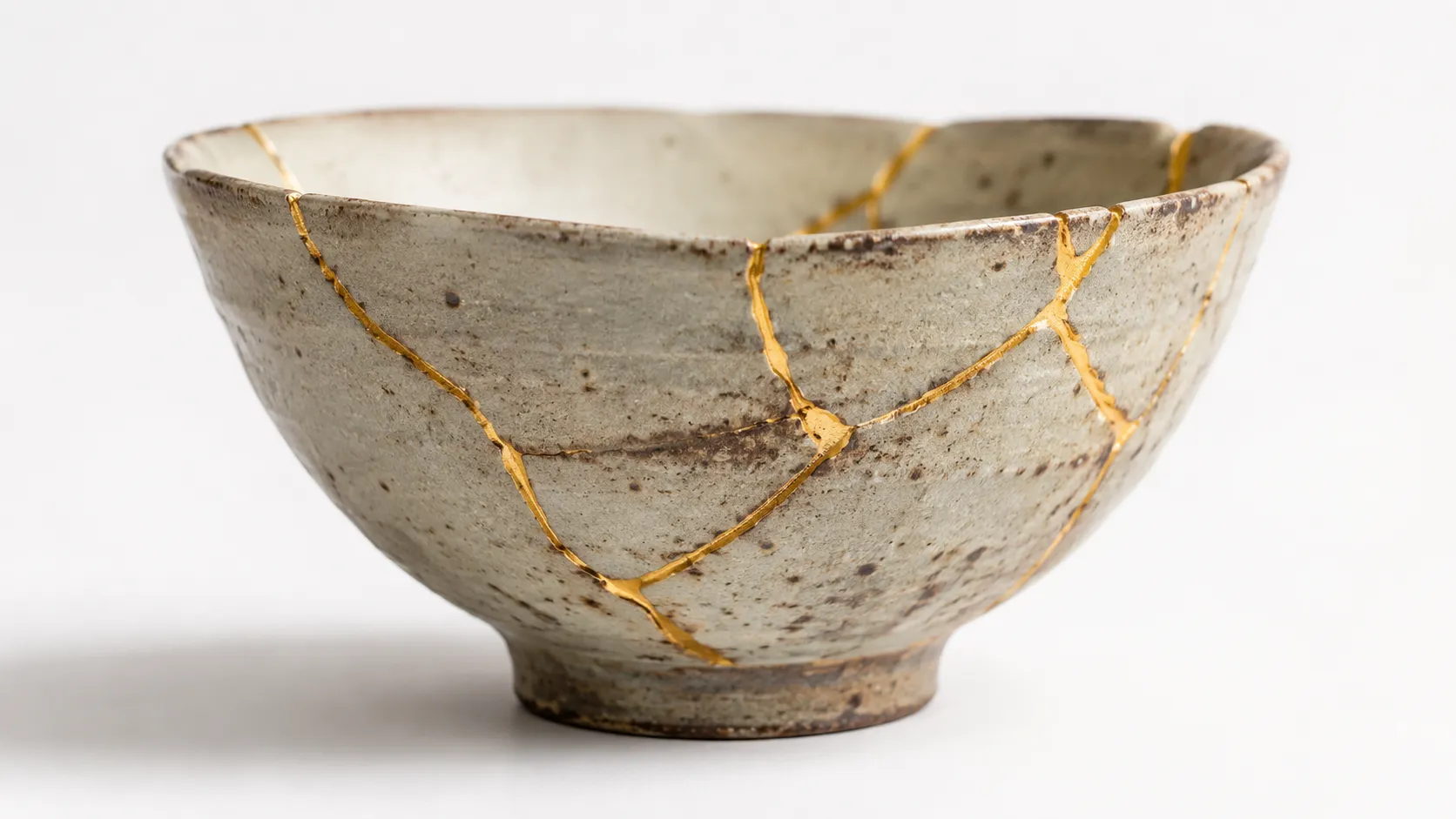
The Kintsugi repair process step by step
Traditional Kintsugi is slow, deliberate, and treats the damage as the most important part of the story.
The break
The piece shatters. Every fragment is collected and kept. Nothing is discarded.
The first lacquer
Urushi lacquer is applied to the broken edges. The piece is left to cure in a humid box for days or weeks.
The joining
Fragments are fitted back together. The joins are pressed and left to cure again. No rushing.
The filling
Gaps and surface dips are filled with additional lacquer mixed with powdered stone or clay.
The gold
A final layer of lacquer is applied to the seams and dusted with gold, silver, or platinum powder while still wet.
Where it came from
How Kintsugi started with a broken teacup and a dissatisfied shogun
The most widely told origin story goes back to around 1500 in Japan. The shogun Ashikaga Yoshimasa broke his favourite celadon tea bowl, a Chinese piece he treasured enormously. He sent it to China to be repaired. It came back held together with ugly metal staples. He was not happy.
Japanese craftsmen, tasked with finding a better solution, developed the technique of using lacquer mixed with gold to seal the breaks. The repaired bowl came back more striking than it had been whole. The cracks glowed. The damage had become the decoration.
Whether this exact story is historically accurate or partly legend, the technique became central to the Japanese tea ceremony culture, where age, imperfection, and history are considered sources of beauty rather than reasons for replacement.
The word itself breaks down simply. Kin means gold. Tsugi means joinery or repair. Golden joinery. It does not pretend the break did not happen. It announces it.
The philosophy
The philosophy behind Kintsugi is not about positivity, it is about honesty
The Western instinct when something breaks is to hide the damage. Fill it with clear glue. Sand it down. Paint over it. The goal is to make it look like nothing happened. Kintsugi does the opposite on purpose.
The philosophy sits within the broader Japanese aesthetic of Wabi-Sabi, which finds beauty in impermanence, incompleteness, and imperfection. A mossy stone. A faded piece of cloth. A ceramic bowl that has lived a long life. Wabi-Sabi does not require things to be perfect to be beautiful.
Kintsugi takes that one step further. It says the specific places where something was damaged and then healed are not just acceptable but are the most interesting and meaningful parts of the object. The history of the break is the story of the piece. Without it, the bowl is just a bowl.
Zen Buddhism, which runs through much of the tea ceremony culture where Kintsugi flourished, holds a related idea: that resistance to suffering causes more suffering than the suffering itself. The break is not the tragedy. The refusal to accept the break is. Gold-sealing the crack is a physical act of acceptance.
Myths
Myth: Kintsugi is about making broken things look perfect again
What people think
Kintsugi hides the damage and restores the original appearance.
People often assume the gold is cosmetic, a clever way to disguise the cracks and return the piece to how it looked before it broke.
What actually happens
Kintsugi deliberately makes the damage impossible to miss.
The entire point is that the cracks are visible, gilded, and celebrated. A Kintsugi repair looks nothing like the original piece. It looks like something that broke and was transformed by the breaking. The gold does not erase the history. It frames it.
Kintsugi vs Wabi-Sabi
Myth: Kintsugi and Wabi-Sabi are the same thing
What people think
Kintsugi is just another word for Wabi-Sabi.
Both involve Japanese aesthetics and imperfection so people often use them interchangeably.
What actually happens
Wabi-Sabi is the philosophy, Kintsugi is one specific expression of it.
Wabi-Sabi is a broad worldview that accepts transience and imperfection as sources of beauty. Kintsugi is a specific repair technique that puts Wabi-Sabi into physical practice. All Kintsugi is informed by Wabi-Sabi. Not all Wabi-Sabi is Kintsugi. Think of Wabi-Sabi as the parent concept and Kintsugi as one of its most striking children.
Only pottery?
Myth: Kintsugi is only a pottery technique
What people think
Kintsugi is a craft skill for fixing ceramics, nothing more.
It is easy to treat it as a niche artisan hobby with no wider relevance.
What actually happens
Kintsugi has become a globally recognised framework for thinking about recovery, trauma, and resilience.
Therapists use the metaphor with patients dealing with grief, illness, and trauma. Coaches use it in leadership development. There is a growing body of literature, workshops, and retreats built entirely around applying the Kintsugi principle to human lives rather than ceramics. The pottery technique became a philosophical tool.
Failure and resilience
What Kintsugi actually says about failure
Most frameworks for resilience tell you to bounce back. Get back to where you were. Recover. Return to normal. Kintsugi does not say that. It says you cannot and should not try to return to what you were before.
The broken bowl that becomes a Kintsugi piece is not the same bowl it was. It is a different and more complex object. The repair process changed it. The person who goes through serious loss, illness, or failure is not the same person they were before. Trying to get back to exactly who you were can be a form of refusing to accept what happened.
The Kintsugi answer is not to bounce back but to integrate forward. The break becomes part of you. The healing becomes visible. You do not need to pretend it did not happen.
The psychologist Richard Tedeschi coined the term post-traumatic growth to describe this: the well-documented phenomenon where some people emerge from trauma not merely recovered but genuinely changed in ways they consider improvements. More empathy. Clearer priorities. Deeper relationships. The break made them more, not less. That is the closest scientific parallel to Kintsugi.
Kintsugi in therapy
How Kintsugi is being used in therapy and mental health work
Therapists working with trauma, grief, chronic illness, and addiction recovery have found the Kintsugi metaphor unusually powerful. Most patients come in wanting to get back to who they were before the event that broke them. The Kintsugi framing gives them permission to stop trying.
Instead of recovery as restoration, Kintsugi offers recovery as transformation. The crack is not a flaw in your identity. It is part of your story. And the way you healed it is what makes you you.
In Japan, there are workshops explicitly positioned as therapeutic where participants physically repair broken ceramics using the Kintsugi technique. The act of handling the pieces, choosing not to hide the breaks, and deliberately gilding them creates a tactile experience that mirrors the emotional process. Occupational therapists have noted that the slow, patient nature of urushi lacquer work also forces a mindfulness that is itself therapeutic.
The psychiatrist Cathy Malchiodi has written about art therapy and post-traumatic growth, noting that creative acts of repair and transformation have measurable psychological benefits that purely talk-based therapy sometimes misses.
For people who struggle to articulate their trauma verbally, being handed a broken object and asked to repair it beautifully can unlock something that hours of talking cannot.
Beginner guide
Can you learn Kintsugi at home? A beginner guide
Authentic Kintsugi using urushi lacquer is a serious craft. Urushi is harvested from the Toxicodendron vernicifluum tree and is related to poison ivy. Raw urushi causes severe allergic reactions in many people. Curing requires a humidity-controlled box called a furo and takes weeks between stages. The full process for a single piece can take two to three months.
That said, there are two realistic paths for beginners.
The first is a modern Kintsugi kit that uses epoxy resin or food-safe two-part adhesive instead of urushi, combined with real gold powder or mica-based gold substitute. These kits are widely available, safe to use without special equipment, and produce results that carry the spirit of Kintsugi even if they skip the traditional chemistry. They are a perfectly legitimate starting point.
The second path is to take a traditional Kintsugi course. These exist in Japan and increasingly in the UK, US, and Europe. You work under a trained urushi lacquer artist over several sessions. You get the real process, the slow cure times, and a piece you made properly.
Materials for a modern kit: broken ceramic piece, two-part epoxy adhesive or urushi substitute, gold powder or gold mica powder, a fine brush for application, sandpaper in fine grits, a steady hand and patience.
Start with a piece you actually care about. The whole point is that it has a history. Deliberately smashing something for the exercise misses the emotional core of what Kintsugi is.
Kintsugi vs ordinary mending
What makes Kintsugi an art form and not just fixing a bowl
Goal of ordinary repair
Make the damage invisible. Return the object to its original appearance.
Goal of Kintsugi
Make the damage the most visually prominent feature. Let it tell the story.
Value after ordinary repair
Roughly the same as before, or lower due to the visible repair line.
Value after Kintsugi
Often higher than before. The repair transforms the object into a one-of-a-kind piece.
Time investment
Ordinary repair: minutes to hours. Authentic Kintsugi: weeks to months.
Philosophical stance
Ordinary repair says the break was a problem. Kintsugi says the break was an event worth commemorating.
Surprising facts
Eight things about Kintsugi that most people do not know
1. Some collectors deliberately break valuable ceramics to have them Kintsugi-repaired, because the gold-seamed version is worth more on the art market than the intact original.
2. Urushi lacquer is an allergen so potent that some people react to it through skin contact even after it has fully cured. Traditional Kintsugi masters often develop a tolerance over years of exposure.
3. The tea master Sen no Rikyu, who standardised the Japanese tea ceremony in the 16th century, is credited with embedding Kintsugi as a core aesthetic of the ceremony. He reportedly preferred repaired, worn, and imperfect pieces over pristine imported Chinese ware.
4. Fully cured urushi lacquer is harder than most modern synthetic adhesives and is waterproof, heat resistant, and food safe. Some traditional Japanese lacquerware from the 8th century is still intact.
5. There are three named styles of Kintsugi. Hon-Kintsugi uses the gold seam to trace the exact crack. Hibi involves filling a crack with additional lacquer before gilding, creating a thicker ridge. Yobitsugi combines fragments from different broken pieces into one reconstructed object, like a ceramic patchwork quilt.
6. The Yobitsugi style has a philosophical parallel in psychology called integration, the idea that healing involves combining different aspects of experience rather than selecting which parts to keep.
7. A 2019 study in the Journal of Positive Psychology found that narratives of post-traumatic growth, the real-world equivalent of Kintsugi thinking, were associated with significantly higher long-term life satisfaction than narratives focused on returning to a pre-trauma baseline.
8. The Japanese government has designated several Kintsugi masters as Living National Treasures, a formal recognition given to people who embody irreplaceable traditional craft knowledge.
Quick answers
Common questions
What is Kintsugi? +
Kintsugi is a Japanese art form where broken ceramics are repaired using lacquer mixed with gold, silver, or platinum. The repair does not hide the damage. It highlights it. The word means golden joinery.
What is the philosophy behind Kintsugi? +
Kintsugi draws from Wabi-Sabi and Zen Buddhism. It holds that broken things, when repaired with honesty and care, become more beautiful and more meaningful than they were when intact. The history of damage is a feature, not a flaw.
Is Kintsugi related to Wabi-Sabi? +
Yes. Wabi-Sabi is the parent philosophy that finds beauty in impermanence and imperfection. Kintsugi is one of its most vivid physical expressions. All Kintsugi sits within Wabi-Sabi, but Wabi-Sabi is a broader concept that covers much more than ceramic repair.
What materials are used in Kintsugi? +
Traditional Kintsugi uses urushi lacquer from the lacquer tree, mixed with gold, silver, or platinum powder. Modern kits substitute epoxy resin for urushi and use gold mica powder. The traditional method takes weeks. The modern method takes hours.
How is Kintsugi used in therapy? +
Therapists use the Kintsugi metaphor to reframe trauma and loss. Instead of aiming to recover to a pre-trauma state, patients are encouraged to see their breaks as part of their identity. Some therapists also run hands-on Kintsugi workshops where the act of physically repairing something becomes a therapeutic exercise.
What is the Hemingway quote connected to Kintsugi? +
In A Farewell to Arms, Hemingway wrote that the world breaks everyone, and afterward, some are strong at the broken places. He was not referencing Kintsugi directly but arrived at the same idea: that surviving a break can create strength specifically at the point of fracture.
Can beginners do Kintsugi at home? +
Yes, using a modern kit with epoxy resin and gold powder. Authentic urushi Kintsugi requires specialist materials, training, and weeks of curing time. For beginners, a kit repair still carries the spirit of the practice. Start with something that already has meaning to you.
How do you practise Kintsugi as a life philosophy? +
Stop aiming to recover back to who you were before a difficult event. Instead ask what the event changed in you and what those changes made possible. The philosophy asks you to treat your hardest experiences as the most important parts of your story, not as interruptions to it.