Visual answer
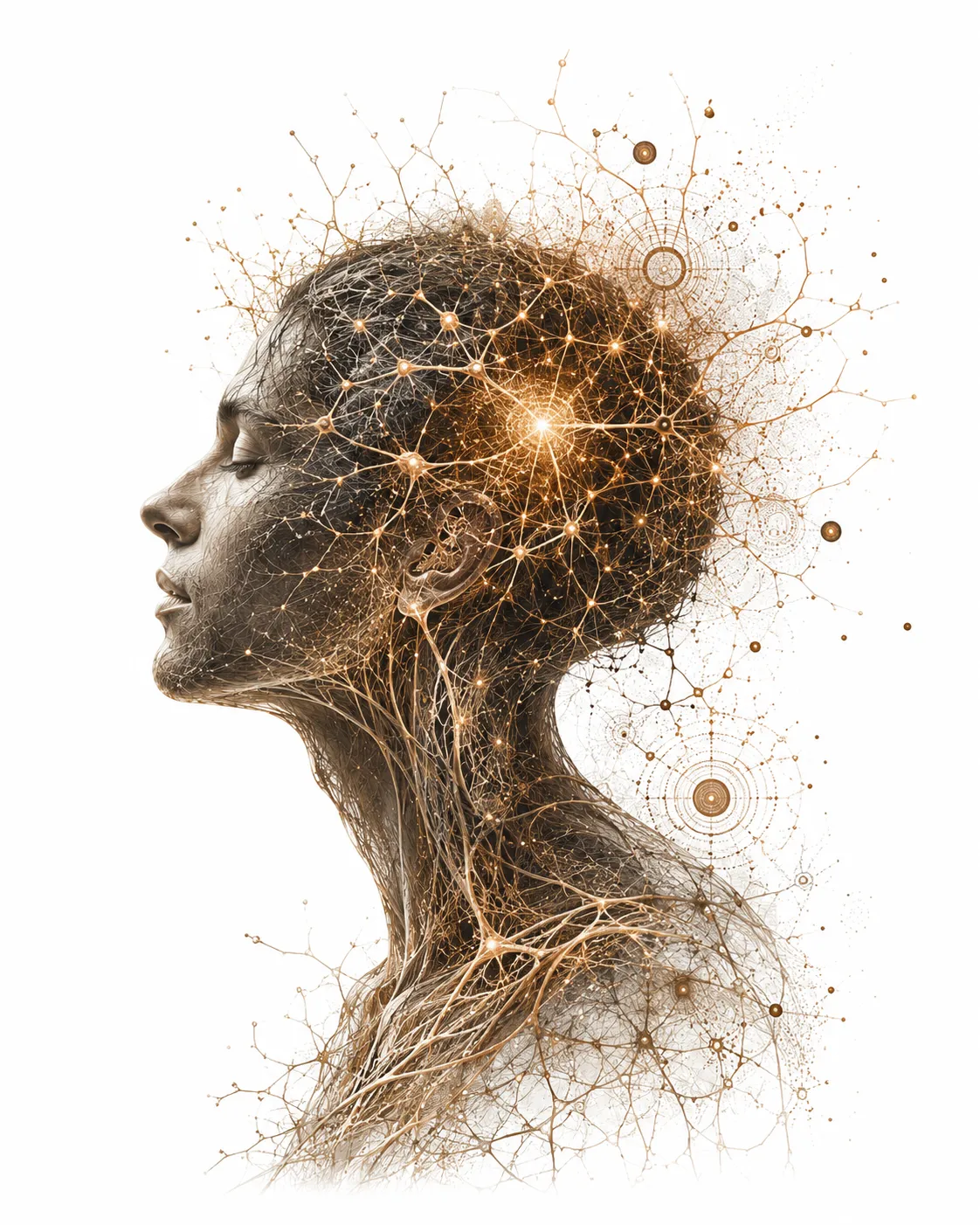
The Explanatory Gap: Brain to Experience
What neuroscience can explain vs. the hard problem it cannot.
Neural firing patterns
Measurable, mappable this is what brain imaging captures.
Information integration
How signals combine across regions the 'easy problems' of consciousness.
Behavioral output
What the person says and does fully explainable by mechanism.
Subjective experience
The felt quality what it's like. The hard problem lives in this gap.
The Hard Problem
Why This Is Different From All Other Brain Questions
Philosopher David Chalmers distinguished between the 'easy problems' of consciousness and the 'hard problem' in 1995. The easy problems are actually quite hard explaining how the brain integrates information, focuses attention, or reports mental states. But they're 'easy' in the sense that we can at least imagine how better neuroscience could solve them. They're problems of mechanism.
The hard problem is different in kind: why does any mechanism produce subjective experience? Why, when light hits your retina and triggers neural cascades, is there something it feels like to see blue? Why isn't all that neural processing happening in the dark efficiently, invisibly, with no inner experience accompanying it?
You could theoretically build a perfect replica of a human brain that processes all the same information, controls all the same behaviors, and responds to all the same stimuli a 'philosophical zombie,' in the technical term yet has no inner experience. Nothing it's like to be it. The hard problem is: why don't we seem to be such zombies? What makes the physical processing also feel like something?
Leading Theories
What the Main Theories Propose
Global Workspace Theory (Baars, Dehaene)
LikelyConsciousness arises when information is selected and broadcast widely across the brain via a 'global workspace' making it available to multiple cognitive processes simultaneously. Unconscious processing is local; conscious processing is globally shared. Supported by brain imaging studies of conscious vs. unconscious processing.
Integrated Information Theory (Tononi)
PossibleConsciousness is identical to integrated information (Φ, phi) the degree to which a system's parts share information that can't be reduced to the sum of individual components. High Φ = rich consciousness. Predicts that some non-biological systems could be conscious. Controversial but mathematically precise.
Higher-Order Theories (Rosenthal)
PossibleA mental state is conscious when there is a higher-order thought about it the brain representing its own states. You're conscious of seeing red when you have a thought 'I am seeing red.' Consciousness is self-representation.
Quantum consciousness (Penrose-Hameroff)
LowMathematical physicist Roger Penrose and anesthesiologist Stuart Hameroff propose that consciousness arises from quantum computations in microtubules within neurons. Highly controversial and not well-supported by neuroscience but not yet definitively ruled out.
Panpsychism
PossibleConsciousness is a fundamental feature of reality, present in some form in all matter. Rather than emerging from complex neural organization, it is a basic property that complex brains integrate into rich conscious experience. Taken seriously by philosophers like Philip Goff and David Chalmers.
The Analogy
The Light in the Fridge
The familiar part
Does the light in your refrigerator stay on when the door is closed? You can reason about it from mechanism the door switch breaks the circuit. But you can never directly observe the fridge's interior with the door closed. You infer the answer from the outside.
How it applies
The hard problem of consciousness is the ultimate version of this. You have direct access to only one conscious experience: your own. Every other consciousness you infer from the outside from behavior, physiology, reports. You cannot directly observe another being's inner experience. We're in a position where the only data point we have about what consciousness feels like from the inside is ourselves.
Where the analogy breaks
Unlike the fridge, we can't even theoretically open the door and check. A perfect brain scan would show neural correlates it could never show the felt quality of the experience itself.
The Myth
"Neuroscience Will Eventually Fully Explain Consciousness"
What people think
The assumption that consciousness is just a complex brain process we haven't fully mapped yet
The standard scientific assumption: consciousness is what the brain does, and once we understand the brain well enough all its circuits, all its dynamics we will understand consciousness. It's a matter of more research.
What actually happens
Explanation of mechanism doesn't automatically explain experience
Even a complete mechanical description of the brain leaves open the question of why any physical process feels like anything. This isn't a gap that more neuroscience automatically fills it's a conceptual gap about the relationship between objective physical description and subjective experience. Many philosophers of mind argue this gap requires not just better neuroscience but a genuinely new conceptual framework.
Final insight
The Mystery at the Center of Everything
Consciousness is the one thing you are absolutely certain exists your own experience, right now, is undeniable. And it is simultaneously the thing science understands least. We have exquisite maps of the brain, detailed models of neural dynamics, and still no satisfying answer to why any of it feels like anything. This is not a failure of science. It may be the sign that we need new concepts, not just more data.
Quick answers
Common questions
Has neuroscience made any progress on consciousness? +
Yes on the easy problems. We've mapped extensive neural correlates of conscious experiences, identified the neural signatures of anesthesia and sleep, and developed ways to detect whether vegetative-state patients retain hidden consciousness. The hard problem remains unsolved, but the science around it has advanced enormously.
Is there a difference between consciousness and self-awareness? +
Yes. Basic consciousness phenomenal consciousness is simply having any subjective experience: the redness of red, the pain of pain. Self-awareness is a higher-order capacity: being conscious of oneself as a distinct entity. Many animals may have phenomenal consciousness without full self-awareness. The mirror test measures self-recognition, not consciousness itself.
Could an AI ever be conscious? +
Under some theories (IIT, panpsychism), yes if the right informational or physical properties are present. Under others (biological naturalism, some higher-order theories), no consciousness requires specific biological substrates. This isn't a question current science can answer, but it's not science fiction either.
What is the 'neural correlate of consciousness'? +
The NCC is the minimal set of neural mechanisms sufficient for any one specific conscious experience. Finding NCCs (which neuroscience is actively doing) tells us which brain activity accompanies consciousness but doesn't tell us why that activity feels like anything. It's correlation without explanation of causation.