Visual answer
The Real Ikigai vs the Viral Version
Two very different ideas share the same name. Here is how they compare and where each one actually comes from.
The Original: A Daily Reason to Live
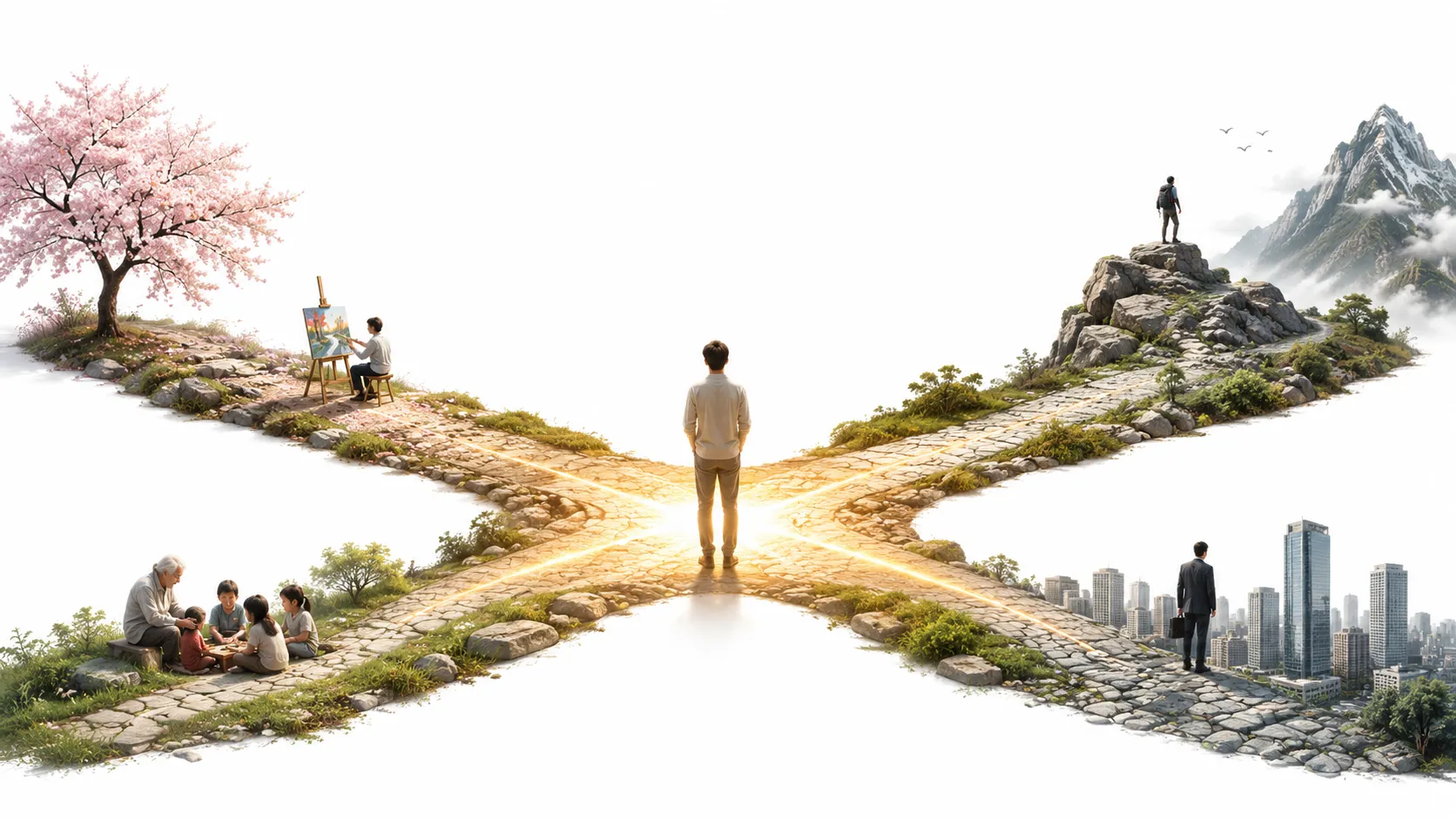
In Japanese culture, Ikigai is an internal, personal feeling. It requires no formula. It is simply the answer to the question: what makes today worth having? For most Japanese people, Ikigai is found in relationships, small rituals, and craft rather than in career ambition.
The Venn Diagram: A Western Career Framework
The famous four-circle model asks you to find the intersection of passion, mission, profession, and vocation. This is a useful career planning tool but it was created in the West and is not how Ikigai is understood in Japan. It conflates purpose with professional success in a way Japanese culture does not.
Where They Overlap
Both versions agree that Ikigai involves doing something meaningful that serves others and draws on what you genuinely care about. The difference is that the Japanese version does not require you to get paid for it or to build a career around it.
Finding Yours: Start Small
Japanese Ikigai researchers suggest starting with the question: what makes me lose track of time? Then ask: who benefits when I do this thing? The overlap between those two answers is often closer to Ikigai than any career strategy session.
What it actually means
What Ikigai Actually Means in Japan
Break the word down and you get iki, meaning life or alive, and kai, meaning effect, result, or worth. Put them together and you get something like the effect that makes life worth living. It is one of those words that does not translate cleanly into English, which is probably why it became a sensation the moment English-speaking audiences encountered it.
In everyday Japanese conversation, Ikigai is not a philosophical concept you debate at dinner. It is something you feel. You might hear a retired schoolteacher say her Ikigai is her vegetable garden. A sushi chef might say his Ikigai is perfecting a rice recipe he has been working on for thirty years. A grandmother might say her Ikigai walked in the door this morning and asked for breakfast.
The Japanese psychologist Michiko Kumano published research in 2017 distinguishing Ikigai from simple pleasure. Pleasure, she argued, is hedonic. Ikigai is eudaimonic, which is the philosophical term for a sense of flourishing that comes from living in alignment with your deeper values rather than from chasing immediate gratification. You can feel Ikigai while doing something difficult or even uncomfortable, as long as it feels worthwhile.
That distinction matters. It means Ikigai is not about optimizing your life for maximum enjoyment. It is about finding meaning in what you are already doing, or gently moving toward things that carry that quality of meaning.
Myth: the Venn diagram
Myth vs Reality: The Venn Diagram Is How Japan Defines Ikigai
What people think
Ikigai is the intersection of what you love, what you are good at, what the world needs, and what you can be paid for
This four-circle model has been shared hundreds of millions of times online and is now almost universally associated with Ikigai. Most people assume it is an ancient Japanese concept.
What actually happens
The diagram was made by a Spanish blogger in 2012 and has no roots in Japan
The model was created by Andres Zuzunaga and later expanded by a Western writer. When researchers and journalists asked Japanese people about the diagram, the most common reaction was confusion. Japanese Ikigai has no career requirement, no payment circle, and no formula. Author Ken Mogi, one of Japan's leading Ikigai researchers, has explicitly said the Western version misrepresents the concept.
Myth: one true Ikigai
Myth vs Reality: You Have One True Ikigai to Find
What people think
There is one single Ikigai waiting for you that you need to discover
The way Ikigai is sold in Western self-help culture suggests that finding it is like finding a treasure chest. Once you find it, your life clicks into place.
What actually happens
Most Japanese people have multiple Ikigai that change over a lifetime
Japanese research consistently shows that people report different Ikigai at different life stages. A young person might find Ikigai in athletic training. A parent might find it in raising children. An older person might find it in a craft or community role. There is no single discovery moment. Ikigai is cultivated daily and shifts as your life does.
Myth: Ikigai must be your job
Myth vs Reality: Your Ikigai Should Be Your Career
What people think
The whole point of Ikigai is to turn your passion into a profession
Western interpretations of Ikigai almost always frame it as a career strategy. Find what you love, make it your job, and success and happiness follow.
What actually happens
In Japan, Ikigai is completely separate from how you earn money
Many Japanese people with strong Ikigai have entirely ordinary jobs. Their Ikigai is the garden they tend on weekends, the fishing they do at dawn, or the neighborhood association they volunteer with. Separating Ikigai from income is not a bug in the Japanese model. It is a feature. It means your sense of purpose is not hostage to your employment situation.
Ikigai and longevity
Why Does Having Ikigai Seem to Help People Live Longer?
The connection between Ikigai and longevity is not just anecdote. A large-scale study published in the journal Psychosomatic Medicine in 2008 followed over 43,000 Japanese adults for seven years. Those who reported a strong sense of Ikigai had significantly lower rates of cardiovascular disease and all-cause mortality than those who did not, even after controlling for age, diet, exercise, and socioeconomic factors.
The mechanism is not mysterious. Having a daily reason to get up reduces the physiological effects of stress. Purpose-driven people tend to maintain social connections longer, which is itself one of the strongest predictors of longevity. They tend to stay physically active because they have somewhere to go and something to do. And they report higher baseline levels of contentment, which reduces chronic inflammation, one of the main drivers of age-related disease.
The Okinawan data is particularly striking. Okinawa has historically had one of the world's highest rates of centenarians per capita. Researchers have pointed to diet, genetics, and tight community structures. But what stands out when you actually talk to elderly Okinawans is how many of them describe a daily activity that matters to them. A 102-year-old woman who still feeds the neighborhood cats every morning. A 96-year-old man who still gives advice to younger farmers. These are not grand missions. They are Ikigai.
The lesson for the rest of us is probably less about finding a calling and more about not letting the small meaningful activities drain out of daily life as we get older or busier. The research suggests that protecting those things matters more than we tend to think.
Ikigai vs Western purpose
Ikigai vs the Western Idea of Purpose
Scale
Ikigai embraces tiny daily joys. Western purpose culture tends to demand a grand mission or calling that justifies your existence.
Career connection
Ikigai has no requirement to earn money from it. Western purpose is almost always framed as something to turn into a career or side hustle.
Discovery process
Ikigai is found by paying attention to what already moves you. Western purpose culture often requires retreats, coaches, and frameworks.
Stability
Ikigai is expected to evolve with your life stage. Western purpose is usually presented as a single fixed answer you must find and keep.
Social dimension
Japanese Ikigai almost always involves contributing to others around you. Western purpose can be entirely self-focused.
How to find yours
How to Actually Find Your Ikigai
If the Venn diagram is not the right tool, what is? Japanese researchers and writers suggest starting not with career strategy but with attention. Pay attention to the moments in your day when you feel most alive. Not most excited. Not most productive. Most genuinely present.
Ken Mogi, the neuroscientist and author of The Little Book of Ikigai, suggests five pillars: starting small, accepting yourself, connecting with others, seeking small joys, and being in the here and now. Notice that none of those involve a whiteboard session about your professional skills.
A practical exercise from Japanese Ikigai researchers goes like this. Write down the last five times you felt a quiet sense of satisfaction, not achievement pride, but genuine quiet contentment. Look for patterns. Those patterns are pointing at something. That something is probably closer to your Ikigai than any career assessment ever will be.
The hardest part for most people shaped by Western productivity culture is accepting that the answer might be small. It might be cooking a particular dish. It might be a conversation style you have with certain people. It might be the specific quality of attention you bring to a creative hobby no one else sees. Ikigai does not need an audience. It only needs to be real.
Ikigai vs dharma
Is Ikigai the Same as Dharma, Flow, or Calling?
When Westerners first encounter Ikigai, they almost always reach for an equivalent. Is it the same as dharma from Hindu philosophy? Is it the flow state described by psychologist Mihaly Csikszentmihalyi? Is it what Christians call a calling?
There are genuine overlaps. Dharma shares the sense that each person has a particular nature and that living in alignment with it produces wellbeing. Flow shares the quality of absorbed engagement that Ikigai activities tend to produce. A calling shares the sense that the activity connects you to something larger than yourself.
But there are important differences. Dharma carries cosmic weight. It implies a universal order that assigns roles. Ikigai makes no such claim. It is personal and practical rather than metaphysical. Flow is a psychological state that can happen during any skilled activity, including morally neutral ones. Ikigai specifically requires a contribution dimension. It matters that what you are doing is good for someone other than just you.
The closest Western equivalent is probably the philosopher Aristotle's concept of eudaimonia, which he defined as living in accordance with your highest capacities in service to your community. The difference is that Aristotle was building a philosophical system. The Japanese concept is not philosophical at all. It is simply a word for something ordinary people feel on ordinary days.
Quick answers
Common questions
What is Ikigai and how do I find mine? +
Ikigai is the Japanese idea of a daily reason to feel alive. Finding it involves paying attention to the activities that make you feel quietly satisfied and present rather than just busy or entertained. Start by noticing what you return to voluntarily, what you do for others that feels genuinely worthwhile, and what small rituals make your day feel complete.
What are the 4 elements of Ikigai? +
The four-element model of What You Love, What You Are Good At, What the World Needs, and What You Can Be Paid For is a Western framework that became associated with Ikigai. The authentic Japanese concept has no fixed elements. Japanese researchers describe Ikigai in terms of presence, contribution, relationships, and small joys rather than any diagram.
Can Ikigai be found without making money from it? +
Yes, and in Japan this is the norm. Ikigai has no income requirement. Separating your sense of purpose from your paycheck is actually considered one of the strengths of the concept. It means your reason for living is not tied to market conditions.
Can you have more than one Ikigai? +
Yes. Japanese research shows that most people have several sources of Ikigai simultaneously and that these change over a lifetime. A single fixed Ikigai is actually a Western imposition on the concept.
How does Ikigai relate to longevity? +
Multiple large-scale Japanese studies have found that people who report a strong sense of Ikigai have lower mortality rates from cardiovascular disease and other causes. The mechanism likely involves reduced chronic stress, stronger social connections, continued physical activity, and higher baseline contentment.
Is Ikigai the same as dharma? +
They share the idea that living in alignment with your deepest nature produces wellbeing, but dharma carries cosmic and religious weight that Ikigai does not. Ikigai is practical and personal, not metaphysical. It also specifically includes the dimension of contributing to others, which dharma does not always require.
What is the Ikigai of people in Okinawa? +
Research from Okinawa shows that elderly people there typically describe their Ikigai as community roles, daily rituals, close relationships through Moai groups, gardening, cooking, and craft practices. Very few describe a career as their Ikigai.
How to find your Ikigai when you have no passion +
Japanese researchers suggest that the framing of passion is part of the problem. Instead of looking for something that excites you, look for something that you return to voluntarily, that benefits someone else, and that leaves you feeling settled rather than drained. Ikigai often hides in habits you have already built but not yet named.