Visual answer
Why imprinting creates a liger, and a tigon, and why they're so different
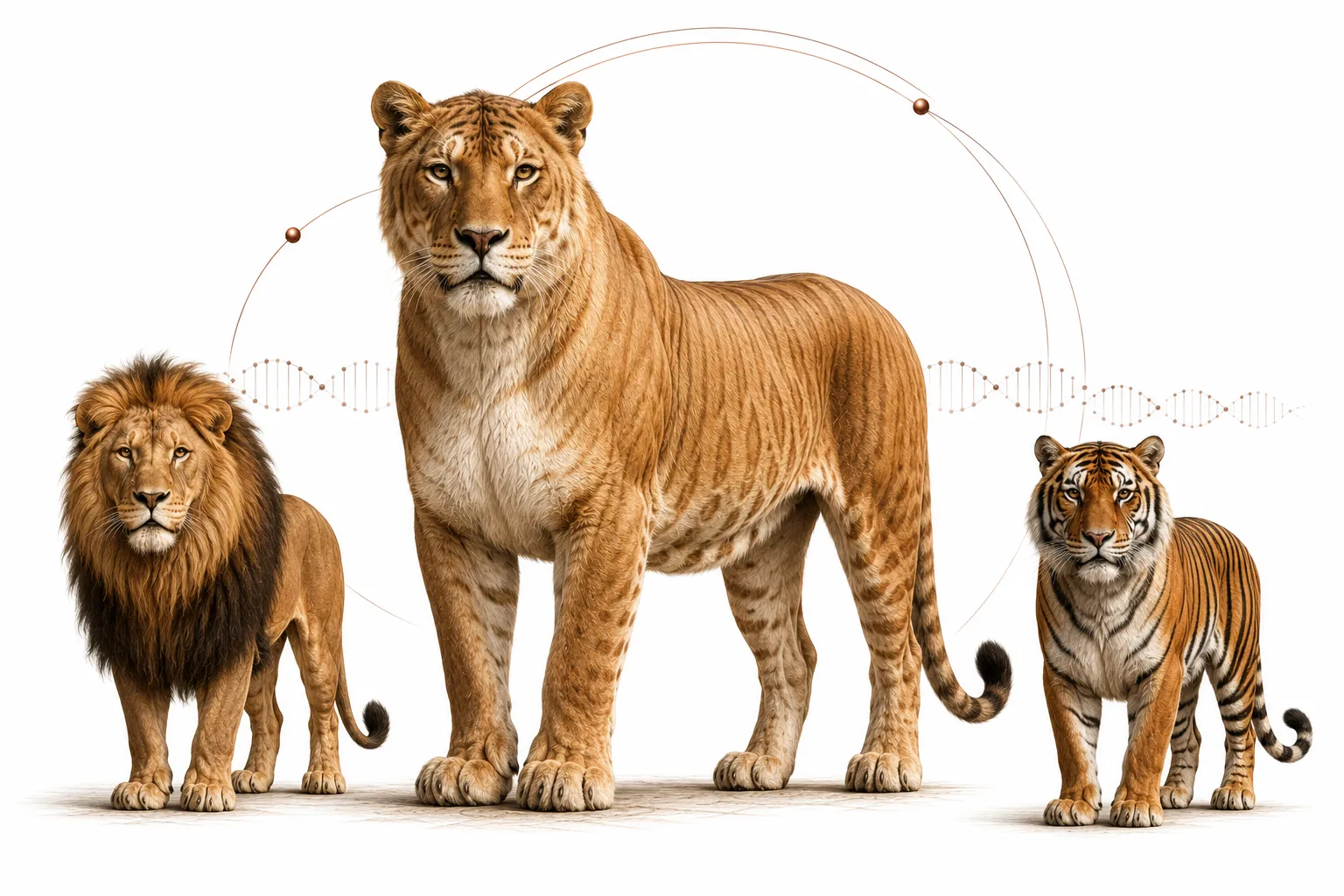
How paternal and maternal imprinting signals interact or fail to in each direction of the cross
Normal lion
Lion father's growth-promoting genes balanced by lion mother's growth-suppressing imprinting normal adult size
Liger (lion ♂ × tiger ♀)
Lion father's growth signals present; tiger mother's imprinting doesn't suppress them growth is unregulated upward
Tigon (tiger ♂ × lion ♀)
Lion mother's growth-suppressing imprinting operates on tiger father's signals often results in smaller-than-average offspring
The lesson
Size in hybrids depends on which direction the cross goes paternal and maternal genomes are not interchangeable
The verdict
Verdict
The liger's size is a predictable consequence of genomic imprinting gone unbalanced
Lions and tigers have independently evolved systems for regulating offspring growth through genomic imprinting where the same gene is expressed differently depending on which parent it came from. In a normal lion, the father's growth-promoting imprinted genes are counterbalanced by the mother's growth-suppressing ones. In a liger, the lion father's growth-promoting genes are inherited but paired with a tiger mother's imprinting system, which didn't evolve to suppress them. The result is a chronic growth-promotion signal with no corresponding brake. The liger keeps growing well past the size either parent would reach.
Useful analogy
Imagine two negotiators who have spent millennia developing a system to agree on the right size for their offspring the father pushing for larger, the mother moderating toward sustainable. Put the father from one negotiating tradition in a room with a mother from a completely different one, and there's no agreed framework. The father's growth instructions arrive, the mother's moderating system doesn't recognise them as something to counter, and the offspring ends up bigger than either party intended.
The catch
The size is not an advantage. Ligers frequently suffer from joint problems, heart issues, and reduced lifespans compared to either parent species. Gigantism in this context is the by-product of a miscommunication, not an adaptation. In the wild, an animal that grew to 900 lbs would have trouble finding enough prey to sustain itself.
What genomic imprinting is
Genomic imprinting: why it matters which parent a gene came from
Most genes work the same way regardless of whether they came from your mother or father. Imprinted genes are different they are chemically tagged during egg or sperm formation so that only one copy is active in the offspring, depending on which parent contributed it. You have both copies of the gene; only one speaks.
This tagging system evolved in part because maternal and paternal interests in offspring size sometimes diverge. Fathers benefit from large, robust offspring bigger tends to mean more likely to survive and reproduce. Mothers are simultaneously supporting multiple offspring and need to moderate how much each one draws on her resources. Imprinting is, in a rather dark light, the genetic encoding of this negotiation.
Lions and tigers have evolved their imprinting systems independently, optimised for their own species. When a lion's genes meet a tiger mother's imprinting instructions, some signals go unread. The growth-promoting genes from the lion father are expressed; the tiger mother's imprinting system was never designed to suppress lion-origin growth signals. The liger is the result of a conversation conducted in two languages with no shared dictionary.
Big cat crosses compared
What happens when the big cats are crossed and in which direction
Liger (lion ♂ × tiger ♀)
Largest of the crosses up to 900 lbs. Growth-promoting imprinting from lion father, no counterbalancing from tiger mother. Males always sterile; females sometimes fertile.
Tigon (tiger ♂ × lion ♀)
Often smaller than either parent lion mother's growth-moderating imprinting now operates, while tiger father's signals are less dominant in this context. Rarer and generally shorter-lived.
Jaglion (jaguar ♂ × lion ♀)
Extremely rare, documented in only a handful of captive cases. Typically smaller than either parent; both sterile.
Leopon (leopard ♂ × lion ♀)
A few confirmed cases in Japanese and Indian zoos in the 20th century. Intermediate in size. No confirmed fertile individuals.
Natural or not?
Could ligers occur in the wild?
What people think
"Ligers are an unnatural human creation they couldn't possibly exist outside captivity"
The assumption is that lions and tigers are so categorically different that only human interference could bring them together.
What actually happens
The biology would allow it but geography has prevented it for thousands of years
Historically, lions and tigers did share overlapping ranges in parts of Asia the Gir Forest in India once had both. Occasional hybridisation was theoretically possible. Today, lions live in sub-Saharan Africa and a small population in India's Gir Forest; tigers live across South and Southeast Asia. Their ranges no longer overlap, and both are endangered enough that captive populations have become the only context for this cross. The liger is a captivity artefact not because the biology forbids it but because the geography now does.
Final insight
The liger as a thought experiment made flesh
The liger exists because two animals were placed in proximity that evolution never intended to overlap, and their genomes attempted a conversation without a shared language. What emerged is remarkable, and genuinely troubled. It is the largest cat alive, and it is unlikely to live as long as either of its parents. It is a demonstration of how much is controlled by genetic rules that only work correctly when the right two parties are following them together. Put the wrong players at the table and you don't get chaos you get something very large, moderately confused, and unable to reproduce.
Quick answers
Common questions
Is a liger stronger than a lion or tiger? +
Almost certainly yes, purely on the basis of mass. Muscular strength scales with body size, and a 900-lb liger is carrying significantly more muscle than a 420-lb lion. Whether this constitutes a meaningful advantage is another matter the liger's size also brings significant health costs, and in any natural context, a predator that large would struggle to find sufficient prey. It's a powerful animal in the way that a structurally unsound bridge can still hold a lot of weight: the raw numbers are impressive; the engineering is questionable.
Are female ligers really fertile? +
Occasionally, yes which is the opposite of what most people expect. Haldane's Rule predicts that in hybrid crosses, the more complex sex (in mammals, the male, with XY chromosomes) is more likely to be sterile. Male ligers are always sterile. A small number of female ligers have been confirmed fertile; some have even produced 'liliger' or 'litigon' offspring when mated with lions or tigers. These second-generation hybrids are typically smaller and less robust.
How do ligers compare to the largest prehistoric cats? +
The largest liger individuals are comparable to or exceed the estimated weight of the American lion (Panthera atrox), which went extinct around 10,000 years ago and is thought to have been the largest felid of the Pleistocene. This comparison is often cited in popular articles and is roughly accurate, though not exact. The liger doesn't represent an evolutionary peak so much as an accidental overshoot.
Do ligers behave more like lions or tigers? +
Both, in ways that reflect each parent's tendencies. Ligers often enjoy swimming a tiger trait; lions typically avoid water. They are social and relatively placid more lion-like. They can produce both roars (lion-derived) and chuffing sounds called prusten (tiger-derived). They are, behaviourally, something genuinely in between, which makes them interesting to study and difficult to house, since their needs don't map neatly onto protocols designed for either parent species.