Quick Facts
Quick Facts
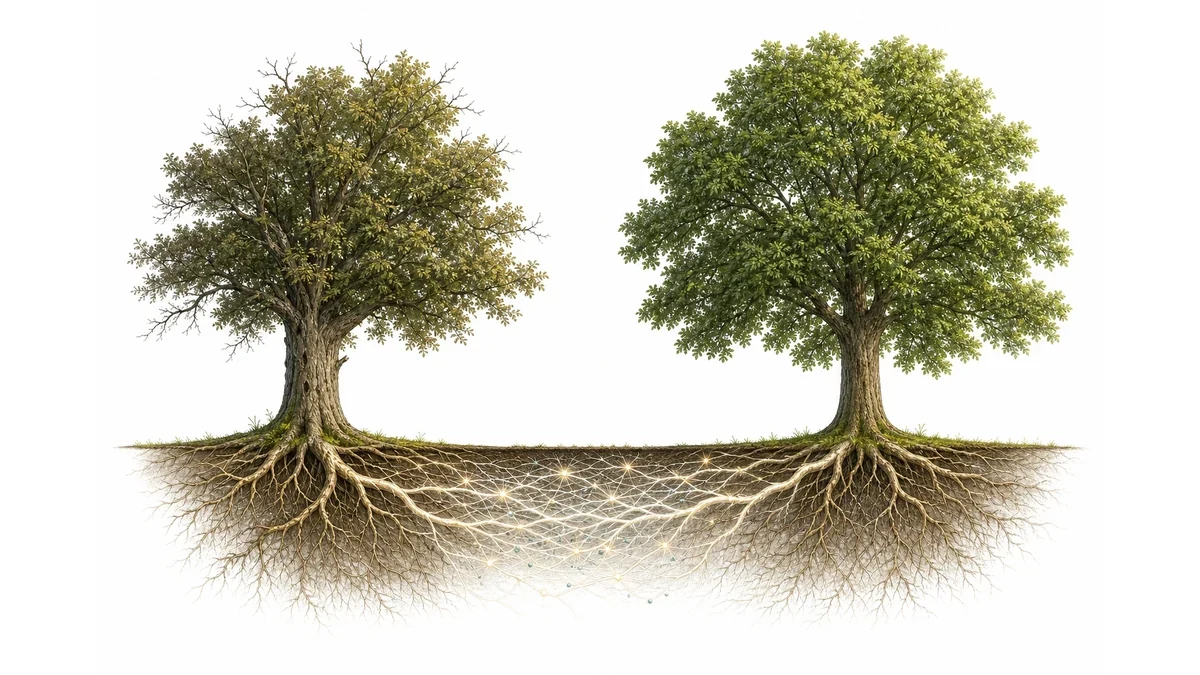
Trees are connected by underground fungal networks.
They share resources like water and nutrients.
They can warn each other of insect attacks.
Mother trees recognize and feed their offspring.
The forest is a social network.
Visual answer
The Wood Wide Web
How trees communicate through fungal networks.
Mycorrhizal Network
Fungi connect tree roots.
Resource Sharing
Trees share water and nutrients.
Warning Signals
Trees warn of danger.
Mother Tree
Older trees support seedlings.
Story in brief
Story in Brief
Ancient Times
People observe trees growing in patterns.
1990s
Suzanne Simard discovers that trees share resources.
The idea of tree communication is born.
2000s
Research confirms that trees use fungal networks.
The Wood Wide Web is understood.
Today
We know that forests are social networks.
The forest is a community, not a collection.
The Story
How Trees Communicate
Imagine a social network. But instead of people, it is trees. Instead of posts, it is chemicals. Instead of likes, it is nutrients.
Trees are connected by underground fungal networks called mycorrhizal networks. The fungi attach to the roots of trees and exchange nutrients. The fungi receive carbon from the trees. The trees receive water and minerals from the fungi.
But the network is not just for trading. It is for talking. A tree under attack by insects releases chemicals that are detected by its neighbors. They prepare their defenses. A mother tree can recognize its own offspring and feed them.
The forest is not a collection of individuals. It is a community. And it is connected.
Famous Quote
"A forest is a social network. Trees are not competing with each other. They are cooperating."
, Suzanne Simard
Simard discovered that trees share resources through fungal networks.
Evidence
How Trees Talk
Trees are connected by mycorrhizal networks.
StrongThey share nutrients and water.
StrongThey warn each other of insect attacks.
StrongThey recognize and support their own offspring.
StrongKey Points
Key Points So Far
Trees are connected by underground fungal networks.
They share resources like water and nutrients.
They warn each other of insect attacks.
The forest is a community, not a collection.
Curiosity Notes
Details Most People Miss
Why this still matters
Why This Still Matters
The idea that trees talk to each other changes how we see forests. They are not collections. They are communities. The next time you walk through a forest, remember: you are walking through a social network.
Key Findings
- ✓Core findingTrees communicate through underground fungal networks.
- ✓Strong evidenceThey share resources, warn of danger, and support their offspring.
- ⚠Main consequenceThe forest is a community, not a collection.
- ✓Wider legacyThe Wood Wide Web is a social network.
Final insight
A Last Thought
The forest is not silent. It is a conversation. The trees are talking. They are sharing. They are warning. They are supporting. And they have been doing it for millions of years. We just were not listening.
Quick answers
Common questions
How do trees talk to each other? +
Through underground fungal networks. They send chemical signals through the fungi.
Do all trees talk to each other? +
Most trees in temperate forests are connected to fungal networks. The network is nearly universal.

Analogy
Like a Social Network
The familiar part
A social network connects people. They share messages and support.
How it applies
The forest is a social network. Trees share messages and support.
Where the analogy breaks
Trees do not have profiles. But they do have connections.