Earth Science

Why Is a Volcano a Cone Shape?

One of the most dramatic shapes in nature turns out to have a very simple explanation. A perfectly conical volcano silhouetted against the sky is one of geology's most iconic images - symmetrical, dramatic, almost too tidy for something built by an explosion. And yet the cone shape is almost inevitable, which makes it either reassuringly logical or slightly unsatisfying, depending on your taste for mystery. The answer involves the angle of repose, material building up on itself, and the reason different types of volcanoes produce dramatically different shapes.

Quick answer

Volcanoes form cones because erupted material, lava, ash, and rock, piles up around the central vent and builds outward and upward at the steepest angle the material can maintain without sliding down, a property called the angle of repose, naturally producing a conical shape. Not all volcanoes are cones at all. Shield volcanoes, built from very fluid lava, are broad, gently sloping domes that look nothing like the classic silhouette - the cone is a product of the material, not the eruption itself.
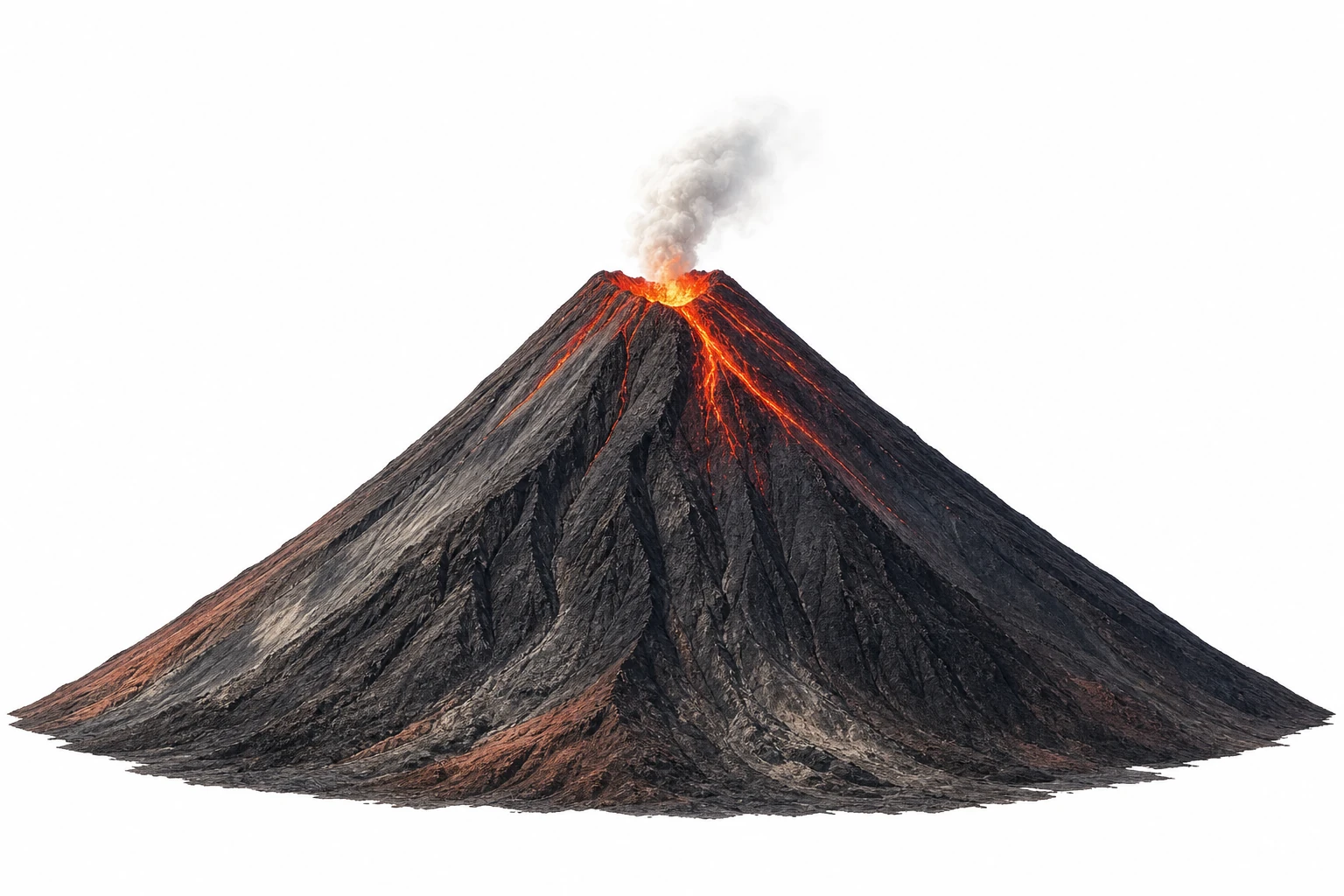
Why Is a Volcano a Cone Shape? hero image

The mystery

The answer involves the angle of repose, material building up on itself, and the reason different types of volcanoes produce dramatically different shapes.

The short answer

Volcanoes form cones because erupted material, lava, ash, and rock, piles up around the central vent and builds outward and upward at the steepest angle the material can maintain without sliding down, a property called the angle of repose, naturally producing a conical shape.

The twist

Not all volcanoes are cones at all. Shield volcanoes, built from very fluid lava, are broad, gently sloping domes that look nothing like the classic silhouette - the cone is a product of the material, not the eruption itself.

Common mistake

Many people imagine that a volcano's cone is formed by one large eruption event.

The cone is simply what happens when things pile up

A volcanic cone is the natural result of material accumulating around a point source - the same geometry that forms a pile of sand or snow.

Erupted material settles around the central vent

With each eruption, lava and pyroclastic material, ash, cinders, and rock, accumulate around the volcanic vent as they cool and solidify.

This material consistently builds up closest to the vent and thins with distance, naturally producing a roughly circular mound.

A volcanic cone is, geometrically, just a very dramatic pile - formed by the same rules that govern a heap of sand.

The angle of repose sets the slope

Every granular or fragmented material has a maximum slope angle it can maintain without sliding, called the angle of repose. For volcanic cinders and ash, this is typically around 30 to 35 degrees.

As material accumulates beyond this angle, it slides down the slope, automatically maintaining the characteristic cone profile.

The slope of a volcano is not a decision made by geology; it is a physical limit imposed by how material behaves when it piles up.

Lava type determines whether a cone forms at all

Very fluid basaltic lava flows too far from the vent to build steep slopes, spreading widely to create low, broad shield volcanoes. Thicker, more viscous lava produces steeper accumulations and sharper cones.

The iconic steep cone of a stratovolcano is built by alternating layers of thick lava and pyroclastic material, which is why they are also called composite volcanoes.

A runny lava volcano has no excuse to be pointy; a thick lava volcano has no way to avoid it.

From eruption to cone

A short sequence explains how repeated eruptions build the classic shape.

1

01. Erupted material exits from a central vent

Lava, ash, and pyroclastic debris are deposited around the eruption point.

2

02. Material accumulates most heavily near the vent

Closer deposition builds elevation fastest at the center.

3

03. Slopes are limited by the angle of repose

Excess material slides down until the slope settles at the stable resting angle.

4

04. Repeated eruptions build the cone progressively higher

Each eruption adds to the accumulation, maintaining the cone shape as the volcano grows.

Why the cone shape is nearly universal in nature

The angle of repose is not unique to volcanoes; it governs the shape of sand dunes, grain piles, scree slopes, and practically any accumulation of loose material.

The volcano's cone is simply the geological expression of a universal geometric principle that operates wherever material piles up around a source.

Surprising volcano shape facts

The world's largest volcano is barely a bump
Mauna Loa in Hawaii, one of Earth's most voluminous volcanoes, is a shield volcano with such gentle slopes that it barely looks volcanic from most angles.
Calderas form when cones collapse inward
After a very large eruption drains a magma chamber, the overlying cone can collapse into the void, forming a wide, flat-bottomed crater called a caldera.
Perfectly symmetrical cones are actually rare
Most real volcanoes are irregular due to wind patterns during eruptions, asymmetric lava flows, and varying eruption intensities over time.

Isn't the cone caused by a single massive explosion?

Myth

Many people imagine that a volcano's cone is formed by one large eruption event.

The dramatic imagery of volcanic eruptions suggests they always produce landscape-altering single events, when in reality most cones are patient, cumulative constructions.

Reality

Most volcanic cones are built gradually over hundreds or thousands of years of repeated eruptions, each adding a layer to the accumulating structure.

Most volcanic cones are built gradually over hundreds or thousands of years of repeated eruptions, each adding a layer to the accumulating structure.

Where the angle of repose shapes other landscapes

Sand dunes
The windward and leeward slopes of sand dunes are governed by the angle of repose of dry sand.
Scree slopes in mountains
Rock debris that falls from cliffs accumulates in cone-like fans below the cliff face, following identical angle-of-repose principles.

Why understanding volcanic shape matters

Volcanic cone shape, slope angle, and structure are used by volcanologists to assess eruption history and predict future behavior.

Changes in a volcano's cone profile - bulging, asymmetry, or new vents - can signal magma movement and provide early warning of volcanic activity.

Worth noting

Nature's most dramatic pile

A volcanic cone is, in the end, just material piling up as high as it can around the place where the earth decided to stop holding things in. Few things in nature are as dramatic as a volcano, or as simply, inevitably explained by the humble physics of a pile.

Quick answers

Common questions

Why do some volcanoes have a crater at the top?

The crater is the opening of the central vent, which can widen through explosive eruptions or partial collapse.

Are all volcanic islands cone-shaped?

Not at all; Hawaii's islands are shield volcanoes with very gentle profiles, while islands like Stromboli have steep, classic cones.

Earth Science

Related questions

Lava viscosity determines slope; thin, fluid lava spreads wide, while thick lava builds steep cones.

The geologist who classified volcanic forms

Giuseppe Mercalli

An Italian volcanologist who contributed significantly to the classification of volcanic types and eruption intensities in the early 20th century.

Related questions

What happens to a volcano's cone after a massive eruption?

If the underlying magma chamber empties rapidly, the cone can collapse into a caldera.

Where the angle of repose shapes other landscapes

Sand dunes

The windward and leeward slopes of sand dunes are governed by the angle of repose of dry sand.

Where the angle of repose shapes other landscapes

Scree slopes in mountains

Rock debris that falls from cliffs accumulates in cone-like fans below the cliff face, following identical angle-of-repose principles.

Isn't the cone caused by a single massive explosion?

Most volcanic cones are built gradually over hundreds or thousands of years of repeated eruptions, each adding a layer to the accumulating structure.

Most volcanic cones are built gradually over hundreds or thousands of years of repeated eruptions, each adding a layer to the accumulating structure.