Everyday Science

Why Does a Boomerang Come Back?

A piece of curved wood that quietly understood aerodynamics long before anyone wrote the equations. Throw most objects and they go where you threw them, then stop, embarrassed, somewhere in the grass. Throw a boomerang correctly and it sails away from you in a curve, loops gracefully through the air, and arrives back near your hand - as if it had simply gone out for a walk and remembered the way home. The answer involves the same principle that keeps airplanes in the sky, a spin that fights itself, and a wobble that is actually doing all the work.

Quick answer

A boomerang returns because its spinning, curved arms generate uneven lift on each side, causing the entire object to slowly curve through a circular flight path back toward the thrower. Most boomerangs used historically for hunting were not designed to return at all; the returning boomerang was likely a recreational refinement.
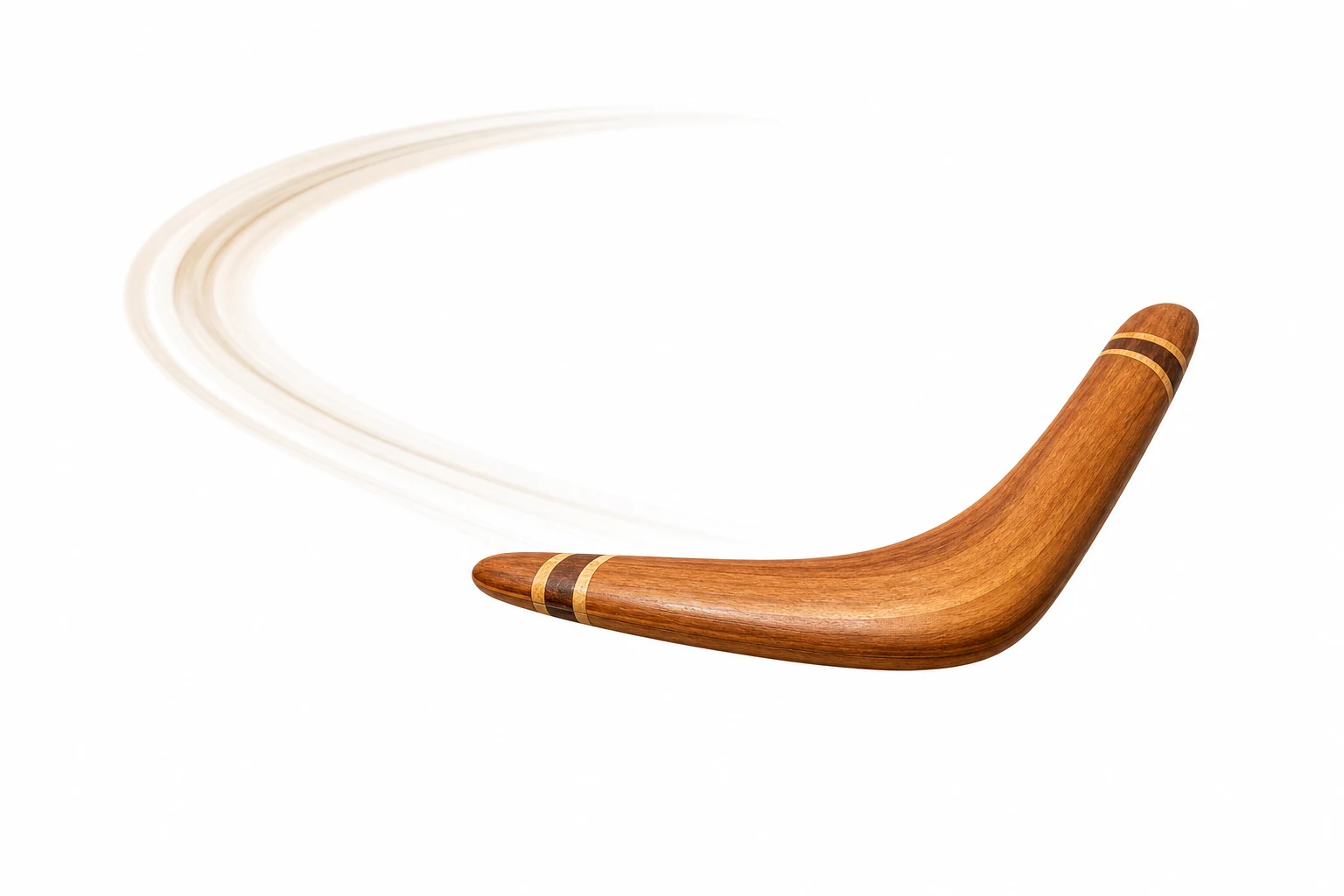
Why Does a Boomerang Come Back? hero image

The mystery

The answer involves the same principle that keeps airplanes in the sky, a spin that fights itself, and a wobble that is actually doing all the work.

The short answer

A boomerang returns because its spinning, curved arms generate uneven lift on each side, causing the entire object to slowly curve through a circular flight path back toward the thrower.

The twist

Most boomerangs used historically for hunting were not designed to return at all; the returning boomerang was likely a recreational refinement.

Common mistake

Many people assume the return is purely about throwing technique, with no real role for the boomerang's shape.

The physics hiding in a curved stick

A boomerang's flight is really a combination of two simple ideas working together in an unexpectedly elegant way.

Each arm is a small wing

A boomerang's arms are shaped with a curved cross-section, just like an airplane wing, which generates lift as air flows over them.

Thrown with a spin, each arm acts as its own miniature wing, slicing through the air dozens of times per second.

A boomerang is not one object in flight; it is two small airplane wings, spinning around a shared problem.

Uneven lift causes the curve

As the boomerang spins, the arm moving in the same direction as the throw travels faster relative to the air than the arm moving against it, generating more lift on that side.

This lopsided lift pushes the spinning axis sideways, bending the flight path into a wide circle.

The boomerang curves because, for a brief moment, one of its arms is simply working harder than the other.

Gyroscopic precession does the rest

The boomerang's fast spin behaves like a gyroscope, resisting changes to its orientation and converting the sideways push into a gradual, stable turn rather than a sudden swerve.

This combination of lift and gyroscopic stability is what bends a straight throw into a closed loop.

A boomerang does not turn so much as it negotiates its way around in a circle, one spin at a time.

The return flight, step by step

A successful throw depends on getting several small details right at once.

1

01. It is thrown nearly vertically

A near-upright throw keeps the curving flight path roughly level rather than diving into the ground.

2

02. It is launched with heavy spin

Spin rate, not throwing strength, is what generates the lift difference needed to curve.

3

03. Uneven lift bends the path

The spinning arms generate more force on one side, curving the trajectory sideways.

4

04. The loop closes back to the thrower

Properly tuned, the continuous curve completes a circle that ends near the starting point.

What the boomerang reveals about flight

A returning boomerang is, in miniature, a working demonstration of lift, spin stability, and circular motion - the same principles that keep helicopters airborne and satellites in orbit.

It is a strange kind of compliment to early toolmakers that a hunting weapon, refined over generations by trial and error, happened to anticipate aerodynamic principles by thousands of years.

Boomerang facts that surprise people

Not all boomerangs return
Traditional hunting boomerangs were typically heavier and designed to fly straight and fast, not loop back.
Boomerangs have been found in ancient Egypt
Tutankhamun's tomb contained boomerang-like throwing sticks, suggesting the design arose independently in multiple cultures.
Wind direction changes everything
Experienced throwers angle their throw relative to the wind, since the boomerang's curve depends heavily on airflow.

Doesn't it just come back because of how it's thrown?

Myth

Many people assume the return is purely about throwing technique, with no real role for the boomerang's shape.

The thrower's role is the visible part of the trick, while the aerodynamics happening mid-flight are invisible.

Reality

Technique matters, but the shape and spin of the boomerang are what physically generate the curving flight; throwing technique simply sets it in motion correctly.

Technique matters, but the shape and spin of the boomerang are what physically generate the curving flight; throwing technique simply sets it in motion correctly.

Where similar physics shows up

Frisbees
Frisbees use the same spin-generated lift, though without the extreme curve of a returning boomerang.
Helicopter rotors
Rotor blades rely on similar spinning-wing aerodynamics to generate continuous lift.

Why this ancient toy still matters

The boomerang demonstrates that sophisticated aerodynamic principles can be discovered through patient experimentation, long before formal physics existed to explain them.

It stands as early evidence that human engineering intuition often outpaces theoretical understanding by centuries.

Worth noting

A circle drawn by physics

A boomerang's flight path is, quite literally, a circle drawn in the air by lift, spin, and a few careful centuries of trial and error. Few objects are designed, quite deliberately, to come back to the hand that let them go.

Quick answers

Common questions

Can a boomerang return indoors?

Generally no - returning boomerangs need open space and consistent airflow to complete their curved path safely.

Do all cultures that used boomerangs make them return?

No - returning boomerangs are mainly associated with recreational use in Aboriginal Australian culture, while hunting versions in other regions typically flew straight.

Everyday Science

Related questions

Frisbees are symmetrical and flat, producing balanced lift rather than the lopsided lift of a boomerang's arms.

An ancient aerodynamicist

Indigenous Australian Toolmakers

Generations of careful design refined boomerangs for both hunting and, eventually, returning flight.

Related questions

Why does spin stabilize a flying object?

Spinning objects resist changes to their orientation, a property called gyroscopic stability.

Where similar physics shows up

Frisbees

Frisbees use the same spin-generated lift, though without the extreme curve of a returning boomerang.

Where similar physics shows up

Helicopter rotors

Rotor blades rely on similar spinning-wing aerodynamics to generate continuous lift.

Doesn't it just come back because of how it's thrown?

Technique matters, but the shape and spin of the boomerang are what physically generate the curving flight; throwing technique simply sets it in motion correctly.

Technique matters, but the shape and spin of the boomerang are what physically generate the curving flight; throwing technique simply sets it in motion correctly.