1
01. You apply a spin to the shell
Your fingers transfer rotational energy directly to the eggshell.
Everyday Science
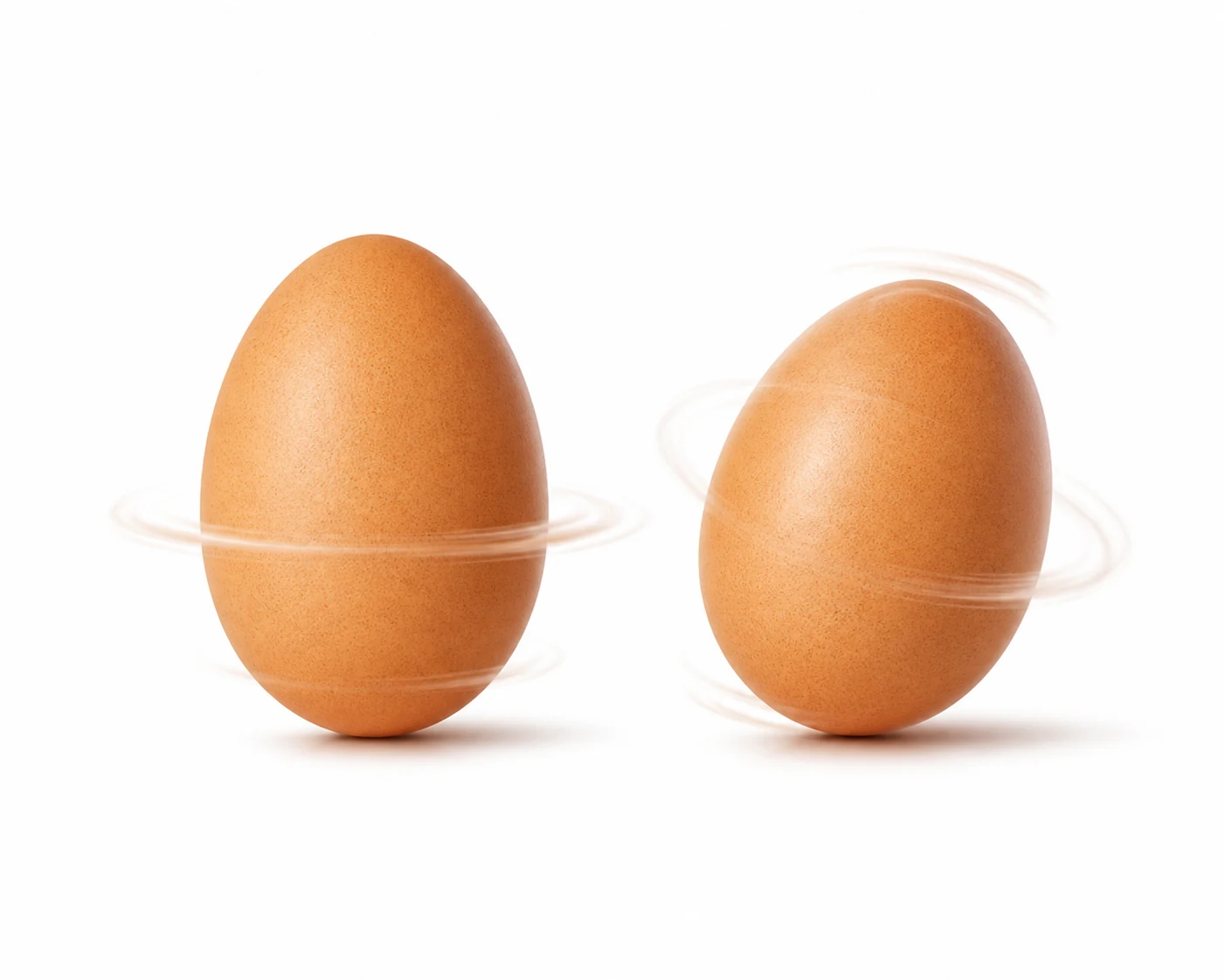
The world's least violent way to settle a breakfast argument. Somewhere in your kitchen there is a trick that lets you identify a boiled egg without cracking it open, and it works every single time, with the reliability of a law of physics - because it is one. Spin two identical-looking eggs side by side, and one will whirl along smoothly while the other wobbles, stumbles, and gives up early. The difference is entirely about what is sloshing around inside. The answer involves liquid physics, a property called angular momentum, and a clever trick chefs have used for generations.
Quick answer
A hard-boiled egg spins faster and more steadily because its insides are solid and rotate as one unit, while a raw egg's liquid interior lags behind, dragging on the shell and slowing the spin. If you stop a spinning raw egg with your finger and let go quickly, it will start spinning again on its own, because the liquid inside is still moving.
The mystery
The answer involves liquid physics, a property called angular momentum, and a clever trick chefs have used for generations.
The short answer
A hard-boiled egg spins faster and more steadily because its insides are solid and rotate as one unit, while a raw egg's liquid interior lags behind, dragging on the shell and slowing the spin.
The twist
If you stop a spinning raw egg with your finger and let go quickly, it will start spinning again on its own, because the liquid inside is still moving.
Common mistake
Many people assume boiled eggs spin faster simply because cooking changes the egg's weight.
Everyday Science
Yes - a partially set interior produces a spin somewhere between raw and fully hard-boiled.
The everyday physicist's favorite trick
A kitchen demonstration passed down for generations, used long before anyone explained the physics behind it.
Related questions
Solid, evenly distributed spinning mass creates stable angular momentum, much like a boiled egg.
Where this principle shows up elsewhere
Unevenly distributed wet laundry causes the same kind of wobble during a spin cycle.
Where this principle shows up elsewhere
Unbalanced tires wobble at speed for related reasons involving uneven mass distribution.
Isn't it just about the egg's weight?
Boiled and raw eggs weigh almost exactly the same; the difference is entirely about how the mass inside moves.
Continue learning
Everyday Science
Another familiar question explained by simple physics.

Everyday Science
Another familiar question explained by simple physics.
Everyday Science
Another familiar question explained by simple physics.