1
01. The kicker strikes off-center
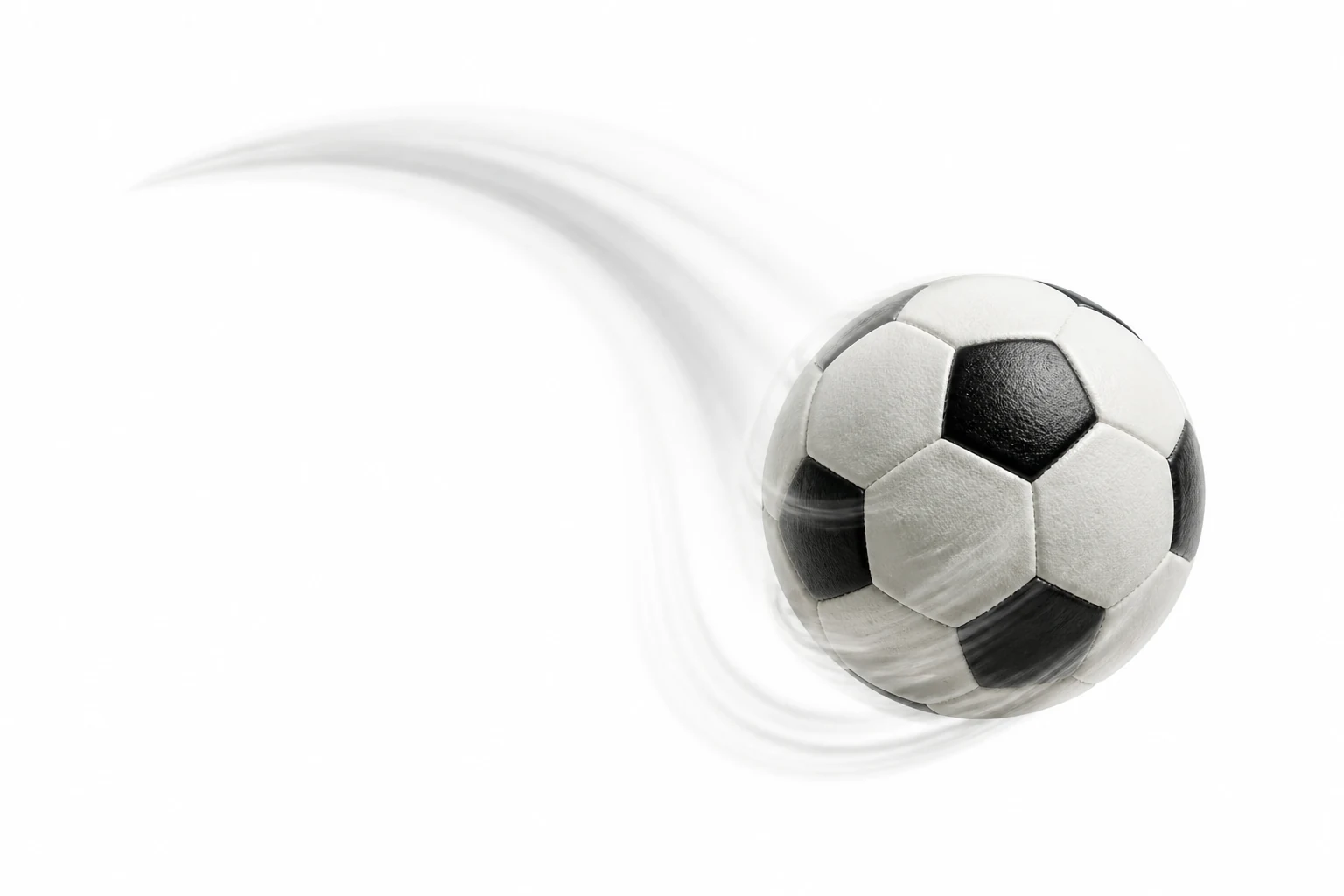
An off-center strike imparts spin to the ball as it leaves the foot.
Everyday Science
The physics behind the free kick that bends impossibly around a wall of defenders. A perfectly struck free kick seems to defy belief: the ball sails wide of the goal, curves sharply in midair, and somehow ends up in the back of the net. Defenders watch it happen and still cannot quite explain it. Physicists, fortunately, can. The answer involves spin, air pressure differences, and a phenomenon named after a 19th-century German physicist who never once kicked a soccer ball professionally.
Quick answer
A soccer ball curves because spin imparted by the kicker creates unequal air pressure on either side of the ball - a phenomenon called the Magnus effect - pushing the ball sideways into a curved flight path. The same physics that bends a free kick also explains why a poorly thrown baseball curves unpredictably, and why golf balls have dimples at all.
The mystery
The answer involves spin, air pressure differences, and a phenomenon named after a 19th-century German physicist who never once kicked a soccer ball professionally.
The short answer
A soccer ball curves because spin imparted by the kicker creates unequal air pressure on either side of the ball - a phenomenon called the Magnus effect - pushing the ball sideways into a curved flight path.
The twist
The same physics that bends a free kick also explains why a poorly thrown baseball curves unpredictably, and why golf balls have dimples at all.
Common mistake
Some assume a curving free kick is mainly the result of wind conditions on the day.
Everyday Science
Topspin combined with the Magnus effect generates extra downward force on the ball's path.
The physicist behind the curve
A 19th-century German physicist who first scientifically described the sideways force on spinning objects moving through air.
Related questions
Dimples manage airflow turbulence to increase lift and reduce drag, helping the ball fly farther.
Where the Magnus effect shows up in other sports
Pitchers use the same spin-based pressure difference to make a baseball drop or curve unexpectedly.
Where the Magnus effect shows up in other sports
Players exploit the Magnus effect at small scale to make the ball dip or curve sharply after leaving the paddle.
Isn't the curve just caused by wind?
While wind can influence a ball's path, the dramatic, consistent curve of a well-struck free kick is caused primarily by spin and the Magnus effect, independent of wind.
Continue learning
Everyday Science
Another familiar question explained by simple physics.
Everyday Science
Another familiar question explained by simple physics.
Everyday Science
Another familiar question explained by simple physics.