1
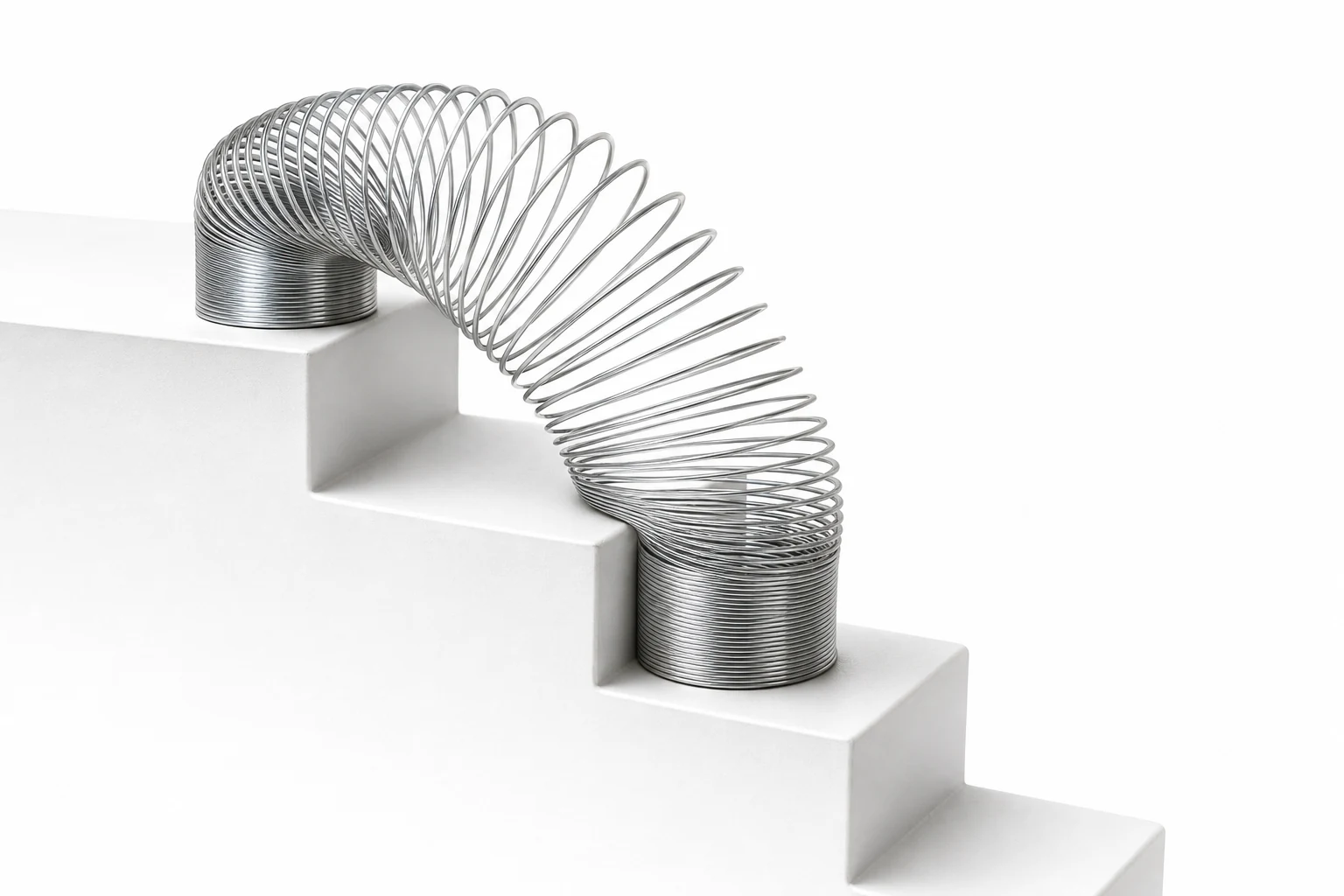
01. Part of the coil extends past the step's edge
Gravity begins pulling that overhanging section downward.
Everyday Science
A coil of metal that turned itself into one of the most beloved toys in history by accidentally discovering physics. Set a Slinky at the top of a staircase, give it a small nudge, and it does something no ordinary spring has any business doing: it flips end over end, step by step, walking itself all the way to the bottom. It looks alive. It is not. It is simply a very good demonstration of stored energy refusing to sit still. The answer involves elastic potential energy, a center of gravity playing tricks, and a naval engineer's accident that became a toy store legend.
Quick answer
A Slinky walks down stairs because its stretched coils store elastic potential energy, which is released to pull the trailing end up and over the leading end, repeatedly shifting its center of gravity forward off each step under the pull of gravity. A Slinky was originally designed not as a toy at all, but as a device meant to stabilize sensitive equipment on ships, before its inventor noticed it could walk.
The mystery
The answer involves elastic potential energy, a center of gravity playing tricks, and a naval engineer's accident that became a toy store legend.
The short answer
A Slinky walks down stairs because its stretched coils store elastic potential energy, which is released to pull the trailing end up and over the leading end, repeatedly shifting its center of gravity forward off each step under the pull of gravity.
The twist
A Slinky was originally designed not as a toy at all, but as a device meant to stabilize sensitive equipment on ships, before its inventor noticed it could walk.
Common mistake
Some people assume a Slinky's stair-walking is essentially a form of rolling.
Everyday Science
A compression wave must travel down the coil before the bottom physically begins falling.
The engineer who dropped a spring
A mechanical engineer whose accidental 1943 discovery of a self-walking spring led to the creation of the Slinky toy.
Related questions
Deforming a spring's coils stores elastic potential energy according to the material's resistance to deformation.
Where similar energy storage applies
These store and release elastic energy in a spring with each bounce, similar to a Slinky's coil.
Where similar energy storage applies
A wound mainspring stores elastic potential energy, gradually released to power the watch's movement.
Doesn't a Slinky just roll down stairs like a wheel?
A Slinky does not roll at all; it flips end over end through alternating tension and release, an entirely different mechanism from rolling.
Continue learning
Everyday Science
Another familiar question explained by simple physics.
Everyday Science
Another familiar question explained by simple physics.
Everyday Science
Another familiar question explained by simple physics.