1
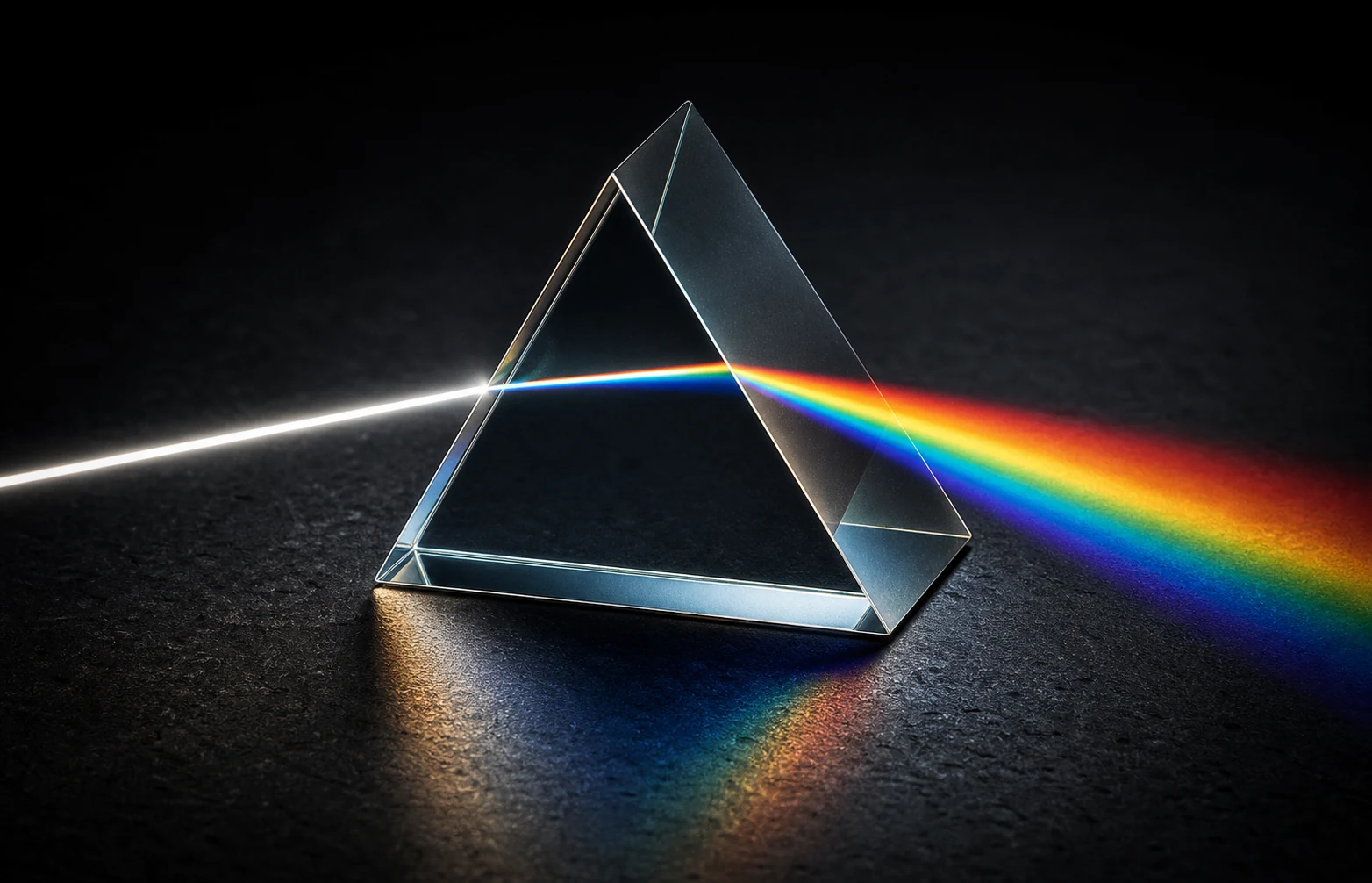
01. White light enters the prism
Sunlight, containing a mixture of all visible wavelengths, strikes the angled glass surface.
Everyday Science
The simple glass shape that revealed white light was never actually white at all. Pass a beam of ordinary white sunlight through a triangular piece of glass and something startling happens on the other side: a full rainbow spills out, neatly ordered from red to violet, as if the glass had been hiding it the whole time. In a sense, it had - or rather, the light had been hiding it all along, and the glass simply revealed the secret. The answer involves wavelengths bending by different amounts, a young Isaac Newton's quiet act of scientific rebellion, and the surprising fact that white light is not one color at all.
Quick answer
A prism splits light because different wavelengths of light, which we perceive as different colors, bend by slightly different amounts as they pass through glass, separating white light into its full spectrum of component colors through a process called dispersion. Before Isaac Newton's experiments in the 1660s, many scientists believed prisms somehow added color to light, rather than simply revealing colors that were already present within it.
The mystery
The answer involves wavelengths bending by different amounts, a young Isaac Newton's quiet act of scientific rebellion, and the surprising fact that white light is not one color at all.
The short answer
A prism splits light because different wavelengths of light, which we perceive as different colors, bend by slightly different amounts as they pass through glass, separating white light into its full spectrum of component colors through a process called dispersion.
The twist
Before Isaac Newton's experiments in the 1660s, many scientists believed prisms somehow added color to light, rather than simply revealing colors that were already present within it.
Common mistake
A common historical and modern misconception is that the prism adds color to otherwise colorless white light.
Everyday Science
Each wavelength of light bends by a consistent, predictable amount, producing the same color sequence every time.
The scientist who proved white light's secret
In the 1660s, Newton used prisms to demonstrate that white light is composed of a mixture of all visible colors.
Related questions
Diamonds have a much higher dispersion rate, separating light into more vivid, intense colors.
Where dispersion shows up beyond prisms
Sunlight refracting and dispersing through raindrops creates the same separation of colors seen in a glass prism.
Where dispersion shows up beyond prisms
Camera and telescope lenses must be carefully designed to minimize unwanted color fringing caused by this same dispersion effect.
Doesn't the prism actually create the colors itself?
The prism does not create any color; it merely separates colors that were already combined within white light, as Newton definitively demonstrated.
Continue learning

Everyday Science
Another familiar question explained by simple physics.

Everyday Science
Another familiar question explained by simple physics.

Everyday Science
Another familiar question explained by simple physics.