1
01. White light hits the disc
Ordinary light, containing all visible wavelengths, strikes the CD's reflective surface.
Everyday Science
A piece of plastic engineered to store music quietly moonlights as a prism. Tilt an old CD under a light and something unexpected happens: the dull silver surface erupts into shifting bands of color, as if a tiny rainbow had taken up residence on a disc meant only for storing songs. The CD was never designed to do this. It is simply too small, too precise, and too covered in tiny grooves to avoid it. The answer involves microscopic grooves, the separation of white light into colors, and a phenomenon that also explains butterfly wings and oil slicks.
Quick answer
A CD's surface is covered in thousands of microscopic, evenly spaced grooves that diffract white light, splitting it into its component colors the way a prism does, but through interference rather than refraction. The colors are not actually "on" the CD at all - they appear only because of how light waves interact with the disc's structure, and they change completely depending on the viewing angle.

The mystery
The answer involves microscopic grooves, the separation of white light into colors, and a phenomenon that also explains butterfly wings and oil slicks.
The short answer
A CD's surface is covered in thousands of microscopic, evenly spaced grooves that diffract white light, splitting it into its component colors the way a prism does, but through interference rather than refraction.
The twist
The colors are not actually "on" the CD at all - they appear only because of how light waves interact with the disc's structure, and they change completely depending on the viewing angle.
Common mistake
Some assume the rainbow is simply ordinary reflected light, similar to a mirror catching sunlight.
Everyday Science
Light reflecting off the bubble's thin film interferes with itself, separating colors in a related but different way.
The physicist behind the wave theory of light
An English scientist whose double-slit experiment in 1801 demonstrated that light behaves as a wave.
Related questions
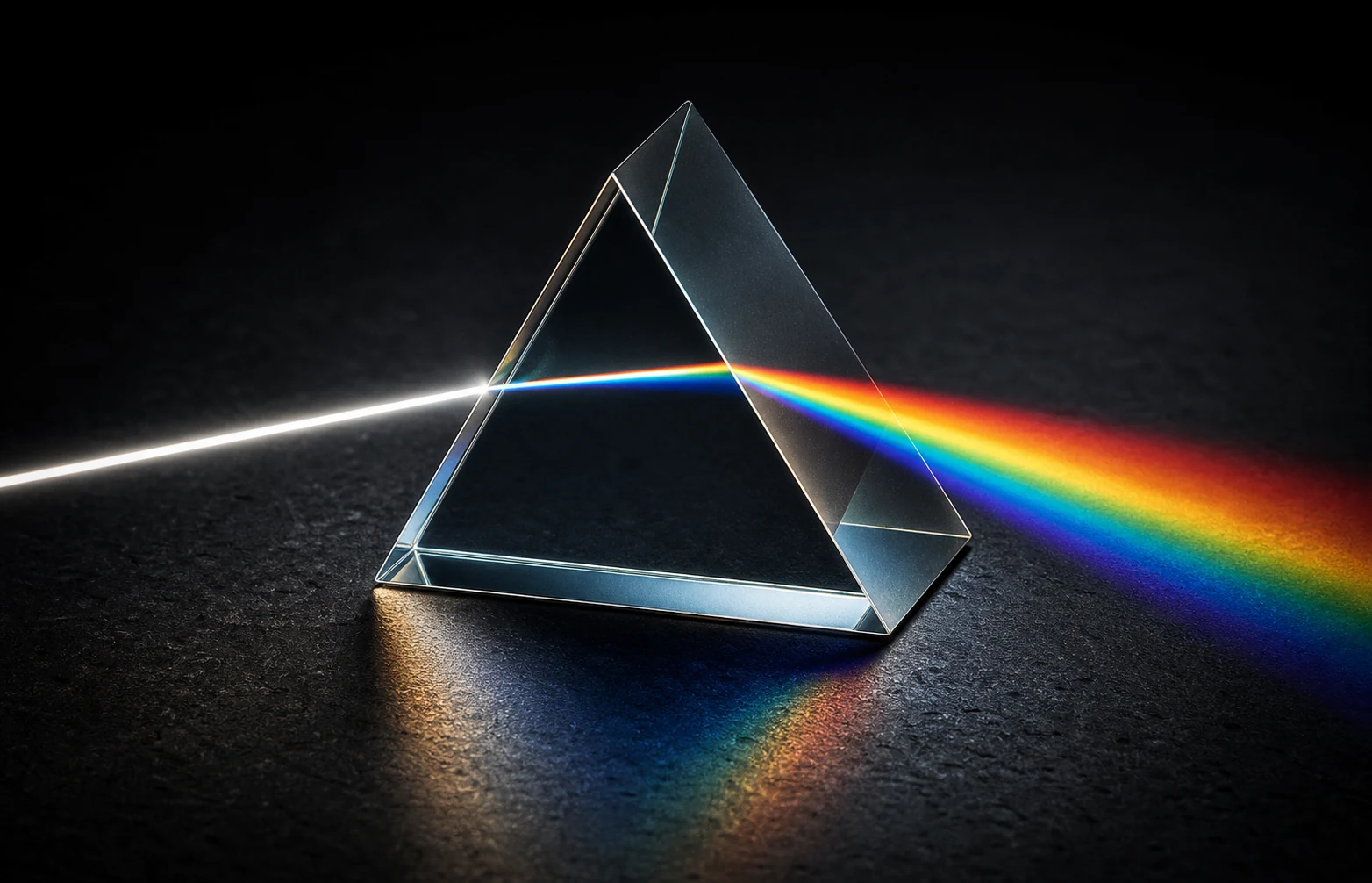
A prism bends different wavelengths by different amounts through refraction, not diffraction.
Diffraction gratings in technology
Scientific instruments use precisely etched diffraction gratings, working on the same principle as a CD, to analyze light from stars and chemicals.
Diffraction gratings in technology
Many holographic images rely on microscopic diffraction patterns similar to those on a CD's surface.
Isn't the CD just reflecting normal light colors?
A mirror reflects all colors together as white light; a CD specifically separates them through diffraction, which a flat mirror cannot do.
Continue learning

Everyday Science
Another familiar question explained by simple physics.
Everyday Science
Another familiar question explained by simple physics.

Everyday Science
Another familiar question explained by simple physics.