Everyday Science

Why Does a Paperclip Bend but Not Break?

Steel that bends and returns. Steel that bends and stays. Steel that bends until it breaks. The difference is less obvious than you might expect. Bend a paperclip once and it holds its new shape. Bend it back and forth repeatedly and eventually it breaks at the bend. This progression, from elastic to plastic to fracture, is not random. It follows precise material science, and understanding it reveals something fundamental about why metals behave as they do. The answer involves crystal dislocations, work hardening, and the reason metals can absorb enormous amounts of energy through deformation before they finally give up.

Quick answer

A paperclip bends without immediately breaking because steel's metallic crystal structure allows rows of atoms to slip past each other through dislocation movement under stress, permanently rearranging without fracturing. Repeated bending causes work hardening that makes this slipping progressively harder until fracture eventually occurs. Bending a paperclip repeatedly at the same spot actually makes the metal harder and stiffer at that location through work hardening - which is why it eventually breaks there rather than at an unbent section.
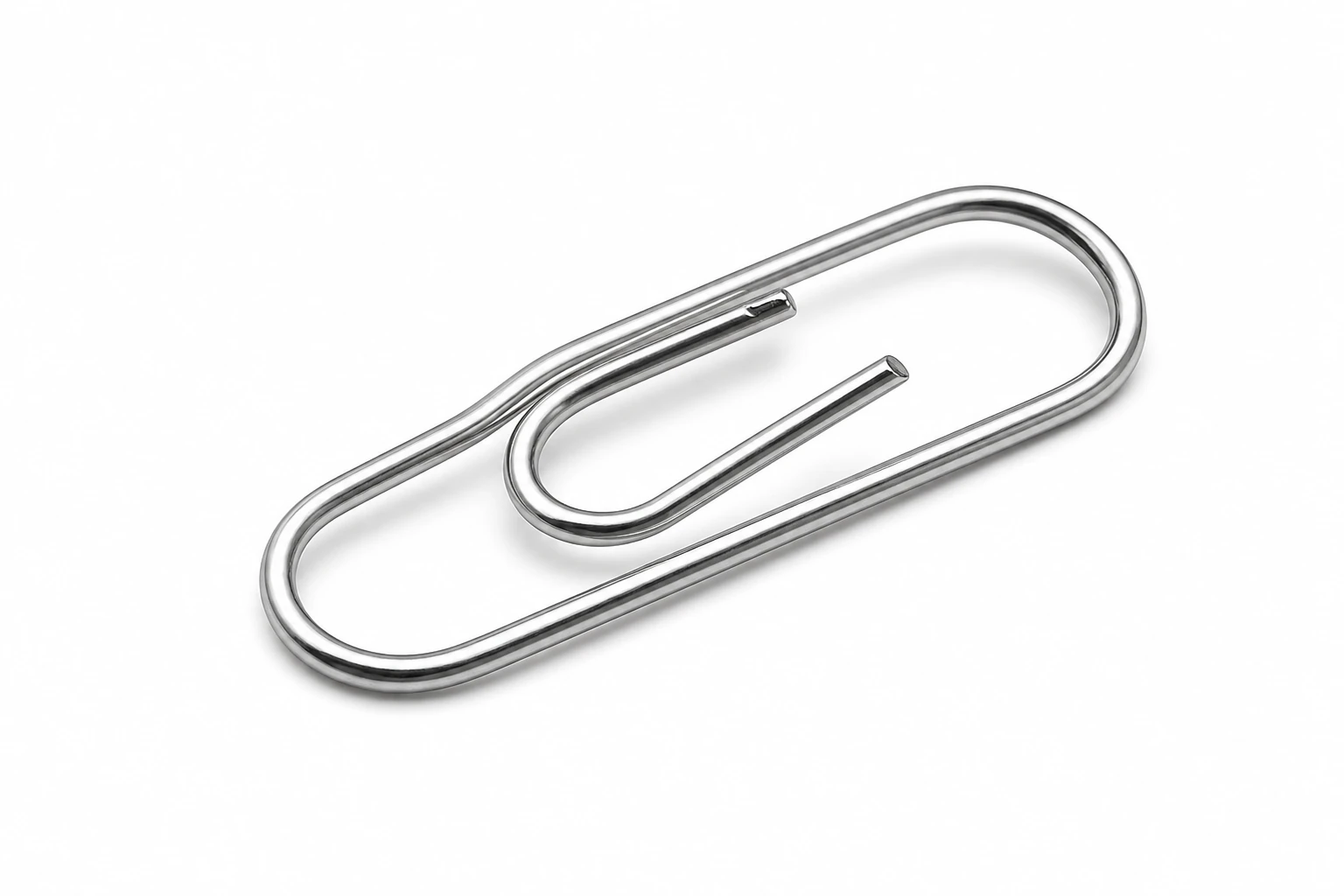
Why Does a Paperclip Bend but Not Break? hero image

The mystery

The answer involves crystal dislocations, work hardening, and the reason metals can absorb enormous amounts of energy through deformation before they finally give up.

The short answer

A paperclip bends without immediately breaking because steel's metallic crystal structure allows rows of atoms to slip past each other through dislocation movement under stress, permanently rearranging without fracturing. Repeated bending causes work hardening that makes this slipping progressively harder until fracture eventually occurs.

The twist

Bending a paperclip repeatedly at the same spot actually makes the metal harder and stiffer at that location through work hardening - which is why it eventually breaks there rather than at an unbent section.

Common mistake

Strength and flexibility are often assumed to be opposite properties.

Metal crystal structures that can move without breaking

Steel's ability to bend is built into its atomic structure, not a property of the metal in bulk.

Metal crystals contain movable defects called dislocations

Metals are crystalline, with atoms arranged in repeating lattice patterns. These crystals are full of defects called dislocations, where the lattice is locally disrupted.

Under stress, these dislocations move through the crystal, allowing rows of atoms to slip past each other without breaking the overall structure.

A metal bends not because the whole crystal moves at once, but because millions of tiny defects quietly shuffle one step at a time.

Plastic deformation preserves the bond but changes the shape

As dislocations move, atoms find new neighbors and form new bonds without the original bonds ever completely breaking simultaneously.

This cooperative rearrangement is what allows metal to permanently deform under stress - plastic deformation - while remaining intact.

Bending metal is less like breaking something and more like slowly rearranging a crowded room without anyone sitting down at exactly the same time.

Work hardening makes the metal stiffer with each bend

Each deformation creates more dislocations, and dislocations interfere with each other's movement, making further deformation progressively harder.

This is called work hardening - the bending itself makes the metal harder and more brittle at that spot, which is why the paperclip eventually fractures after enough cycles.

The paperclip is working against itself every time it bends, building a fatigue that will eventually become fatal.

From bend to break

A short sequence explains the full lifecycle of a repeatedly bent paperclip.

1

01. First bend: dislocations move through the crystal

Atoms slip past each other and the paperclip takes a new shape.

2

02. Repeated bends: dislocations multiply and tangle

The crystal accumulates defects that impede further dislocation movement.

3

03. Work hardening makes the bend site stiffer

The repeatedly bent spot becomes harder and more brittle than surrounding metal.

4

04. Fracture occurs at the fatigued location

With no remaining dislocation movement available, the crystal breaks rather than bending.

Why metals are so useful precisely because they bend

A material that can absorb energy through deformation rather than immediately fracturing is enormously valuable in engineering - this property, called toughness, is why metals are used in situations where sudden failure would be catastrophic.

Ceramics, for comparison, fracture rather than bend, which is why a dropped ceramic plate shatters while a steel plate merely dents.

Surprising metal deformation facts

Work hardening is used deliberately in manufacturing
Cold-working metal - forming it below its recrystallization temperature - intentionally increases hardness and strength through controlled dislocation multiplication.
Metal fatigue caused multiple early aircraft crashes
Before fatigue failure was well understood, aircraft structures failed catastrophically at stress concentration points after many flight cycles.
Annealing reverses work hardening
Heating metal to the right temperature and cooling slowly allows dislocations to rearrange and reduces back to the unhardened state.

Does a stronger metal always bend less?

Myth

Strength and flexibility are often assumed to be opposite properties.

Hard objects in everyday experience, like stone or glass, also tend to be brittle, creating an intuitive hardness-brittleness link that does not always apply to metals.

Reality

They are different properties, and materials can be engineered to have various combinations of both through alloying and heat treatment.

They are different properties, and materials can be engineered to have various combinations of both through alloying and heat treatment.

Where understanding metal deformation matters

Car crash safety
Modern car bodies are designed to crumple in controlled ways during collisions, absorbing impact energy through deformation rather than transmitting it to occupants.
Structural engineering
Steel beams in buildings and bridges are designed to bend rather than break under overload, providing warning before catastrophic failure.

Why this materials science matters

Understanding metal deformation and fatigue has direct applications in safety engineering for everything from aircraft to medical implants.

Material fatigue analysis is now a standard part of engineering design for any component subjected to repeated stress cycles.

Worth noting

A small metal loop demonstrating big material science

A paperclip bending and eventually breaking is a miniature fatigue test, running on the same physics that engineers use to design aircraft, bridges, and medical implants. The paperclip is not breaking because it is weak. It is breaking because it has been asked to be strong too many times.

Quick answers

Common questions

Does temperature affect how many bends a paperclip can take?

Yes, lower temperatures generally make metals more brittle and reduce the number of bending cycles before fracture.

Everyday Science

Related questions

Repeated flight stress cycles cause microscopic fatigue damage accumulation that must be managed through inspection and replacement schedules.

The engineer who defined metal fatigue

August Wöhler

A 19th-century German engineer who systematically studied metal fatigue in railway axles after a series of catastrophic failures, establishing the S-N curve used in fatigue analysis today.

Where understanding metal deformation matters

Car crash safety

Modern car bodies are designed to crumple in controlled ways during collisions, absorbing impact energy through deformation rather than transmitting it to occupants.

Where understanding metal deformation matters

Structural engineering

Steel beams in buildings and bridges are designed to bend rather than break under overload, providing warning before catastrophic failure.

Does a stronger metal always bend less?

They are different properties, and materials can be engineered to have various combinations of both through alloying and heat treatment.

They are different properties, and materials can be engineered to have various combinations of both through alloying and heat treatment.