That hole in the same spot every time

Why Do Shoes Get Holes Above the Big Toe?

A hole above the big toe can look like cheap shoe material. Often, it is your toe lifting and rubbing the upper with every step.

Quick answer

Your foot is the culprit, not the shoe. About one in five people have a gait pattern where the big toe lifts slightly upward during toe-off — the moment when you push off the ground with each step. At that exact moment, the tip and nail of the big toe press against the mesh directly above it. Repeat that over tens of thousands of steps per week and the mesh gets abraded until it wears through. Toenails that are too long or curved act like tiny cutting blades and speed up the process. A shoe that's too tight in the toe box compresses the toe upward and makes it worse.

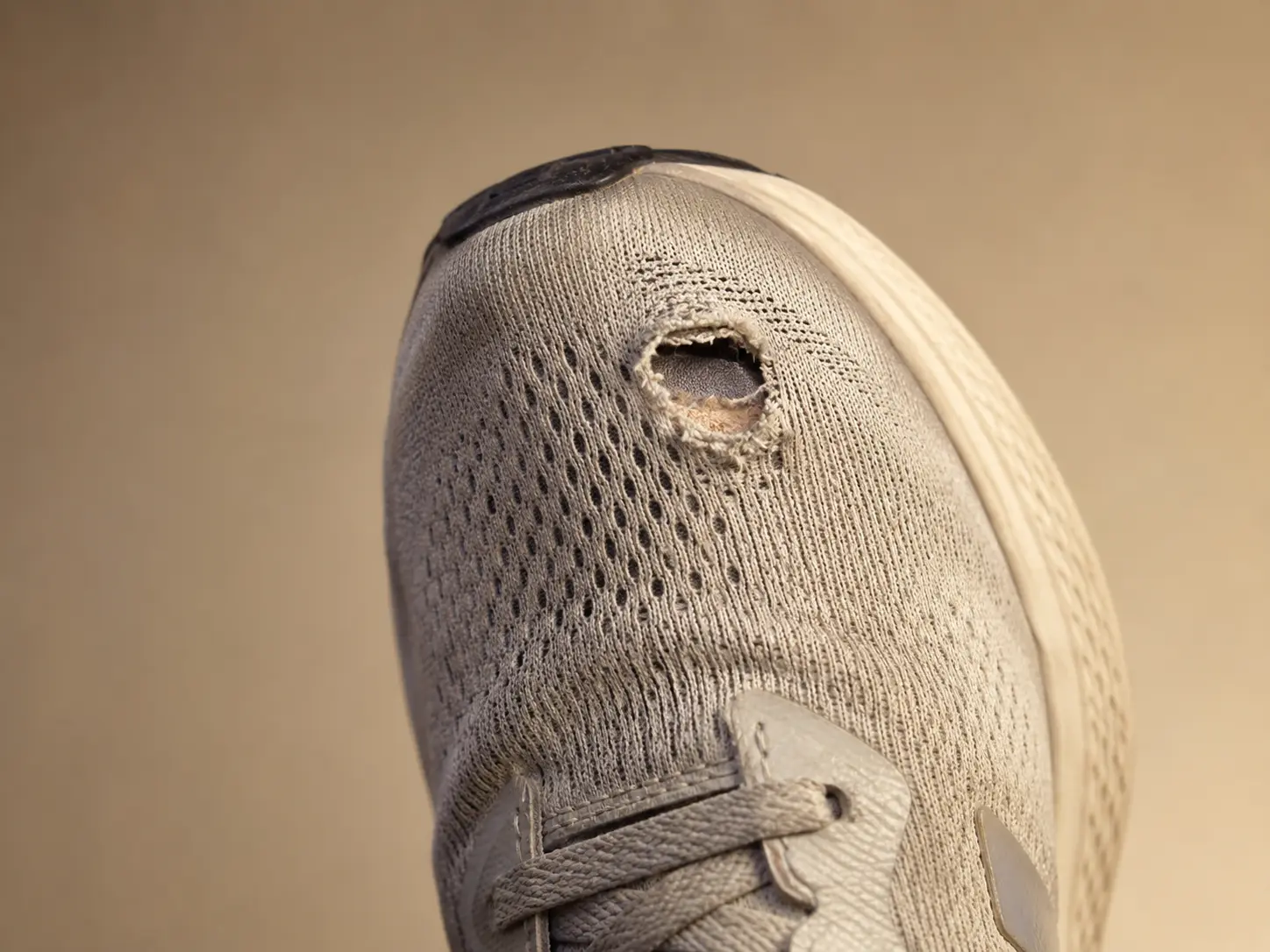
Close-up of a worn sneaker with a hole in the mesh fabric above the big toe area

Main cause

Big toe lifts during toe-off

How common?

Roughly 1 in 5 people

Made worse by

Long nails + tight toe box

Shoe quality the cause?

Rarely — it's usually gait

It's not the shoe — it's how your foot moves

The technical cause is called hyperextension of the distal phalanx — a fancy way of saying the tip of your big toe lifts upward at the wrong moment during your stride.

When you push off the ground, your big toe should bend at the main joint, keeping the tip low. In people with limited hallux dorsiflexion — restricted movement at the big toe joint — the toe compensates by lifting the tip instead. That tip, including the nail, then presses against the mesh from underneath with each step.

This happens at a moment when the shoe mesh is already close to the toes. The repeated contact over thousands of steps wears the mesh down from the inside.

Myth vs Reality

Myth

Holes above the big toe mean the shoes are cheap or defective.

The most common reaction is to blame the manufacturer. Expensive running shoes and budget trainers both get these holes in the same spot.

Reality

The shoe is fine. It's the gait pattern wearing the mesh from inside.

Premium running shoes actually prioritize lightweight breathable mesh — which is thinner and more prone to abrasion damage. The cause is nearly always the foot mechanics of the person wearing them, not the manufacturing quality.
Three causes and what to do about each

Gait: toe tip lifts during toe-off
A gait analysis from a physiotherapist or running specialist can identify this. Strengthening the glutes and improving ankle dorsiflexion often reduces the compensatory toe lift.
Long or curved toenails
Keep toenails trimmed short and straight. This simple change can dramatically extend shoe life in affected wearers. File down any sharp edges.
Toe box too tight
A shoe that compresses the big toe upward amplifies the problem. Running shoes are typically sized a half to full size larger than regular shoes to allow toe movement. Make sure there's a thumb-width of space between the longest toe and the front of the shoe.

Note

You can reinforce the mesh from inside

If you're prone to toe holes, stick a small gel heel pad or piece of duct tape to the inside of the toe box, directly above the big toe. Some runners also use specialist reinforcement patches. It adds a few grams and eliminates the problem while you work on the underlying gait issue.

Quick answers

Common questions

Why do my shoes get holes above the big toe?

Usually because the tip of your big toe lifts during toe-off and presses against the mesh from underneath. Repeated over thousands of steps, this friction wears through the fabric.

Is it the shoe's fault?

Rarely. The cause is almost always gait mechanics — how the foot moves — combined with factors like toenail length and toe box fit.

How common is this?

About one in five people experience this regularly. The underlying gait pattern — limited big toe joint mobility causing the toe tip to lift — is not unusual.

Can trimming my toenails help?

Yes, significantly. A toenail that extends beyond the toe pad acts as a cutting edge against the mesh. Keeping nails short and filed reduces friction at the contact point.

Are my shoes the wrong size?

Possibly. If the toe box is too tight, it compresses the big toe upward and increases contact with the mesh. Running shoes should have a half to full size of extra room in the toe.

Can I fix the gait pattern causing it?

Often, yes. Limited dorsiflexion at the big toe joint can be improved with specific stretching and strengthening. A physiotherapist or gait specialist can assess and recommend exercises.

How do I stop holes forming while I fix my gait?

Apply a gel pad or reinforcement patch to the inside of the toe box above the big toe. It creates a buffer between the toe and the mesh and extends shoe life significantly.